


Dharmesh Shah, the Founder and CTO at HubSpot, has said since IN’24 that the future is near where humans and AI will work in one team.
Today, as customers demand quality and AI-speed together, leaders are experimenting with different AI LLMs that can fulfill their requirements. But this may turn out to be time-consuming till they find a suitable one.
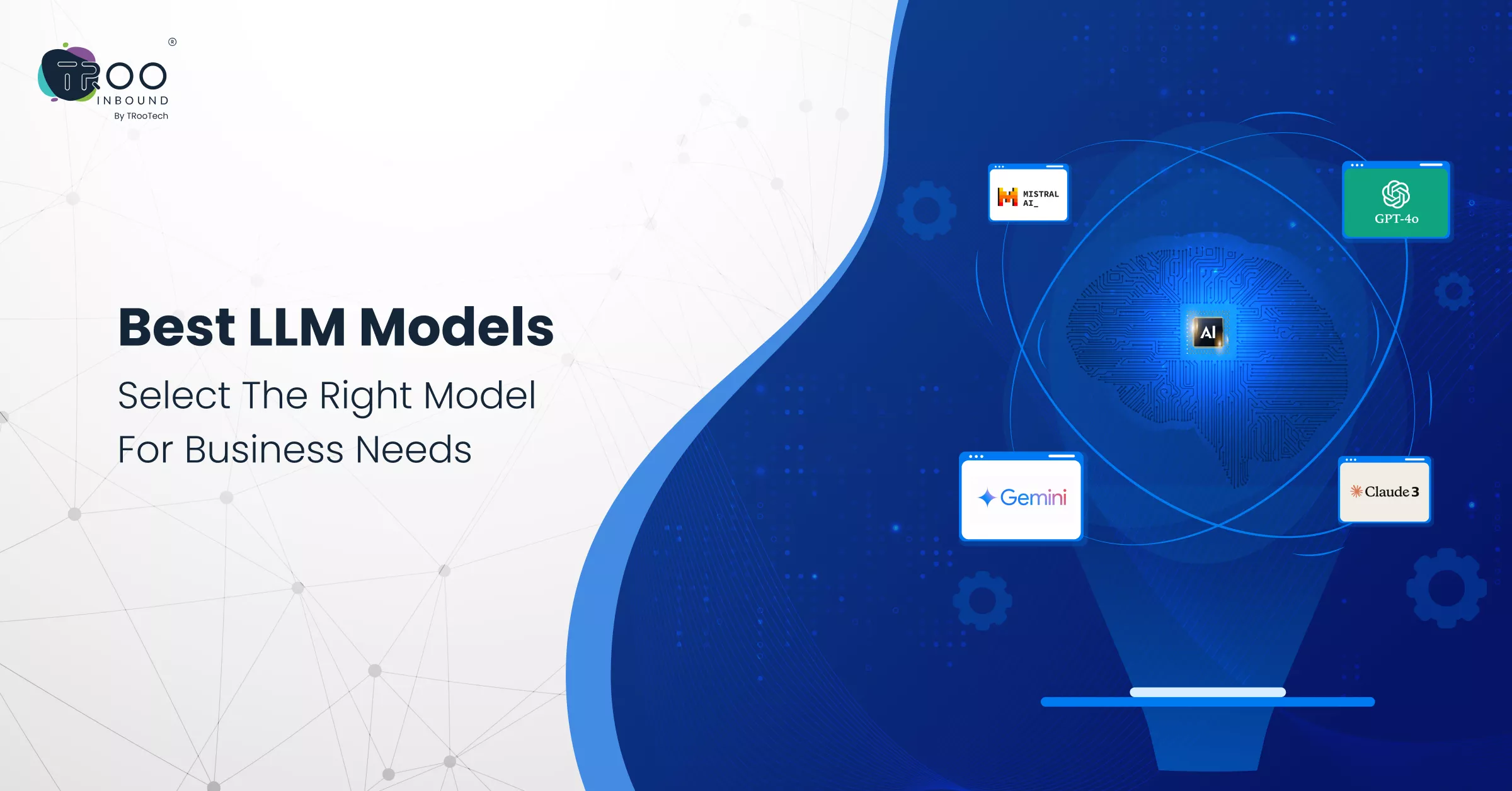
So, we have narrowed down the list to the seven best LLM models like GPT-4o, LLaMA 3, Inflection AI, and more. Plus, as a bonus tip, we’ve added a list of free LLM models at the end that can be used for an unlimited time for different business processes.
Let’s dive in!
Quick Brief To LLMs
Large Language Models (LLMs) are deep learning AI models fed with vast text data to understand and generate human-like outputs.
They are built on transformer architectures and are trained in stages (small data chunks), including pre-training on general language patterns and fine-tuning on specific datasets.
Based on your goals, feed the SEO focused LLM with a relevant dataset and train it to perform as per your requirements. Models like Claude Sonnet 3.7, Gemini, and others generally excel in content generation, query answering, audio/video creation, advanced coding, reasoning, and more.
While powerful, LLMs can be resource-intensive to train and may require careful consideration of their outputs.
Now, let’s see some must-have factors that make a model worth your time and investment.
Key Factors to Consider for Selecting the Best LLM Models

Choosing the right LLM isn’t just about picking the most popular one. Here are a few essentials that define a high-performing model:
- Accuracy – Does it understand context and deliver relevant responses?
- Multimodal Capabilities – Can it handle text, code, images, or audio?
- Speed & Scalability – How quickly can it respond? Can it scale with your needs?
- Customization – Can you fine-tune it for specific domains or tasks?
- Cost Efficiency – Does it offer good performance without draining your budget?
With this in mind, let’s explore the best LLM models we’ve curated that might help you provide unique AI solutions to your clients.
7 Top LLM Models in 2025

LLMs in 2025 are the early chatbots that used to reply to us in plain text a few years ago. But now they can interpret tone and emotion and understand PDFs, images, and videos all at once.
Let’s look at the latest and best LLM Models that we’ve picked for you:
1# GPT-4.5 Turbo (OpenAI)
With existing branching logic, HubSpot AI chatbots can ask context-aware questions and qualify leads based on their responses. This automated qualification process ensures your sales team only gets high-intent contacts.
The first paradigm increases its accuracy and intuition (also seen in GPT‑3.5, GPT‑4). While the second one lets it think and generate thoughts before just responding, so that it can tackle complex STEM or logic problems well (also seen in OpenAI o1 and OpenAI o3‑mini).
Pros
- Exceptional NLP understanding and generation
- Strong reasoning and coding capabilities
- Access to real-time tools (via plugins, browsing, code interpreter, etc.)
- Highly customizable
Cons
- Turns out to be expensive for high-volume usage
- Can hallucinate when prompted with vague or complex requests
2# Claude Sonnet 4 & Opus 4 (Anthropic)
Claude Sonnet 4 is an upgrade to Sonnet 3.7 and delivers superior coding and reasoning, and responds quite precisely to your instructions. Meanwhile, Opus 4 is one of the best coding LLM models that has sustained performance on complex and long-running tasks.
In the Claude 4 announcement, the team mentioned that:
“Cursor calls it (Opus 4) state-of-the-art for coding and a leap forward in complex codebase understanding.”
“GitHub says Claude Sonnet 4 soars in agentic scenarios and will introduce it as the model powering the new coding agent in GitHub Copilot.”
Pros
- Both models of Claude 4 are coding powerhouses
- Sonnet 4 is more cost-effective
- Works well for agentic workflows
- Handles enterprise-level tasks easily
- Opus 4 excels at complex reasoning, long-context understanding, and advanced creative tasks.
Cons
- Opus 4 is expensive
- Can stall or loop on very complex coding tasks
- Sonnet 4 may seem to be less powerful than Opus 4 in certain tasks that are too complex
3# Gemini 2.5 (Google DeepMind)
Gemini 2.5 is an advanced iteration of Google DeepMind’s Gemini series. Known for its impressive multimodal capabilities and lightning-fast processing, this model integrates easily across Google’s ecosystem.
The model combines natural language understanding and reasoning tasks, with the ability to simultaneously process and generate text, images, and audio.
Pros
- Multimodal processing for text, code, images, and speech
- Incredibly fast and scalable
- High accuracy in handling complex, real-world tasks
- Strong integration with Google Cloud AI tools and APIs
- Continually updated with Google’s data-driven enhancements
Cons
- Some tasks still require additional fine-tuning
- Limited customization outside of Google’s ecosystem
4# LLaMA 4 (Meta AI)
LLaMA (Large Language Model Meta AI) 4 is Meta’s latest open-weight model that offers speed, performance, strong research, and enterprise use all in one.
This model provides additional success to LLaMA 3 with its improved reasoning and factual accuracy. It’s especially popular among developers and researchers due to its openness, allowing full customization and on-premise deployment.
Pros
- Open-weight and highly customizable
- Strong performance in multilingual, coding, and reasoning tasks
- Can be fine-tuned for specialized industry use cases
- Ideal for privacy-sensitive applications
Cons
- Requires significant computing resources
- Lacks some native multimodal capabilities
5# Pi (Inflection AI)
Inflection Pi is an AI model developed by Inflection AI, designed with one core goal: deep and emotionally intelligent conversations. It focuses on being your supportive companion who is safe to talk to.
In 2025, Pi has evolved with improved memory, contextual continuity, and a more natural tone, making it ideal for personal coaching, wellness, and casual interaction.
Pros
- Responds in a natural and friendly tone
- Strong emotional intelligence and empathy modeling
- Built-in memory for continuity across sessions
- Prioritizes safety and alignment with human values
Cons
- Limited to chat-style interactions
- Not suited for content generation or data-intensive applications
6# Grok 4 (xAI)
xAI released Grok 4 on July 9, 2025, positioning it as its most advanced AI model. It’s trained on the powerful Colossus supercomputer and offers improved reasoning, code understanding, multimodal handling (text and image), and real-time web search.
It’s available in two versions:
Grok 4 Generalist for broad conversational and reasoning tasks
Grok 4 Heavy is a multi-agent architecture that solves complex problems by running multiple AI agents and comparing their solutions.
Pros
- Grok 4 comes with strong mathematical reasoning
- The second version provides agentic capabilities
- It’s an academic wizard that can break through benchmarks like ARC-AGI.
Cons
- Need more work on its multi-modal capabilities
- Potential for biased or misinformation in specific areas like medicine, politics, etc.
- Performance may vary based on the complexity of queries asked
7# Command A (Cohere)
Cohere’s Command A is a 111-billion-parameter, open‑weight model optimized for enterprise-scale applications. It also supports agentic workflows, multilingual tasks, and Retrieval‑Augmented Generation (RAG), all with superb efficiency.
Pros
- Handles even extremely long documents
- Supports secure deployment, multilingual support for 23 languages, and is fine-tuned for on-premise or private cloud use
- Rated highly in human evaluations across business, STEM, coding, and language tasks
Cons
- Requires access to GPUs (A100/H100)
- Licensing and hosting may require enterprise agreements
These are the 7 best LLM Models that you can use to give an AI upgrade to your traditional services. Other than that, as we promised, find below three of the most popular free LLMs that help unlimited time with your day-to-day tasks.
List of Free LLM Models to Use Unlimited
While some of the above may be partially free for certain limits, here are the completely free LLMs that you can use for different business purposes:
1# Mistral AI Models
Mistral AI has rapidly emerged as a powerhouse in the open-source LLM space, delivering models that rival (and sometimes outperform) closed-source giants.
They are completely free, Apache 2.0 licensed, unrestricted for commercial use, and designed to be lean, fast, and highly adaptable for real-world deployment.
Pros
- Fully open source
- Mistral 7B outperforms LLaMA 13B; Mixtral 8x7B rivals GPT-3.5 in benchmarks.
- You can use the Codestral and Mathstral models for the Code & Math Specialization.
- Easy integration with Hugging Face, LM Studio, Ollama, Llama.cpp, and more.
Cons
- No native chat interface. You need to host it or use a third-party frontend for working with these models
- Self-hosting may involve knowledge of CLI tools, Docker, or Python libraries
2# Databricks DBRX
DBRX is a powerful open-weight LLM released by Databricks, a leader in data and AI platforms. It’s a Mixture-of-Experts (MoE) model with 132 billion parameters, trained to be efficient, modular, and highly accurate across a wide range of natural language tasks.
Pros
- Suitable for chatbots, summarization, document Q&A, reasoning tasks, and more
- Freely available for academic and commercial use
- Benchmarks show DBRX beating or matching GPT-3.5 and Mixtral in reasoning, math, and multilingual tasks.
- Integration into the Databricks Lakehouse ecosystem for enterprise users.
Cons
- Users must self-host or rely on third-party platforms like Hugging Face or Together.ai.
- Running DBRX still needs high-end GPUs or cloud infrastructure.
3# BigScience BLOOM
BLOOM (BigScience Large Open-science Open-access Multilingual Language Model) is a landmark open-source LLM developed by the BigScience research collective, coordinated by Hugging Face and over 1,000 AI researchers globally.
Pros
- Open access and transparent models
- Trained on 46 natural languages and 13 programming languages
- Strong for research, education, and global applications
Cons
- Demands high computational resources
- Relatively older architecture
How to Choose the Best LLM Model for Your Business in 2025
Choosing the right LLM depends on what your business needs: speed, multilingual support, cost-efficiency, or full control through open-source models. While GPT-4.5 and Claude Sonnet 4 offer top-tier performance, models like Mistral and BLOOM are excellent free alternatives for businesses that want more flexibility.
At TRooInbound, we may not build LLMs, but we help businesses create smarter, faster, and more scalable digital systems. From HubSpot CRM setup and automation to custom websites and marketing workflows, we ensure your tech stack is ready to grow with the future of AI.