


Today, enterprise Marketing Operations (MarOps) has reached a breaking point where traditional workflows can no longer keep pace with the modern customer engagement expectations. Teams are expected to manage complex customer journeys, automate engagement, and analyze performance, yet most marketers are still juggling 10–15 disconnected tools just to keep their systems running. The result? Industry needs more unified systems to boost ROI.
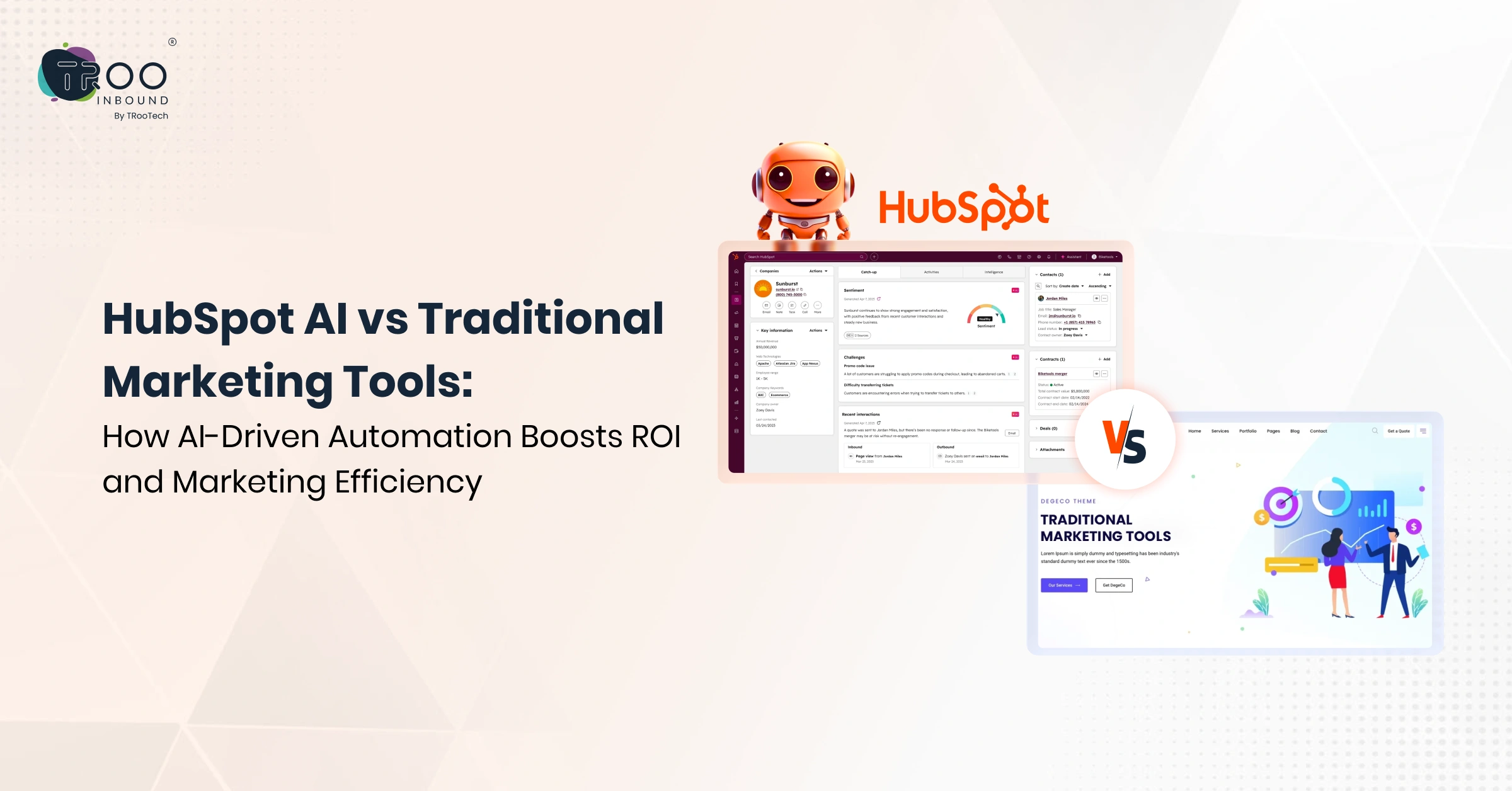
HubSpot’s recent INBOUND 2025 product launches signal a fundamental shift: the rise of hybrid human-AI teams where HubSpot AI tools assist humans to multiply marketing impact. At the center of this transformation was HubSpot’s Breeze platform, which embeds AI-driven automation directly into CRM workflows, content generation, and customer intelligence.
For CMOs and marketing directors evaluating their marketing stack, it’s the right time to incorporate HubSpot AI into it. It will help with faster campaign execution, predictive insights that improve over time, and personalization that scales without proportional headcount increases.
Let’s further examine how HubSpot AI tools compare against traditional platforms across 5 critical dimensions: lead management, content production, campaign optimization, attribution accuracy, and workflow intelligence.
The Traditional Marketing Stack: Challenges Enterprises Face
Traditional marketing tools were built for an era where channels were fewer, data was simpler, and customer expectations were lower. But today, enterprises need a fundamentally different level of agility and intelligence.
1. Multiple Tools Means Siloed Data
Most enterprises still rely on different platforms for managing customer relations, emails, analytics, marketing, and other business ops. Each works independently, but very few communicate cleanly.
The result:
- Delayed insights
- Inconsistent customer records
- Manual reconciliation across teams
This slows decision-making and weakens your ability to deliver connected experiences across the funnel.
2. Scalability Limitations
Traditional tools depend on fixed segmentation logic and static workflows. They can’t adapt when buyer behavior changes in the moment. As a result, campaigns often feel generic, reactive, and poorly timed, costing both efficiency and conversions.
3. Lack of Predictive Intelligence Limits Growth
Most legacy systems report on what has already happened. They don’t forecast:
- Which leads are likely to convert
- Which accounts are at risk
- Which campaigns will outperform
- Where can spending efficiency be improved
Without predictive signals, enterprise marketing becomes reactive instead of strategic, and this is where AI-native platforms have an inherent advantage.
HubSpot AI: The New Era of Intelligent & Connected Marketing
Traditional tools have relied on static rules and isolated workflows to determine how to engage customers. Meanwhile, HubSpot AI tools are able to learn from CRM data and make adjustments in real-time based on the engagement patterns of users across the platform – enhancing the marketing and revenue engine at all levels and stages of the customer journey.
What HubSpot AI Actually Does
HubSpot AI introduces intelligence across your entire go-to-market operation and goes far beyond simple content assistance by offering:
- AI-enhanced content creation for emails, ads, landing pages, and blogs
- Predictive lead scoring to prioritize accounts more accurately
- Behavioral modeling that guides timing, channel selection, and segmentation
- Conversation analysis for sales and service alignment
- Real-time recommendations for optimization, not just reporting
As a result, it creates a marketing system that continuously improves performance without relying on manual intervention.
Unified Smart CRM + Marketing Automation
As HubSpot’s CRM, CMS, automation, and reporting, everything lives inside one platform, AI has access to the whole customer context and not just fragmented data.
This foundation strengthens every advanced capability, from smart personalization to automated lifecycle nurturing.
This is also where TRooInbound adds value, through services like: HubSpot CRM Setup, HubSpot Automation & Workflows, Enterprise CRM Platform configuration, HubSpot Custom Modules Development, and more.
A central, AI-ready CRM ensures that the intelligence HubSpot AI generates is accurate, actionable, and aligned across teams.
AI Tools Designed for Enterprise-Scale Growth
HubSpot AI supports large, global teams by offering:
- Enterprise-grade governance and permissions
- Scalable workflows with adaptive logic
- Cross-channel alignment across marketing, sales, and service
- Reliable performance during high-volume campaigns
Instead of adding another standalone AI tool on top of an existing stack, HubSpot positions AI as a native capability, embedded directly into the systems your teams already use.
HubSpot AI vs Traditional Marketing Tools: A Feature-by-Feature Comparison
Traditional marketing platforms were built for manual execution, but HubSpot AI is designed for speed and predictive intelligence.
Here are the best practical comparison that shows where AI-native capabilities start to outperform legacy systems:
1. Campaign Creation & Speed
Traditional Tools
- Manual copywriting, design, segmentation, and testing
- Long production cycles, especially across large teams
- Limited assistance for ideation or optimization
HubSpot AI
- AI-generated drafts for emails, ads, landing pages, and CTAs
- Intelligent recommendations for messaging and timing
- Faster iteration loops and shorter go-to-market timelines
Outcome: Enterprises launch more campaigns in less time, without adding operational overhead.
2. Personalization & Segmentation
Traditional Tools
- Predefined segments based on static rules
- Limited ability to adapt to real-time behavior
- Personalization requires manual configuration
HubSpot AI
- Dynamic, behavior-driven segmentation
- AI-driven personalization for content, timing, and channel selection
- Adaptive responses based on intent signals
Outcome: Campaigns feel more relevant, improving engagement, lead quality, and ROI.
3. Automation & Workflows
Traditional Tools
- Rule-based workflows that require constant manual updates
- Fragmented triggers across multiple tools
- Rigid sequences not optimized for evolving buyer journeys
HubSpot AI
- AI-enhanced workflows with predictive triggers
- Smart routing, scoring, qualification, and nurturing
- Greater alignment across marketing, sales, and service
Outcome: Automations become more intelligent, reducing operational cost and improving funnel efficiency.
4. Reporting, Forecasting & Optimization
Traditional Tools
- Focus on historical reporting (“what happened”)
- Difficult to unify data across multiple platforms
- Limited intelligence for decision-making
HubSpot AI
- Predictive forecasting for leads, revenue, and churn
- Recommendations for optimizing campaigns, CTAs, and workflows
- Unified reporting across CRM, marketing, and CMS
Outcome: Leadership teams get forward-looking insights instead of backward-facing reports.
5. ROI & Marketing Efficiency
Traditional Tools
- High human dependency
- Slow operational turnaround
- Limited ability to scale campaigns without increasing headcount
HubSpot AI
- Reduced manual workload
- Sharper targeting and higher conversion efficiency
- Improved performance with the same (or lower) marketing spend
Outcome: Teams achieve higher ROI with significantly less effort.
How HubSpot AI Directly Boosts ROI Across the Marketing Funnel
HubSpot AI strengthens performance across every stage of marketing. Instead of adding isolated efficiencies, it enhances acquisition, engagement, conversion, and retention simultaneously, creating measurable and compounding ROI for enterprise teams.
Reduced Manual Workload
AI automates repetitive tasks like segmentation, list updates, content drafting, lead routing, and follow-ups. This reduces operational effort and shortens campaign launch timelines, allowing teams to focus on strategy instead of maintenance.
Higher Conversions Through Personalization
HubSpot AI adapts content, timing, and messaging based on real-time behavior and customer context. This elevates relevance across emails, ads, and landing pages, driving stronger engagement and improving conversion rates at every stage of the funnel.
Smarter Lead Prioritization
Predictive scoring shifts lead management from guesswork to data-driven accuracy. AI highlights high-intent prospects, improves sales alignment, and accelerates movement through the pipeline, resulting in more efficient revenue generation.
Better Retention and Lifetime Value
By identifying churn indicators early, HubSpot AI empowers teams to take proactive action. Targeted communication and personalized retention sequences help stabilize recurring revenue and extend customer lifetime value.
More Efficient Marketing Spend
Continuous AI-driven optimization ensures budget is allocated to the campaigns, audiences, and channels that perform best. Improved attribution and forecasting help reduce waste and strengthen ROI without increasing spend.
Implementing HubSpot AI: What Enterprises Need to Get Right
Adopting HubSpot AI isn’t a plug-and-play exercise. To realize its full value, enterprise teams need the right foundations, governance, and operational alignment. The more mature your CRM and workflows are, the more impact AI delivers.
1# Start With Strong CRM Data Foundations
Enterprises should begin by ensuring clean, unified, and consistently structured CRM records because a well-organized CRM enables HubSpot AI to generate accurate predictions, relevant personalization, and reliable insights.
2# Foundations First, AI Second
AI amplifies structured workflows; it doesn’t eliminate the need for them. Enterprises should design clear lifecycle stages, lead routing logic, and nurturing paths. With these frameworks in place, HubSpot AI can optimize triggers, messaging, and timing to improve performance.
3# The More Complete the Picture, the Smarter the Predictions
HubSpot AI performs best when connected to the broader revenue stack, like analytics platforms, ad networks, ERP systems, product databases, and service tools. This helps reduce blind spots and allows AI to interpret behavior across the entire customer journey.
4# Enterprises that Uplift Team Capability See the Fastest AI ROI
Technology alone doesn’t transform marketing. Teams must shift from manual configuration to insight-driven decision-making. This includes understanding AI recommendations, adjusting workflows based on predictive signals, and embracing iterative optimization rather than rigid processes.
5# Establish Governance and Performance Guardrails
As AI influences more touchpoints, governance becomes essential. Enterprises need clear rules for message quality, brand guidelines, data usage, and automation approvals.
How TRooInbound Helps Enterprises Maximize HubSpot AI
Enterprises often adopt AI tools without full preparation of the underlying CRM and data structure that makes AI effective. We solve this by building an AI-ready foundation within HubSpot that can deliver accurate predictions and reliable insights regularly.
Beyond the data layer, TRooInbound strengthens the operational backbone required for AI-driven automation. We design scalable workflows, lead management systems, and multi-path nurturing sequences that give AI the structure it needs to optimize performance.
Instead of relying on rigid, rule-based processes, enterprises gain adaptive automation that improves efficiency, aligns teams, and moves prospects through the funnel with greater precision.
In addition to that, we also ensure HubSpot AI is fully integrated into the broader technology ecosystem. Whether connecting HubSpot to ERPs, analytics platforms, ad networks, or custom applications, we create a unified environment where AI has complete context for forecasting, attribution, and optimization.
The result: you get a marketing system that keeps on getting smarter, faster, and more effective over time.
Final Verdict
Traditional tools cannot keep up with the speed and complexity of modern enterprise marketing. HubSpot AI gives teams a smarter way to work by improving targeting, simplifying operations, and creating more predictable revenue outcomes. When supported by the proper CRM setup, connected workflows, and a strong data foundation, the results are immediate and measurable.
If your organization is exploring AI-powered marketing or planning to upgrade from older systems, now is the right time to evaluate what HubSpot AI can unlock. With the proper guidance, you can build an adaptive and efficient marketing engine that grows with your business.
Ready to move from traditional tools to AI-driven automation and better ROI? Contact TRooInbound to get started today!