
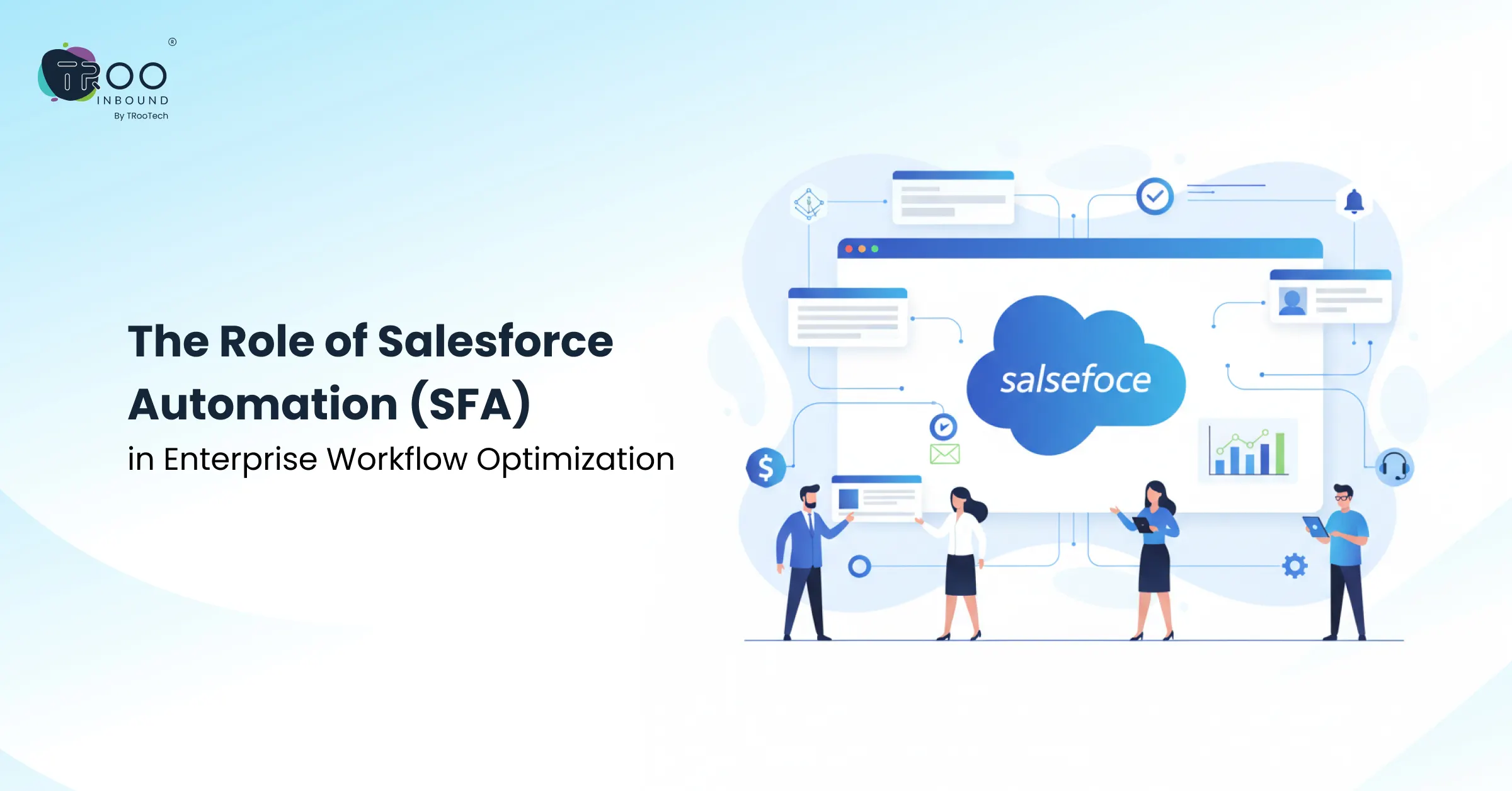


Enterprise teams manage complex sales cycles, high-volume service interactions, and multi-channel marketing programs to keep customers engaged. But when these operations run on siloed tools, the desired outcome is not achieved. Salesforce Automation (SFA) addresses this challenge by bringing business workflows together under a connected CRM environment.
Salesforce workflow automation helps businesses reduce manual efforts for repetitive processes and ensure that the information flows consistently across teams. This makes the sales team spend less time updating records, service teams resolve issues faster, and marketing teams run more relevant campaigns using real-time CRM data.
This blog acts as one of the best guides to understand Salesforce Automation and its impact on sales, service, and marketing workflows. Let’s dive in and explore more essentials of SFA.
Why Workflow Automation Matters: Challenges Without It
Many enterprises still rely on a mix of manual steps and partially automated systems to manage critical customer-facing processes. Over time, it creates compound gaps and operational drag, making it difficult for businesses to scale efficiently.
Organizations commonly face the following challenges without a unified automation layer:
- Tracking leads and activities manually
Lead data is often stored in spreadsheets, while follow-ups depend on individual discipline. This increases the risk of missed opportunities for conversion.
- Inconsistent handling of service requests
Service requests move slowly when routing rules are unclear or applied inconsistently, leading to delayed resolutions and frustrated customers.
- Static and dispersed marketing outreach
Marketing campaigns frequently rely on static segments that fail to reflect real-time customer behavior or lifecycle stages.
- Fragmented systems across departments
Sales, service, and marketing teams operate on disconnected tools or poorly synchronized platforms, causing alignment to break down.
- Lack of shared customer context
Sales teams may miss recent service issues, marketing may continue nurturing disqualified leads, and service teams may respond without visibility into campaign or deal history.
Key Features & Tools That Power Salesforce Automation
Salesforce Automation is a set of tightly connected tools and features that automate how work moves across your business teams. At the core of this capability are Salesforce’s workflow and logic builders, which define how records, tasks, and approvals progress through the system, forming the foundation for agentic automation frameworks like Agentforce 360.
Core Automation Tools in Salesforce Include
Flow Builder (primary automation engine)
A visual, drag-and-drop tool that enables teams to automate complex workflows across objects, users, and systems.
Process Builder and Workflow Rules (legacy support)
Still used in many organisations to support existing automation logic while transitioning to Flow Builder.
Everyday Workflow Automation Use Cases
- Automatic lead assignment based on territory, source, or criteria.
- Triggered follow-up tasks and reminders for sales and service teams.
- Real-time record updates to keep data consistent across teams.
- Automated notifications and alerts based on defined conditions.
Cross-Functional Automation Across Teams
Sales automation
Lead-to-opportunity progression, quote generation, contract management, and deal stage updates without repeated data entry.
Service automation
Case creation, routing, prioritization, escalation, and resolution workflows that ensure faster response times.
Marketing automation
Triggered nurturing journeys and campaign actions driven by CRM activity instead of static lists.
Enterprise-grade Flexibility and Extensibility
No-code and low-code automation
Business users can build and manage workflows without writing code, while technical teams can extend automation when needed.
System integrations and data flow
Native and third-party integrations with ERP systems, support platforms, marketing tools, and external applications eliminate data duplication.
Approvals, Controls & Governance
- Automated quote and pricing approvals.
- Contract review workflows with predefined paths.
- Service escalation rules that reduce bottlenecks and maintain compliance.
Together, these features create a shared automation layer that keeps processes aligned, governed, and scalable across the enterprise, allowing teams to operate at speed without sacrificing control or visibility.
Impact Of Salesforce Automation On Sales Workflows
SFA affects Sales workflows most directly in their day-to-day operations, like:
Lead management and follow-up:
- SFA automates lead assignment and routing based on predefined rules or categories like industry, deal size, territory, or product interest.
- It also automates task creation and sets reminders, so that no lead goes untouched, even in high-volume traffic.
- Salesforce Automation also keeps the lead nurtured until it becomes sales-ready to reduce the risk of lost opportunities.
Opportunity and pipeline management:
- Deal stages automatically update based on key actions like proposals sent, meetings logged, or contracts generated.
- Approvals, quote & contract document generation, and notifications trigger automatically for accelerating the quoting process.
- It standardizes workflows to eliminate manual data entry and prevent pipeline distortion across teams.
Productivity gains:
- Fewer internal delays chasing approvals or information.
- Less time spent updating CRM records manually.
- Shorter deal cycles due to faster transitions from lead to close.
- More time for customer conversations, deal strategy, and relationship building.
Forecasting and sales analytics:
- Your sales dashboards stay accurate because data updates automatically as deals move forward.
- Get clear visibility into conversion rates, stage velocity, and revenue projections.
- Sales leaders can adjust strategy early rather than reacting after targets are missed.
Together, these improvements turn Salesforce Automation into a foundational sales execution engine, enabling teams to scale performance without adding complexity or administrative overhead.
Impact of Salesforce Automation on Customer Service Workflows
As organizations scale, customer service teams are often the first to feel operational strain. Here’s how SFA helps in reducing stress:
- Support requests are captured automatically from email, web forms, chat, and integrated systems.
- Cases are assigned based on issue type, urgency, customer tier, or service-level agreements, ensuring faster ownership.
- Notifications trigger automatically when response or resolution thresholds are met, preventing stalled cases.
- Workflows move cases forward without manual coordination, reducing delays and handoffs.
- Automatic and timely responses across all support channels.
- Less repetition, as customers are not required to restate issues.
- Support teams scale volume without proportional headcount increases.
- Provides a single customer record with sales history, past cases, and marketing interactions.
- Better context for agents, enabling more personalised and effective support.
Impact of Salesforce Automation on Marketing Workflows
Salesforce Automation brings in responsive, data-driven workflows that replace manual scheduling and static campaigns with real-time execution, especially when combined with Salesforce Marketing Cloud Services for cross-channel campaign orchestration and journey automation. Here’s how:
- Automated lead nurturing and campaign triggers based on CRM activity such as lead status changes, website behaviour, or sales interactions.
- Prospects receive the right message at the right stage, without delays caused by manual intervention.
- Stronger alignment with sales and service through shared CRM visibility.
- Automated campaign launches, email sends, audience updates, and follow-ups.
- Campaign performance is tied directly to pipeline and revenue data for improved tracking and ROI visibility.
Business Value and ROI of Salesforce Automation
Other than operational clarity, Salesforce Automation measurably impacts productivity gains, cost efficiency, and improved experiences across the company.
Productivity increases across teams as:
- Sales reps no longer spend hours updating records or chasing internal approvals.
- Customer service reps no longer need to do manual case routing and status checks.
- Marketing teams reduce time spent on execution logistics by automating repetitive tasks, content generation, publishing content across multiple channels, etc.
Additionally, automated workflows enforce consistent updates, required fields, and standardized processes, so that CRM data becomes accurate and trustworthy.
Parallely, customer and employee experience also improve through Salesforce automation. Customers get faster responses and consistent communication as the internal teams work within clear, predictable workflows. Ultimately, it reduces frustration and burnout while improving service quality.
From a financial perspective, these gains translate into real ROI. And over time, automation becomes a growth enabler rather than an expense line item.
Salesforce Automation Implementation Best Practices & Considerations
Effective Salesforce Automation begins with clarity, not configuration. So, consider these best practices for implementing scalable automation:
- Map current workflows before automating: Understand how work moves today and identify friction points. Automating broken processes only amplifies inefficiency.
- Prioritize low-code and no-code tools: Use Flow Builder wherever possible to enable faster changes, reduce developer dependency, and give business users ownership of automation logic.
- Maintain strong data hygiene: Clean records, consistent field usage, and defined data standards ensure workflows trigger correctly and reporting remains reliable.
- Establish governance and controls: Define roles, permissions, and approval paths to balance speed with accountability. Logging and audit trails are essential for compliance-sensitive workflows.
- Adopt a phased rollout approach: Start with high-impact, low-complexity use cases like lead assignment or follow-up reminders before expanding into cross-department workflows.
- Continuously monitor and optimize: Track metrics such as response times, conversion rates, and error frequency. Regular reviews help refine automation as business needs evolve.
When implemented with discipline and intent, Salesforce Workflow Automation becomes a long-term operational advantage, supporting growth without increasing complexity or risk.
Final Verdict
Salesforce Automation helps enterprises unify sales, service, and marketing workflows into a single operating system. By reducing manual work and standardizing processes, teams move tasks faster, data stays reliable, and customers experience more consistent engagement.
Just as importantly, automation allows organizations to scale without introducing unnecessary complexity or operational risk. If you are evaluating automation, outcomes depend on how well technology is aligned with real business workflows.
TRooInbound provides end-to-end Salesforce Services to help organizations design, implement, and optimize automation that delivers measurable results. From workflow strategy to enterprise-grade execution, our focus is on building systems that support growth, visibility, and long-term efficiency.
If you are exploring Salesforce Automation as part of your CRM transformation, now is the right time to take a structured, expert-led approach. Connect with our Salesforce experts today!