
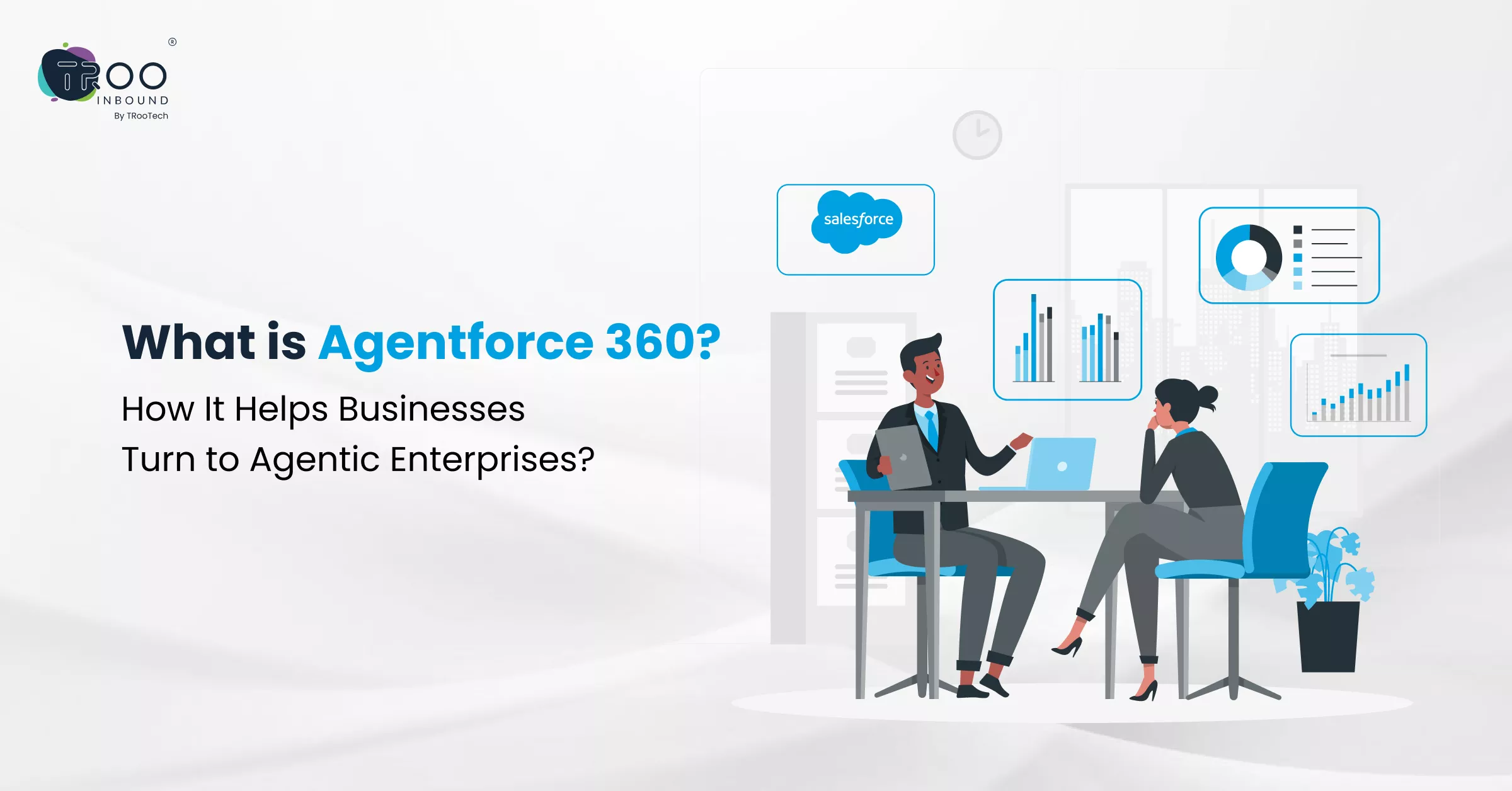


Agentforce 360 is the latest evolution of Salesforce that was unveiled at their annual Dreamforce 2025 event. It is an agentic platform that brings together humans, AI agents, applications, and data under one roof.
Today, teams are trying to adopt a human + AI workforce, but they aren’t succeeding because of scattered data and less control over how pre-built AI agents will work. Turning these challenges into an opportunity, Salesforce built Agentforce 360 to help enterprises build, deploy, and manage AI agents with governance and traceability.
So, let’s explore Salesforce Agentforce 360 from each angle and understand its core features, latest updates, and how it will help organisations transform into truly agentic enterprises.
What is Agentforce 360, and What is Salesforce’s Vision Behind It?
Agentforce 360 is a next-gen, AI agent-building platform that transforms the way businesses operate in the age of rapid automation.
It’s built on the Einstein 1 Platform and unifies people, AI agents, apps, and data into a single, trusted workspace so organisations can move from isolated AI pilots to a coordinated “agentic” workforce that actually grows.
At a product level, Salesforce Agentforce 360 bundles several capabilities into one platform:
- A low-code Agentforce Builder for designing agent “topics, actions, and instructions”
- Control agent behaviour through Agent Script, a human-readable scripting language allowing conditional logic, hybrid reasoning, and more precise execution
- Agentforce Voice to deliver brand-consistent, natural-language, low-latency interactions integrated into CRM workflows
- Intelligent Context, powered by Data 360, helps AI agents understand your business by organising unstructured data into clear, usable insights for accurate and relevant responses and much more.
Salesforce’s Broader Vision: The Agentic Enterprise
Here are some factors that inspired Salesforce to build Agentforce 360:
Unified platform for humans and AI: Salesforce wants to bring people, AI agents, apps, and data together on one platform. This helps teams work in sync and use AI in their daily tasks without switching between different tools.
Strong governance and trust: Agentforce 360 gives businesses full control and visibility over how their AI agents work. You can see what an agent did, review its steps, and set rules to make sure everything follows company policies.
Freedom to choose AI models: Salesforce partners with multiple AI providers like OpenAI, Anthropic, and Google Gemini. This lets businesses pick the model that best fits their data privacy, budget, and performance needs.
Built for real-world use: Salesforce Agentforce 360 brings together voice assistants, company data, automation, and CRM in one system. This makes it easier for companies to use AI in their daily work, not just for testing or small projects.
The History and New Features of Agentforce 360
Salesforce has continuously evolved its Agentforce platform to make AI agents smarter, safer, and more useful for real business operations. Let’s take a quick look at the history of this platform, followed by its newest features:
Version History
- In October 2024, Salesforce first introduced Agentforce as the first platform for enterprise-grade AI agents.
- In December 2024, Agentforce 2.0 was released with pre-built skills, workflow integrations, and Slack deployments.
- Then, in March 2025, Agentforce 2dx was launched, which enabled embedding agents across any workflow to support more interactive customer experiences.
- In June 2025, Agentforce 3 was announced with an emphasis on governance, interoperability, observability (through a “Command Center”), and enterprise-scale deployment readiness.
- And recently, in October 2025, Salesforce announced Agentforce 360. This builds on all prior versions and positions the platform as a unified “agentic enterprise” stack: merging humans, agents, apps and data.
New Features of Agentforce 360
Here are key new capabilities introduced with or for Salesforce Agentforce 360:
| Feature | Description | Why it matters |
|---|---|---|
| Agentforce Builder / Low-Code Agent Builder | Visual and low-code tools that let users build agents, test, debug, and deploy within one interface | Speeds up time-to-value: less reliance on heavy development |
| Agent Script | A human-readable scripting language (JSON-based) for defining agent behaviour, branching logic, hybrid rules + LLM capabilities | Gives enterprises control: rather than opaque models, you can define behavior and ensure consistency |
| Agentforce Voice | Agents that handle voice and conversation (not just text) for customer service or employee interactions | Opens up new interaction channels (phone, voice assistants) for agents |
| Data 360 & Unified Intelligent Context | The upgrade of the data layer (formerly “Data Cloud”) to Data 360, enabling agents to pull structured + unstructured data (PDFs, tables, images) and to reason with it | Agents only perform well if they have the correct context; this is a major enabler for real-use effectiveness |
| Hybrid Reasoning & Model Context Protocol (MCP) | The platform supports multiple model types (LLMs from OpenAI, Anthropic, and Google's Gemini) and lets agents connect to different tools/systems via MCP | This flexibility means enterprises are not locked into one model, and can connect their own systems, which is important for real-world enterprise use |
| Observability, Governance & Enterprise-Scale Features | Features like the “Command Center” to monitor agent performance, trace reasoning, and measure impact across workflows | Enterprises need to trust their agents: seeing what they do, auditing them, and controlling them |
| Slack as Conversational Front-Door | Salesforce is positioning Slack as the “agentic OS” where agents live and people interact | This allows agents to work in the tools employees already use and gives a conversational layer to the platform |
How to Become an Agentic Enterprise with Salesforce Agentforce 360
Becoming an agentic enterprise means integrating AI agents as digital teammates of your current employees. It will keep you step-by-step with the shifting market where humans and AI work together to drive speedy, yet better and accurate growth to their business.
Here’s how Agentforce 360 helps organisations achieve the agentic edge:
Begin with: Using Agentforce 360 means centralising your data by default
If you layer AI agents on unstructured data, the outcome will surprise you, but not in a desired manner (iykyk!)
Their work efficiency depends on the data they access. So, before deploying agents, make sure all your customer, sales, and service data lives in Data 360. It ensures that every agent has a complete context of data from every system.
It’s like giving your agents a single source of accurate information, so that they can make confident decisions.
2nd step: Build your own agent and train it as per unique requirements
With Agentforce Builder, you can create AI agents using natural language scripts, without any heavy coding.
You can start building with a small real-life use case like automating lead follow-ups, scheduling calls or meetings, etc. Once you test the agent, it’s ready for final deployment.
Always remember to start small, prove its value, and then expand by building agents for complex challenges.
3rd step: Define how your agent should work through the Agentforce Script
Salesforce introduced Agentforce Script inside Agentforce 360, where you can add a set of clear, human-readable instructions about how your agent should work; what it should do and what it shouldn’t, making it easy to keep brand consistency, governance, and traceability.
Don’t miss this step as it ensures that the agent you built works within rules, and not guesswork.
4th step: Add voice to your agents for using them in daily conversations
By using Agentforce Voice and integrating agents with Slack, you can use them as an active part of daily communication.
It will be like your employees being able to communicate with their digital teammates and ask them for insights, assign them tasks, or get immediate updates without typing out queries or prompts. This makes AI more accessible and easier to adopt across teams.
5th step: Monitor and improve your agents regularly
Leaving AI agents untouched after successful deployment can turn risky over time. Keep a constant eye on them through Salesforce Command Center, which tracks performance, success rates, and response quality of your agents.
It helps you understand how agents are making decisions by staying compliant with rules, and also improves their accuracy gradually.
End with: Empower teams with AI agents, do not try to replace them
The ultimate goal of Salesforce Agentforce 360 is to augment human intelligence. Your sales, marketing, and service teams should see agents as co-workers who handle repetitive work, and free them up for strategy and creativity and not as their replacements.
By following these steps, any organization can move from traditional automation to becoming a truly agentic enterprise where humans and AI agents work in sync to achieve more with less effort.
Step Into the Agentic Future with TRooInbound
Adopting Agentforce 360 will be a tech stack revolution for your business, especially for your employees. Plus, it will definitely require the right setup, strategy, and integration expertise.
If you aren’t sure about whether it’s the right time to upgrade to new technology or where to start from, TRooInbound is here to help!
We understand Salesforce inside out. Our team will help you plan, implement, and optimize Agentforce 360 so your organization is ready to become an agentic enterprise.
The future of work is agentic. Let’s build it together with Salesforce and TRooInbound.