
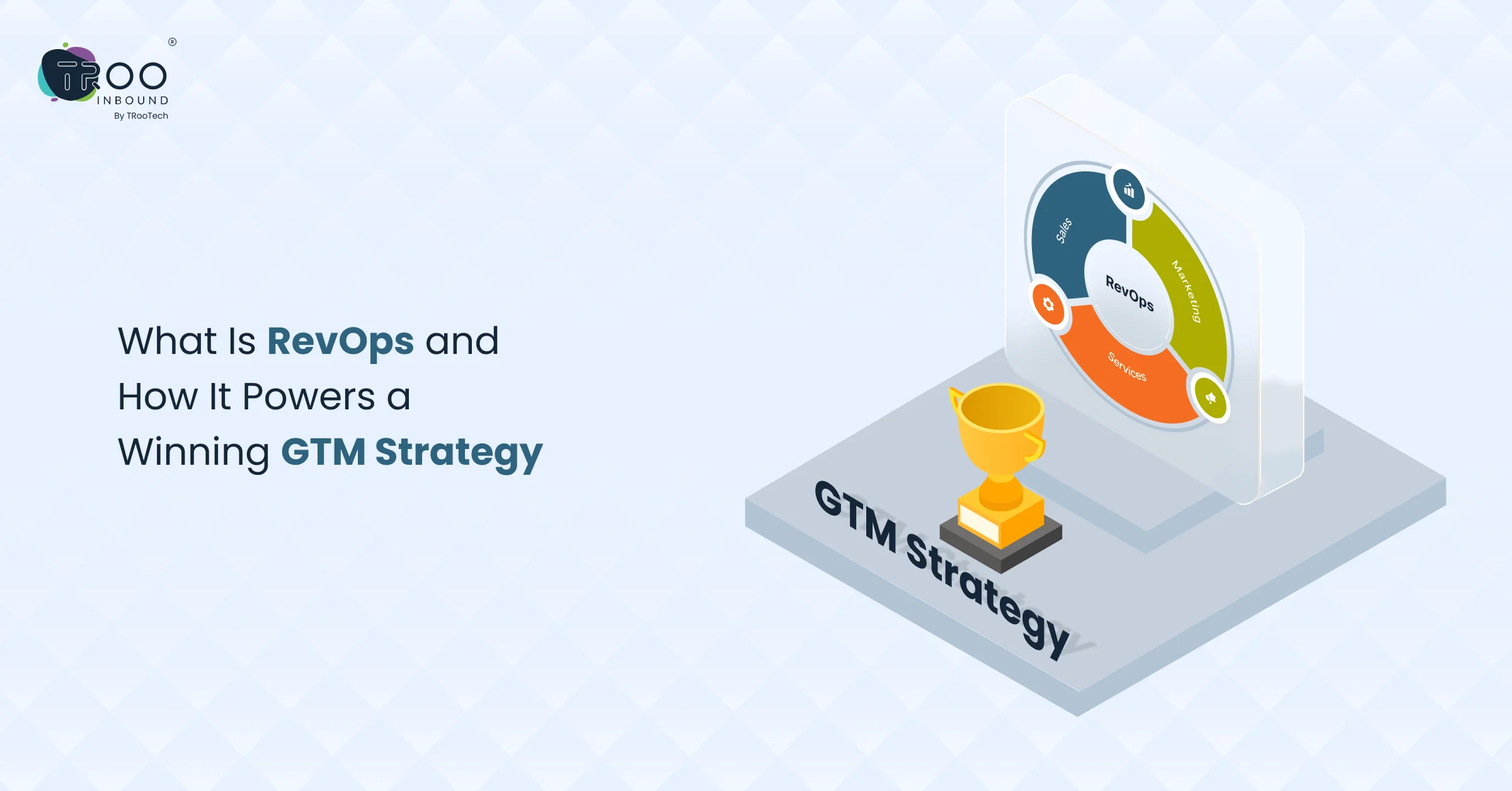


Revenue Operations (RevOps) is a modern strategy that fast-scaling B2B tech companies use to bridge traditionally siloed functions like marketing, sales, and customer success into one aligned process.
As today’s Go-To-Marketing (GTM) landscape demands speed and alignment, teams that are still operating in silos find it difficult to grow their revenue. This is where businesses with a RevOps team often win. They keep systems, data, and people across the company connected. So everyone works together and uses connected and freshly updated data to achieve the revenue goal.
In this blog, we will briefly understand what is Revenue Operations, its real-world applications, why it is called the backbone of GTM strategy, and more. Let’s dive in deep!
What Is RevOps?

RevOps is a strategic alignment of sales, marketing, and customer success teams through shared technology, data, and processes that help maximize revenue generation throughout the entire customer lifecycle.
Instead of departments working in silos, RevOps acts as the “operating system” for growth, breaking down barriers to create a unified, predictable, and scalable revenue engine.
As per the December 2025 report of the S & S Insider: “Global RevOps Market was valued at USD 6.16 billion in 2025 and is expected to reach USD 21.70 billion by 2032, growing at a CAGR of 17.16% from.” This shows that organizations are increasingly investing in RevOps to keep things aligned, reduce the go-to-market time, and generate more revenue, faster.
What is GTM Strategy & Why RevOps Is Essential In It

A Go-To-Market (GTM) strategy means how a company brings its product or service to the right audience, at the right time, through the right channels.
This strategy covers everything from target customer segments and positioning to pricing, sales motion, distribution channels, and post-sale engagement.
In simple terms, a GTM strategy answers three critical questions:
- Who are we selling to?
- What problem are we solving for them?
- How do we consistently turn demand into revenue?
On paper, a GTM strategy looks easy to execute, but the real trouble begins when it’s actually executed. And this is where RevOps plays a critical role in keeping the process running smoothly.
While GTM defines the direction to achieve a goal, RevOps ensures that marketing, sales, and customer success are aligned to move in that direction together. It keeps GTM execution structured and measurable.
With RevOps in place:
- Marketing campaigns are built around revenue goals, not just lead volume.
- Sales teams work from clean, unified data and clear qualification criteria.
- And customer success teams receive full visibility into deal context, enabling smoother onboarding, higher retention, and expansion opportunities.
In short, GTM strategy sets the vision, but RevOps makes it operational. Together, they transform growth from a series of disconnected efforts into a predictable revenue engine.
Why GTM Strategies Fail Without RevOps: 5 Reasons
The most common GTM failures come from misalignment, inefficiencies, and a lack of operational ownership:
1. Siloed teams: Without RevOps, marketing focuses on lead generation, sales prioritizes deal closures, and customer success works on retention, all using different tools, data definitions, and success metrics. This results in fragmented customer journeys and lost revenue opportunities
2. Inconsistent and unreliable data: GTM decisions depend heavily on accurate insights, but without RevOps, data often lives in disconnected systems. This leads to duplicate records, unclear funnel stages, poor attribution, and forecasting that leadership cannot trust.
3. Unclear handoffs between teams: Leads move from marketing to sales without a proper qualification context. Deals close without customer success having visibility into expectations or use cases. These gaps create friction and slow down revenue cycles.
4. Misaligned metrics and incentives: When each team operates in silos, they measure success differently, and GTM execution becomes disjointed.
5. Poor scalability: As companies grow, the processes that were once handled manually becomes bottleneck for further growth. Without RevOps, operations keep on breaking, and revenue gets stalled.
In essence, without RevOps, GTM strategies remain theoretical. And with RevOps, they become executable, measurable, and scalable across the entire revenue lifecycle.
Key Metrics RevOps Teams Track to Drive GTM Success

RevOps brings structure and accountability to GTM execution. Instead of each function tracking isolated KPIs, RevOps ensures that marketing, sales, and customer success operate from a single source of truth.
Here are some of the most critical metrics RevOps teams track:
- Pipeline Velocity
Measures how quickly deals move through the pipeline, helping teams identify bottlenecks that slow revenue generation. - Lead-to-Customer Conversion Rate
Tracks how effectively marketing and sales convert demand into closed revenue, highlighting lead quality and sales efficiency. - Customer Acquisition Cost (CAC)
Evaluates how much it costs to acquire a new customer, enabling GTM teams to optimize channel spend and campaign performance. - Customer Lifetime Value (LTV)
Helps teams understand long-term revenue potential and prioritize retention and expansion strategies. - Win Rate
Indicates how often sales opportunities convert into closed deals, providing insight into messaging, qualification, and sales execution. - Revenue Forecast Accuracy
Ensures leadership can confidently plan growth by comparing projected revenue against actual performance. - Churn Rate
Reveals how well customer success efforts are retaining customers and where post-sale improvements are needed. - Expansion and Upsell Revenue
Tracks additional revenue generated from existing customers, a key indicator of GTM maturity and product adoption.
By monitoring these metrics consistently, RevOps teams enable GTM strategies to evolve from reactive decision-making to data-driven, predictable revenue growth.
Tech Stack That Helps Enable RevOps Execution
RevOps cannot function effectively without the right technology stack. It relies on connected tools that work together as one revenue system to keep teams, data, and processes aligned.
Here’s the list of essential tools that form the foundation of successful RevOps execution:
1. Customer Relationship Management (CRM)
At the center of every RevOps stack sits a unified CRM like HubSpot. Centralizes contacts, companies, deals, and activities, ensuring all teams work with accurate and up-to-date data.
2. Marketing Automation Platforms
Enable demand generation, lead nurturing, attribution tracking, and campaign performance measurement.
3. Sales Enablement and Engagement Tools
Support pipeline management, deal tracking, playbooks, and sales productivity.
4. Customer Success and Support Systems
Provide visibility into onboarding, adoption, renewals, and expansion
5. Data, Reporting, and Analytics Tools
Help RevOps teams monitor funnel health, forecast revenue, and surface actionable insights
6. Integration and Automation Tools
Connect systems, eliminate manual data entry, and ensure information flows seamlessly across the revenue engine.
However, with HubSpot, you will find all these tools in one ecosystem. Plus, if you manage data in other tools and want to integrate it with HubSpot, you can either choose integration from their marketplace or go for a customer integration if needed.
This means that having HubSpot alone can be enough to manage Revenue operations with ease. You can partner with a reliable HubSpot onboarding service provider to help you with easy setup for further integrations.
How to Build or Scale a RevOps Function
Building a RevOps function means creating a centralized ownership model that aligns revenue-generating teams around shared goals, systems, and data.
Whether a company is setting up RevOps for the first time or scaling an existing function, the focus should always be on execution, not complexity. Here’s how they can do it:
- The first step is establishing clear ownership.
- Next comes process alignment across the revenue lifecycle.
- Then comes technology consolidation and optimization.
- After that comes data governance and reporting discipline.
- And at last, continuous optimization.
For many growing companies, building or scaling RevOps internally can be time-consuming and resource-intensive. Partnering with an experienced RevOps partner allows businesses to move faster, avoid costly mistakes, and implement best practices from day one.
How TRooInbound Helps Companies Align RevOps and GTM for Predictable Revenue
Aligning RevOps and GTM demands hands-on execution expertise and a clear understanding of how revenue actually flows through an organization. This is where TRooInbound plays a critical role.
We work with growing B2B companies to design and operationalize RevOps frameworks that directly support their GTM goals.
Our approach begins with a deep audit of your existing revenue operations. Then we identify gaps across funnels, uncover data inconsistencies, and check how the current tech stack is supporting GTM.
From there, we build structured workflows that improve lead handoffs, pipeline visibility, forecasting accuracy, and post-sale engagement.
We also help teams implement and optimize CRM systems, automation workflows, reporting dashboards, and integrations that keep revenue teams aligned in real time.
For enterprises looking to move faster, reduce operational friction, and turn GTM strategy into measurable results, TRooInbound provides the structure, expertise, and execution needed to make RevOps work.
So, are you ready to build a predictable revenue engine?
Schedule a 30-minutes call with us to align your RevOps and GTM strategy and turn growth into a scalable and repeatable process.