
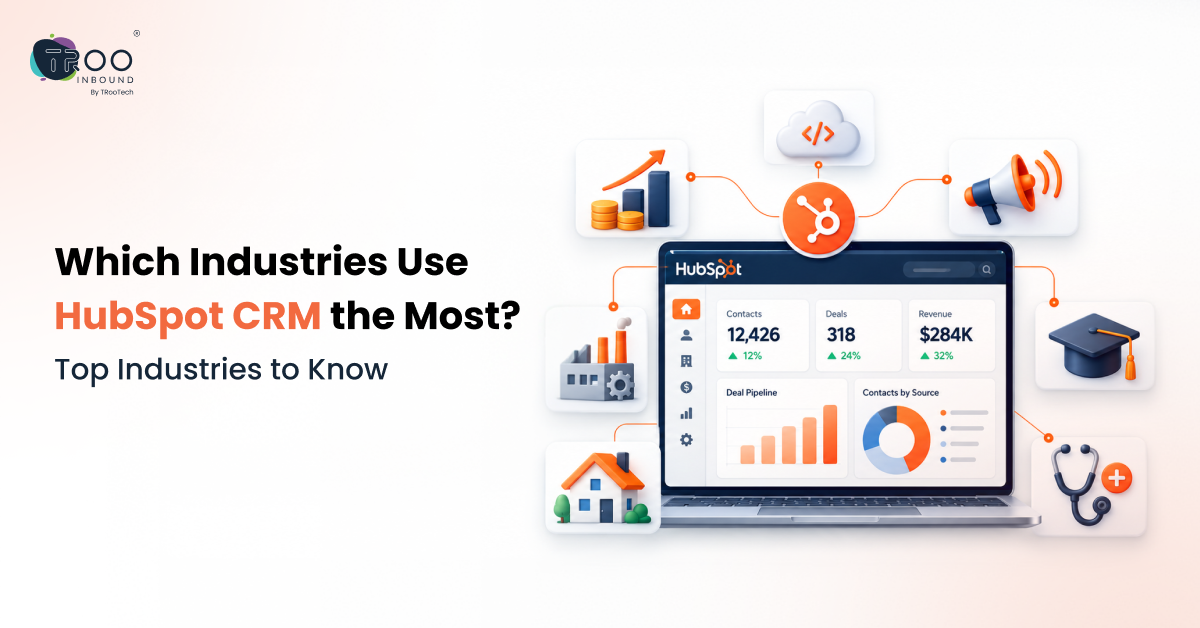
HubSpot CRM is used across various industries, but available technology adoption data from Enlyft, TechnologyChecker.io, TDInsights, and more shows that HubSpot CRM’s usage is strong among the software, SaaS, IT services, marketing and advertising, financial services, healthcare, manufacturing, and other industries managing complex customer journeys.
Let’s explore the top 8 industries where HubSpot CRM is used the most, industry-wise usage segments, how to decide whether HubSpot is useful for your industry or not, and much more.
TL;DR:
- HubSpot CRM is widely used across software, IT services, marketing, financial services, healthcare, manufacturing, retail, and ecommerce.
- Technology and B2B service companies show especially strong HubSpot adoption in third-party usage datasets.
- HubSpot works well across industries because it connects CRM data with marketing, sales, service, automation, and reporting.
- The right HubSpot setup depends on business processes, integrations, data structure, compliance needs, and sales complexity, not just industry.
- HubSpot may be less suitable as a primary system for businesses with highly specialized operational workflows, such as aviation, mining, heavy energy, or large-scale logistics.
- Businesses should evaluate whether HubSpot fits their customer journey, team structure, reporting needs, and wider technology stack before implementation.
Why Is HubSpot CRM Popular Across Different Industries?
Because HubSpot CRM is flexible enough to customize to different industries’ requirements, such as customer lifecycle, sales processes, marketing activity, support service needs, and reporting needs.
That flexibility is essential because the way a software company sells is very different from the way a financial service provider or healthcare organization. HubSpot CRM can support those differences through its capabilities like customizable records and properties, deal pipelines, marketing automation, lead management, shared customer data, and the list goes on.
This allows different teams to work from the same customer context while configuring HubSpot around their business operations and workflows.
Top 8 Industries That Commonly Use HubSpot CRM
1. Software & SaaS

Source: TechnologyChecker.io
TechnologyChecker places Software Development first among the HubSpot industries it identified, representing 8.71% of matched company domains in its August 2026 dataset.
That amount of adoption makes sense in the software and SaaS industry because its sales process often involves multiple stages, stakeholders, and ongoing customer relationships. They may have prospects coming from product demos, outbound sales, free trials, referrals, or other channels. And once the prospect enters the CRM, the business needs to understand where that person stands in the buying process and what needs to happen next.
HubSpot CRM can bring these interactions into a central record and give sales teams a structured way to manage the pipeline.
Common Use Cases of HubSpot CRM for Software and SaaS Industry:
- Managing leads, contacts, companies, and deals
- Building multiple sales pipelines
- Tracking demo requests and sales opportunities
- Managing sales activities and follow-ups
- Automating repetitive sales tasks
- Tracking customer and account information
- Connecting sales data with other business systems
- Creating dashboards for pipeline and sales performance
- Managing data from different sources in one CRM
A Real-life Example
Traction Ag, a SaaS/AgTech company, came to TRooInbound with a HubSpot portal that had become difficult to manage.
The problem was that they had a CRM, but it had accumulated unnecessary properties, workflows, reports, and other configuration over time.
We audited 626 contact properties, mapped contact sources, cleaned up workflows and reporting, standardised naming, and established governance processes.
Read More2. Information Technology & Services
IT services companies deal with different sales processes than transactional businesses. It also involves multiple stakeholders, long sales cycles, service offerings, and projects.
For example, a technology consultancy may offer consulting services, implementation projects, managed services, support contracts, or a combination of these. And a single contact record may be associated with different projects and teams over time.
As the agency grows, keeping customer, sales, project, and account information organised when one contact can be connected to multiple opportunities and teams can become difficult.
That’s where HubSpot CRM helps. It tracks where each opportunity stands, records communication, assigns follow-up activities, manages lead sources, and gives marketing and sales teams a shared view of the prospect.
Common Use Cases of HubSpot CRM for Information Technology & Services Industry:
- Managing complex B2B sales pipelines
- Tracking multiple opportunities for the same account
- Managing sales and delivery handoffs
- Keeping customer information in one place
- Connecting CRM data with other business applications
- Automating lead assignment and follow-ups
- Tracking account activity and engagement
- Creating management dashboards
- Migrating from older CRM systems
3. Marketing & Advertising Agencies
Marketing and advertising agencies manage relationships with many clients, prospects, projects, and internal teams at the same time. Their CRM therefore needs to do more than just store contact information. It needs to keep customer and prospect data organised and give teams a clear view of their relationships and sales opportunities as the agency grows.
Another reason marketing and advertising agencies are a natural fit for HubSpot CRM is their strong focus on generating and converting inbound demand. HubSpot was built around inbound marketing, which makes its CRM a natural fit for agencies that rely on content, campaigns, website traffic, lead generation, and nurturing to bring in new business.
Common Use Cases of HubSpot CRM for the Marketing & Advertising Industry:
- Managing new business pipelines
- Tracking leads generated through different channels
- Managing client accounts and relationships
- Recording meetings, calls, and emails
- Automating follow-ups
- Assigning leads to the right salesperson
- Managing multiple sales pipelines
- Tracking client opportunities and renewals
- Creating sales performance reports
- Connecting lead generation tools with the CRM
4. Real Estate
Real estate businesses handle a high volume of inquiries from buyers, sellers, tenants, landlords, and investors. Each of them is at a different stage, and leads come in from many channels: property portals, website forms, open houses, referrals, social media, and paid ads. Without a central system, leads get lost in inboxes and spreadsheets, and follow-ups depend on each agent’s memory.
That’s why more agencies, brokerages, and developers are adopting HubSpot for real estate. The CRM gives teams one record for every contact, along with the properties they’ve asked about, the conversations they’ve had, and where they are in the buying, selling, or leasing process. Agents know who to call next, and managers can see the whole pipeline across agents and listings.
Real estate sales cycles can also be long and driven by relationships. A buyer may browse for months before making a decision, and a past client may come back years later to sell or refer someone. With HubSpot for real estate, teams can nurture these contacts with automated emails, new listing alerts, and timely reminders, so no opportunity goes cold.
Common Use Cases of HubSpot for Real Estate:
- Capturing leads from property portals, website forms, and ads
- Managing buyer, seller, tenant, and investor contacts
- Building separate pipelines for sales, rentals, and property management
- Tracking property inquiries and site visit requests
- Scheduling viewings and automating follow-up reminders
- Assigning leads to agents by location, property type, or budget
- Sending new listing alerts and nurture emails
- Tracking referral sources and repeat clients
- Connecting HubSpot with MLS, listing platforms, or property management tools
- Reporting on agent performance, lead sources, and closed deals
5. Financial Services
The financial industry generally deals with customer relationships that can continue for longer periods. Plus, they may also have complex qualification processes, regulatory needs, and a large amount of sensitive customer information. This makes it essential to have a CRM that offers trust, personalization, and flexibility. That’s where HubSpot CRM helps.
HubSpot CRM can easily help financial services businesses centralise interaction data, manage pipelines, segment contacts, automate follow-ups, and improve visibility across relationship management activities.
Common Use Cases of HubSpot CRM for the Financial Industry:
- Managing prospects and clients
- Tracking financial product or service opportunities
- Managing broker or referral relationships
- Tracking sales pipelines
- Automating follow-ups
- Managing client communications
- Segmenting contacts and accounts
- Creating sales and relationship reports
- Connecting external systems with CRM data
A Real-life Example
TRooInbound worked with an Australian non-bank lender that was receiving important deal information through broker emails.
The challenge was turning those email-based interactions into complete, usable CRM deal records.
This is a good example of where CRM value goes beyond contact storage. The objective is to make important information available in the right place so sales teams can work from a reliable deal record instead of piecing information together manually.
Read More6. Healthcare
The healthcare industry definitely has a completely different CRM requirement from many B2B companies because their customer journeys involve patients, providers, referrals, appointments, communications, and multiple departments.
HubSpot CRM can help them organize relationships and engagement data, manage enquiries and follow-ups, and reduce manual coordination.
Common Use Cases of HubSpot CRM for the Healthcare Industry:
- Managing patient or prospect enquiries
- Tracking referral sources
- Managing enquiry and appointment pipelines
- Automating follow-ups and reminders
- Centralising communication history
- Segmenting contacts
- Tracking engagement
- Managing service requests
- Connecting CRM data with other systems
- Reporting on acquisition and engagement
7. Manufacturing
Manufacturing is often overlooked when people talk about CRM software. But manufacturers can have some of the most complicated customer and sales processes.
Even one opportunity may involve multiple sales representatives, engineers, procurement teams, distributors, customers, and finance teams. Sales cycles can also involve RFQs, specifications, quotations, approvals, production requirements, delivery, and ongoing service. That creates a strong need for a CRM like HubSpot, which can keep its customer and deal data structured.
Common Use Cases of HubSpot CRM for the Manufacturing Industry:
- Managing enquiries and leads
- Tracking RFQs
- Managing complex sales pipelines
- Tracking distributors and partners
- Managing multiple contacts within an account
- Automating sales follow-ups
- Tracking quotations
- Connecting CRM with ERP or operational systems
- Managing customer service information
- Reporting on pipeline and sales performance
A Real-life Example
CURO, a branding, signage, print, and installation services company, had customer, sales, and project information spread across HubSpot, M-Power, and manual processes.
TRooInbound redesigned the CRM architecture, created separate pipelines for different types of work, built a custom Installation Project object, connected HubSpot and M-Power, and automated more than 30 workflows.
This resulted in clearer handoffs between teams and better visibility into project and pipeline information.
Read More8. Retail & Ecommerce
Retail and ecommerce businesses work differently from most of the B2B industries discussed above, but they still have a strong need for customer data. The difference is often the volume and speed of customer interactions.
Instead of tracking a small number of long-running enterprise deals, a retailer may need to understand thousands of customer interactions across marketing campaigns, purchases, service requests, website activity, and repeat buying behavior.
HubSpot CRM can help businesses segment customers, coordinate campaigns, personalize communication, manage service interactions, and better understand customer lifecycle activity.
Common Use Cases of HubSpot CRM for the Retail & Ecommerce Industry:
- Managing customer records
- Tracking leads and business accounts
- Segmenting customers
- Managing sales opportunities
- Tracking repeat customers
- Managing customer communications
- Automating follow-ups
- Connecting ecommerce platforms with CRM
- Creating customer and sales reports
- Managing wholesale or B2B sales alongside ecommerce
Which Other Industries Can Benefit From HubSpot CRM?

HubSpot’s usefulness is not limited to the eight industries above. Because the CRM can be configured around different sales processes, customer journeys, and service models, it can also support organizations across industries such as:
- Education: Track prospective students, enrollment journeys, communications, events, and ongoing engagement.
- Professional services: Manage inquiries, consultations, opportunities, client relationships, and long sales cycles.
- Travel and hospitality: Segment customers, manage inquiries, automate communications, and support repeat engagement.
- Construction: Coordinate leads, projects, contractors, accounts, and longer deal cycles involving multiple stakeholders.
- Nonprofit organizations: Manage supporters, campaigns, communications, events, and relationship data.
- Business consulting: Manage consultations, proposals, opportunities, client relationships, and account growth.
- Media and publishing: Track subscribers, advertisers, partners, campaigns, and audience engagement.
In simple words, we can say: HubSpot tends to be most useful when an organization needs a clearer way to manage customer or prospect data, coordinate teams, automate repetitive processes, and track relationships across multiple touchpoints.
Does that Mean HubSpot CRM is Right for Every Industry?
No. HubSpot can serve businesses across many industries, but being technically capable of supporting an industry does not automatically make it the best CRM for every company within that industry.
Before deciding whether HubSpot is the right CRM, businesses should consider factors like sales process complexity, required integrations, marketing requirements, regulatory needs, data volume and structure, and more. Industry alone shouldn’t be the factor behind the CRM decision.
Which Industries May Be Less Suited to HubSpot CRM?

HubSpot CRM may be less suited for industries requiring deep industry-specific customization, heavy legacy ERP (Enterprise Resource Planning) integration, or complex multi-layered data objects outside standard sales and marketing pipelines.
Two general examples are:
Heavy enterprise / large corporations (>500 users), or niche specialized service sectors like heavy energy operations, mining industry, etc.
It doesn’t mean HubSpot has no role in these industries. It can still be useful for areas such as marketing, stakeholder communication, lead management, partnerships, or customer service.
However, it may be less likely to serve as the central operational platform when the business depends on highly specialized industry workflows.
How to Know if HubSpot CRM Is Right for My Business?
Instead of asking only, “Do other businesses in our industry use HubSpot?” ask whether HubSpot addresses the operational problems your business is trying to solve.
HubSpot may be worth considering if your organization is still managing leads across spreadsheets and inboxes, marketing and sales teams are working with different customer data, or there is limited visibility into the sales pipeline. It can also help when lead follow-up is inconsistent, repetitive tasks are taking too much time, or teams struggle to understand which marketing activities contribute to revenue.
It may also be a good fit when customer systems are disconnected, reporting across the revenue funnel is weak, or teams cannot easily track the full customer journey from first interaction to closed deal and ongoing relationship. As the business grows, HubSpot can provide a more structured way to manage increasing process, data, and team complexity.
The best CRM decision comes from evaluating your processes and technology architecture first, then determining how HubSpot should fit within them.
Confused whether to choose HubSpot CRM for your business or not?
Send us your business details and requirements, and our HubSpot consultants will help you with an accurate solution to your queries.
Walk Us Through Your Project NeedsThe Bottom Line
So, which industries use HubSpot CRM the most?
Available adoption data points most clearly toward software, IT services, advertising and marketing, and financial services, while healthcare also shows significant CRM usage in some datasets. HubSpot itself has expanded its industry-specific capabilities across healthcare, manufacturing, finance, retail, SaaS, and several other sectors.
But the more useful question for most businesses is not whether their industry uses HubSpot. It is whether HubSpot can support their particular customer journey, teams, processes, integrations, and growth plans.
The same CRM can look very different across a SaaS company, manufacturer, healthcare organization, or financial services business.
A thoughtful implementation turns that flexibility into an advantage. The CRM is structured around how the business operates rather than forcing every team into a generic setup.
If you are evaluating HubSpot or planning a new implementation, TRooInbound’s HubSpot consultants can help you assess your requirements, structure the CRM around your revenue operations, and connect HubSpot with the systems and teams that need to use it.
FAQs
Read Popular Questions
Is HubSpot CRM suitable for small businesses in these industries?
Yes. HubSpot CRM can work for small businesses as well as larger organisations. The right setup depends on the complexity of the sales process, number of users, data requirements, integrations, and the level of automation the business needs.
How does HubSpot CRM compare with industry-specific CRM software?
Industry-specific CRM software may offer specialised features for a particular sector, while HubSpot CRM provides a broader platform for managing contacts, companies, deals, activities, and customer relationships. The better option depends on whether your business needs specialised industry functionality or a flexible CRM that can be adapted to its sales process.
How much customisation does HubSpot CRM require for different industries?
The amount of customisation depends on the business. A straightforward sales process may need relatively little configuration, while businesses with multiple sales processes, entities, currencies, integrations, or complex data structures may require a more carefully designed CRM architecture.
Why do companies migrate from another CRM to HubSpot?
Companies may migrate to HubSpot CRM when their existing CRM has become difficult to use, lacks the required automation or integrations, provides poor visibility, or no longer fits their sales process. Migration can also be an opportunity to clean and restructure CRM data rather than simply moving everything as it is.
What should a company evaluate before moving to HubSpot CRM?
A company should evaluate its existing CRM data, sales processes, integrations, reporting requirements, automation needs, user requirements, and data migration requirements. This helps determine whether HubSpot can support the business without simply transferring existing CRM problems into a new system.
What is the biggest mistake businesses make when implementing HubSpot CRM?
One common mistake is configuring the CRM around HubSpot’s available features instead of first understanding how the business actually operates. A better approach is to map the sales process, data structure, team requirements, and integrations first, then configure the CRM around those needs.