
Ask ten B2B leaders about their revenue generation strategies, and most of them will have generic answers like run more ads, hire more salespeople, publish more content, etc. But these traditional tactics won’t give you predictable revenue results.
These strategies worked well when buying journeys were linear and predictable. But today, buyers research on their own, compare options across channels, and arrive with a shortlist already in mind. That shift has broken the old playbook of pushing more leads into the top of the funnel and hoping enough of them convert.
The B2B teams growing the fastest in 2026 are the ones that treat revenue as a collective outcome rather than depending on disconnected approaches. They run a focused mix of strategies that reinforce each other and measure what actually moves the pipeline.
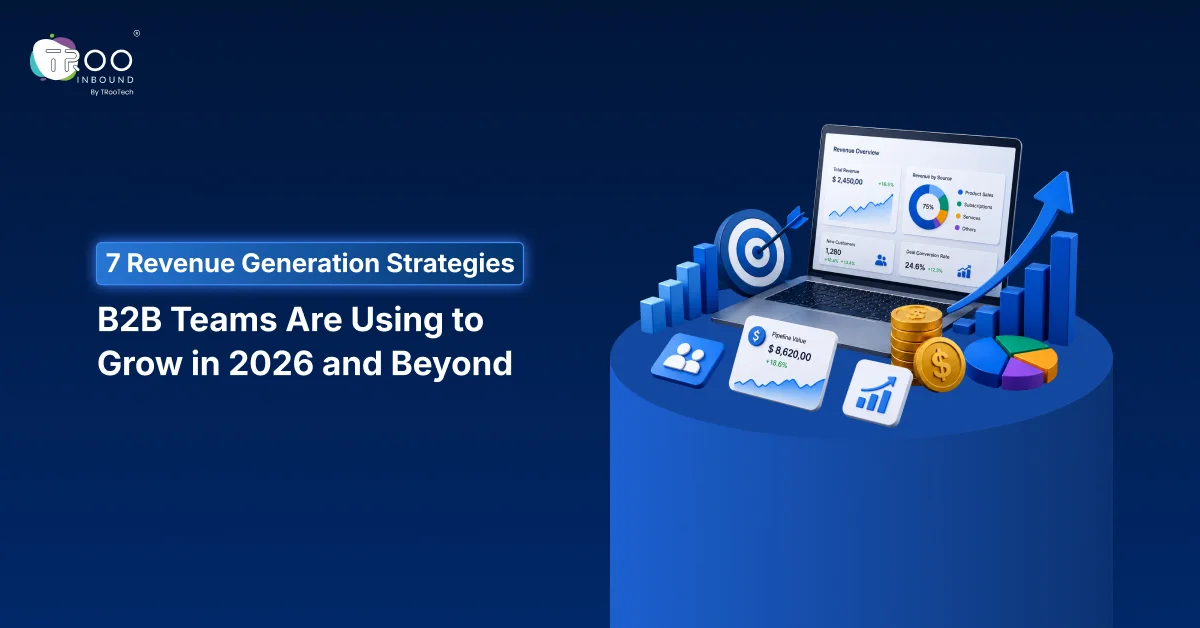
In this guide, we’ll explore seven proven revenue generation strategies that modern B2B companies use to attract qualified prospects, accelerate pipeline growth, improve conversion rates, and generate sustainable revenue.
What is Revenue in B2B terms?
In B2B (Business-to-Business) terms, revenue is the total income a company generates from selling its products or services to other businesses, prior to deducting any expenses. It is also known as top-line income that is used to evaluate a company’s market size, sales growth, and overall scale.
What is Revenue Generation in B2B Business?
Revenue generation in B2B is the holistic, cross-functional process of turning market interest into sustained income. Unlike simple B2B sales, it connects marketing, sales, product development, and customer success into a single aligned system.
As Business-to-Business (B2B) transactions involve longer sales cycles, larger deal sizes, and multiple decision-makers, revenue generation breaks down into three key pillars:
- New Revenue (Acquisition): Attracting and closing brand-new accounts through demand generation, outbound sales, and strategic proposals.
- Expansion Revenue: Generating more income from existing clients through cross-selling, upselling, and contract tier upgrades.
- Renewal/Recovered Revenue: Securing recurring income through contract renewals and successfully bringing back churned accounts.
This can be achieved by implementing different B2B revenue models that suit your requirements, such as:
- SaaS/Subscription – helps to generate recurring revenue
- Enterprise / Contractual – high-value custom contracts negotiated for long-term services
- Pay-as-you-go – billing based on the exact amount of resources used by the business client
- Professional Services – project-based fees or hourly retainers for specialized work
Who Is Responsible for B2B Revenue Generation?
Modern B2B frameworks depend on the close alignment of multiple departments, such as:
- Marketing: Generates high-intent leads and builds brand trust.
- Sales: Orchestrates product demos, manages negotiations, and closes deals.
- Customer Success (CS): Ensures client adoption, drives satisfaction, and unlocks expansion opportunities.
- Revenue Operations (RevOps): Connects the technology, data, and processes across all departments to remove silos.
These teams together implement different trending or strategically built revenue generation strategies to grow the overall revenue of the enterprise. Now let’s explore seven of such proven strategies that B2B teams are using for revenue growth in this AI era.
The 7 Revenue Generation Strategies B2B Teams Rely On
Here are the seven plays, starting with the most targeted demand-side strategies and ending with the operating system that ties them together.
1. Build Account-Based Marketing (ABM) Around High-Value Accounts
In B2B, not all opportunities carry the same revenue potential. And treating every prospect equally is the biggest mistake sales reps make. That’s where ABM enters.
Account-based marketing focuses your marketing and sales efforts on a defined set of high-value accounts instead of a broad audience. Each target account gets personalized, multi-channel attention, and marketing and sales work the list together. This approach works because it concentrates resources where conversion is most likely to happen.
An effective ABM strategy typically includes:
Defining target accounts
- Identifying key stakeholders
- Creating personalised messaging
- Running coordinated campaigns across multiple channels
- Aligning marketing and sales activities
The most successful ABM strategies combine LinkedIn outreach, targeted advertising, personalised content, email sequences, and direct sales engagement.
According to CoinLaw reports, 72% of B2B companies now use some form of ABM strategy. This shows the increasing adoption of targeted marketing to achieve predictable revenue outcomes.
Here’s where having a reliable ABM service provider can help improve revenue generation for your business. They help you define the target account list inside HubSpot or Salesforce, then build account personas, tailored messaging, and coordinated campaigns across email, LinkedIn, and paid media, with every touch tracked and attributed.
2. Invest In Content Marketing, SEO, AEO And GEO
Content marketing and SEO attract prospects by publishing useful, optimized material such as blogs, guides, and videos that answer real buyer questions. The discipline now extends into Answer Engine Optimization (AEO) and Generative Engine Optimization (GEO), which shape how your content shows up inside AI-driven search and answer tools.
Potential buyers search for answers, compare solutions, read reviews, consume content, and evaluate vendors independently. If your business isn’t visible during that research phase, you’re missing valuable revenue opportunities. So, optimizing for all LLMs along with SERPs has also become inevitable.
You can read 9 LLM SEO best practices that can help you optimize your content for visibility over LLMs and AI search engines like ChatGPT, Claude, Llama, Gemini, etc.
Combining these techniques with strategic SEO services and content marketing will make your content a long-term asset that continuously generates qualified leads.
But before partnering with SEO experts, make sure they also have hands-on experience with AEO and GEO so they can help you create content on question-based, intent-rich topics, so that answer engines can read your pages, and track organic traffic, keyword rankings, and content-sourced pipeline.
3. Create an Outbound and Multi-Channel Outreach
Inbound marketing attracts prospects who are actively searching for solutions, while outbound marketing helps you reach buyers who may not yet be looking.
Structured outbound marketing means proactive prospecting through coordinated outreach across email, phone, and social channels. It can target named accounts, which overlap with ABM, or broader segments that fit your ideal customer profile.
Outbound marketing works even today because intent data and better targeting tools have replaced spray-and-pray volume. A coordinated mix of email, calls, LinkedIn touches, and retargeting lifts reply rates and pipeline far more than any single channel on its own, and LinkedIn in particular has become a primary source of B2B pipeline.
To create the most effective outbound strategy, reps have to focus on solving business challenges rather than just promoting their own offerings. You can take help from outbound marketing experts who can help you in & out here.
They will help you define target lists, build email, call, and LinkedIn playbooks, configure cadences, hand over qualified leads to sales with full tracking, and many more services to help you easily create, manage, and trace your revenue generation from outbound.
4. Use Paid Ads (PPC) To Accelerate Pipeline Growth
Pay-per-click (PPC) advertising is one of the fastest ways to generate qualified leads and create pipeline opportunities. By using channels such as Google Ads, Meta Ads, and remarketing campaigns, businesses can put their offers in front of potential buyers at the right time.
Search ads help you reach people actively looking for solutions, while social advertising allows you to target specific audiences based on factors such as job role, company size, industry, and interests. This ability to connect with high-intent prospects makes PPC one of the most effective revenue generation strategies for businesses looking to accelerate growth.
The real advantage of PPC is speed. Unlike organic channels that often take time to gain traction, paid campaigns can drive visibility, website traffic, and lead generation almost immediately. With the right targeting and optimisation, paid media can become a significant revenue driver. For example, we helped a trampoline park client improve event booking conversions through strategic Google Ads management.
If you need expert support, our PPC management services can help you build, optimise, and scale campaigns that generate qualified leads and measurable business outcomes. Start with a controlled budget, identify the campaigns generating the best return, and then scale accordingly.
5. Turn Social Media Marketing into a Revenue Channel
Many B2B companies still view social media primarily as a branding channel. The reality is very different. Social platforms, particularly LinkedIn and Reddit, have become important research and decision-making channels where buyers evaluate vendors, seek peer recommendations, and consume industry insights.
Recent data from Semrush shows that Reddit and LinkedIn are among the most frequently cited domains in leading AI search platforms, highlighting the growing influence of social content in how people discover and validate information.

Businesses that consistently share valuable insights and engage with their audience can turn social media into a meaningful source of leads, opportunities, and revenue.
To maximize results, focus on the platforms where your audience is most active, create content tailored to each stage of the buying journey, and encourage meaningful interactions rather than simply chasing impressions.
Businesses looking to scale their efforts can benefit from professional social media marketing services that combine content strategy, audience engagement, and performance tracking to turn social channels into measurable revenue drivers.
6. Build Automated Email Marketing & Lead Nurturing Programs
Email marketing remains one of the most effective revenue generating strategies that maintains engagement throughout the buyer journey.
It covers sending targeted campaigns to prospects and customers, including newsletters, automated nurture sequences, and event or webinar invitations. It works for both opt-in inbound lists and permission-based outbound.
On top of that, automated workflows can deliver the right message at the right stage of the buyer journey, reducing manual effort while creating a more personalized experience for each contact. But all this works when marketing automation is set up well according to pre-defined mechanics, like:
- Segmenting your list by persona and funnel stage
- Pair each segment with the right content offer
- Run drip sequences of three to five emails, which will outperform occasional one-off sends
Enterprises looking to scale these efforts can benefit from professional email marketing services that combine strategy, automation, personalization, and reporting to turn email into a consistent source of pipeline growth and customer retention.
7. Align Teams Through RevOps
If there is one way that ties all the above revenue generation strategies together, then it is Revenue Operations (RevOps).
RevOps is a business strategy that aligns marketing, sales, customer success, processes, data, and technology around a shared revenue goal. Instead of operating in silos, teams work from the same data, follow consistent processes, and measure success using common metrics.
The importance of implementing RevOps grows as a business scales, and the tech stack becomes more complex. It keeps CRM, teams, processes, and everything aligned with each other, maintaining good CRM data health. Because without clean data, clear ownership, and aligned processes, even the best SEO, paid advertising, social media, and email marketing campaigns can lose opportunities between teams.
Organizations looking to improve operational efficiency and maximize revenue performance can benefit from a structured Revenue Operations service that aligns people, processes, and technology around measurable business outcomes.
Estimated Time of Impact and Industry Use Cases of Each Revenue Generation Strategy
| Strategy | Typical Use Case | Time to Impact | Best for Industries |
|---|---|---|---|
| Account-Based Marketing (ABM) | Landing large, strategic accounts; upselling key clients | 6–12 months | Enterprise/SaaS, Tech, Finance |
| Content Marketing & SEO (AEO/GEO) | Building organic pipeline, thought leadership | 6–12+ months (compounding) | All B2B sectors (e.g. Software, Manufacturing) |
| Outbound Multi-Channel | New market entry; consistent meeting booking | 1–3 months | Tech/Services, Industrial |
| Paid Ads (PPC) | Quick lead spikes; product launches, short cycles | Weeks to 1-2 months | Tech, Healthcare, Consumer Tech |
| Social Media & Social Selling | Brand building; nurturing passive leads; cross-sell | 3–6 months | Professional services, IT, HR |
| Email Marketing & Nurturing | Lead qualification; customer retention | 1–3 months | All (especially SaaS, B2B) |
| Revenue Operations (RevOps) | Scaling growth sustainably; improving forecast accuracy | 3–9 months (foundation) + continuous | Mid-to-large B2B, SaaS, Enterprise |
How to Choose the Right Revenue Generation Strategies?
You do not need all seven strategies at once. The teams that grow efficiently pick three to four plays that match their stage, budget, and sales cycle, instrument every one of them, then expand where pipeline velocity is highest.
A sensible sequence starts with the foundation. Get RevOps, clean data, and your highest-intent channels working first, since they make everything else more efficient. Build outward from there into new channels and segments rather than switching everything on at once.
Match the play to the motion. ABM and outbound suit high-value, named-account selling. Content, SEO, AEO, and GEO compound over time and suit longer buying cycles. PPC and email give you faster feedback and steady nurture. Social supports all of them by building trust and visibility.
If you are not sure where your revenue is leaking, explore our revenue generation solutions to find the gaps and prioritize the fixes.
Turn These Strategies Into a Predictable Revenue Engine
No single strategy will drive sustainable growth on its own. The strongest revenue engines combine multiple channels and initiatives that work together, supported by aligned teams, reliable data, and consistent execution.
Start with the revenue generation strategies that best fit your business goals, measure what works, and refine as you grow. Over time, these efforts can create a more predictable pipeline and a stronger foundation for long-term revenue growth.
If you’re looking to strengthen your revenue strategy, focus on identifying gaps, improving alignment, and investing in the channels that deliver the greatest impact.
Talk to TRooInbound to audit your revenue engine and seal the gaps.