
Marketing software used to wait for your instructions to perform the next move. You built a workflow, set the triggers, and the software followed the rules you gave it. But Agentic marketing changes that relationship. Instead of waiting to be told what to do, AI agents now plan a task, make decisions, and carry the work through to a finished result.
This is the core idea, and it is fast becoming the foundation of next-gen marketing. The shift matters because it moves AI from a helpful assistant to an active operator inside the marketing team. The work still belongs to people. The repetitive execution is what changes hands.
In this blog, we will understand more about Agentic Marketing and its impact on current marketing scenarios.
What Is Agentic Marketing?

Agentic marketing means the digital marketing process that uses autonomous AI agents to plan, execute, and optimize campaigns with limited human input. Instead of just following rigid, pre-set rules like traditional automation, these AI systems take independent action like interpreting data, creating content, and adjusting to customer behavior in real time while operating within human-defined guardrails.
The difference between earlier AI and today’s AI is the level of independence. A chatbot answers a prompt, while an agent takes your goal into consideration and works out the audience, the message, the timing, and the follow-up on its own. However, humans are still important to set the strategy and approve the moments that matter, and the agents handle the work in between.
In short, AI agents in agentic marketing will think of a marketing task in layers:
- The bottom layer is data, a unified record of who the customer is and what they have done.
- The middle layer is reasoning, where the agent interprets a goal and plans the steps.
- The top layer is action, where the agent uses real tools to send a message, update a list, or adjust a journey.
Older AI mostly stopped at the middle layer and handed a suggestion back to a human. An agent closes the loop and acts, within the limits the team has set.
Is Agentic Marketing and Marketing Automation The Same?
No, they are fundamentally different. Marketing automation follows fixed, human-built rules (e.g., if/then branches), whereas Agentic marketing uses AI agents that set their own strategies and autonomously adapt to achieve a desired outcome.
Marketing automation has been around for years, and it runs on fixed rules. If a contact opens an email, send the next one. If a form is submitted, add the lead to a list. These flows are useful, but they are rigid. They cannot adapt when the situation changes.
Agentic marketing replaces rigid rules with reasoning. The agent reads live signals such as browsing activity, purchase history, and engagement timing, then decides what to do next. This moves teams away from scheduled batch sends toward continuous, behaviour-driven responses.
What AI Agents Actually Do in a Marketing Workflow
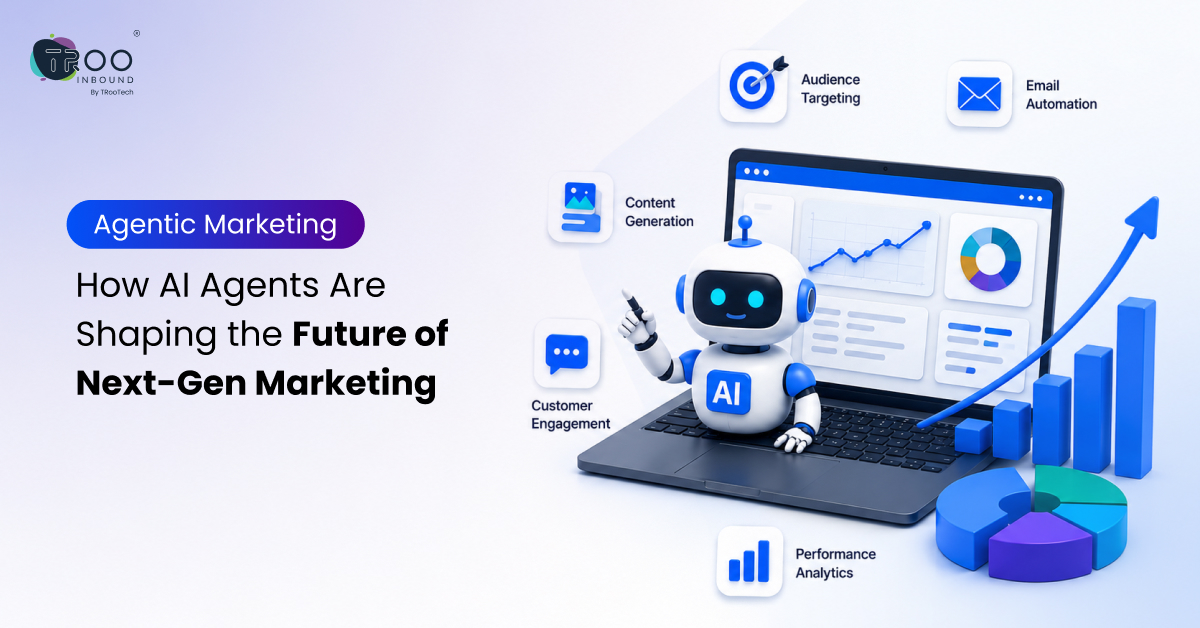
This is easier to picture through concrete tasks. Inside a modern Marketing Cloud setup, agents can take on work like this:
- Generate a campaign brief from a stated goal and draft the first version for review.
- Select and refine the right audience using unified customer data.
- Write and personalise email, SMS, and ad copy at scale.
- Trigger journey actions based on live behaviour, such as a cart left untouched.
- Optimise send times and creative while a campaign is still running.
- Monitor performance and flag the moments that need a human decision.
The pattern is consistent. Agents absorb the repetitive, time-heavy work, while marketers keep control of strategy, creativity, and judgement. Used well, this frees a small team to operate at a scale that used to need a much larger one.
Why Agentic Marketing Is the Engine of Next-Gen Marketing

The momentum behind agentic marketing is hard to ignore. Research from Gartner reported that 60% of brands will use agentic AI to deliver personalised, one-to-one customer interactions by 2028. Gartner went further and described the change as the end of channel-based marketing as we know it.
That phrase is worth sitting with. For decades, marketing was organised by channel: one team owned email, another owned social, another owned the website. But AI agents break down those walls. A single agent can operate across email, web, and messaging at once, guided by one shared view of the customer. This is what makes next-gen marketing feel less like a series of separate campaigns and more like one ongoing conversation.
The bigger change is in how marketing teams actually operate. Channel-based teams measure success one channel at a time. They track the open rate or click rate on a single email or post. An agentic approach measures something different: the result for the customer across every interaction, not the performance of any one message.
Making that switch means rethinking the tech stack, the data behind it, and the metrics teams report on. It is a real shift in mindset, and that is part of why adoption is still uneven even as more teams want to adopt it.
How Salesforce Agentforce Marketing (Formerly Marketing Cloud) Can Help With Agentic Marketing
No company has pushed this idea harder than Salesforce. In June 2025, it renamed Salesforce Marketing Cloud to Agentforce Marketing, a signal that AI agents now sit at the centre of the platform rather than at the edges. The name change reflected a deeper rebuild, not just a fresh coat of paint.
Salesforce rebuilt the Marketing Cloud around real-time data and autonomous action. Here are its key features:
- Data 360, the unified data layer, gives agents a single and current view of each customer.
- Campaign Optimizer can analyse, generate, personalise, and improve campaigns against a stated business goal.
- Two-way email and SMS let customers ask questions and get answers based on their actual history.
- A Brand Center keeps voice and guidelines consistent across everything an agent produces.
The value of this stack depends on clean data and careful setup, not on the software alone. Specialist Salesforce Marketing Cloud services help teams configure the data layer, the agents, and the guardrails so the platform actually delivers on its promise rather than producing confident noise.
A real example shows the scope:
At its Connections 2026 event, Salesforce demonstrated a team of around 1,000 marketers using agents to plan and launch campaigns for 35,000 fans. The agents segmented by geography, drafted personalised emails and SMS, and optimised in real time once the campaigns went live.
In short, the agents handled briefing, asset creation, and performance monitoring, and the people handled the decisions and the fine-tuning. That balance, machines on execution and humans on judgement, is the practical shape of the model today.
How Does Agentic Marketing Affect Digital Marketing Teams?
Agentic marketing fundamentally shifts digital marketing teams from manual executors to strategic conductors.
When agents handle the execution, the team’s job changes. The most valuable work becomes thinking, planning, and creating. People still set the goals the agent works toward. They still decide what the agent is and is not allowed to do. They still check whether its output is actually good. And someone still has to own the brand voice, so the agent sounds right everywhere it shows up.
The work that shrinks is manual production: building each send by hand, pulling lists one at a time, and stitching reports together every week. In practice, this approach rewards teams that are senior, curious, and comfortable directing AI rather than competing with it.
The Honest Risks to Plan For Before Adopting Agentic Marketing
Agentic marketing is promising, but it is not a switch you simply flip. Gartner has warned that more than 40% of agentic AI projects could be cancelled by 2027, with unclear value, weak data, and rising costs as the main reasons. The technology rarely fails on its own. It fails when the groundwork is missing.
Here are the most common issues that come up again and again if the foundation is weak:
- The first is data: An agent acting on incomplete or messy data will produce outputs that sound confident but are wrong, and that erodes customer trust quickly. According to Lyro’s AI in E-Commerce 2026 report, 28% of consumers have already stopped buying from a brand because of its AI.
- The second is governance: Without clear rules, an agent can drift away from brand voice in messages that customers actually see.
- The third is scope: Open-ended automation tends to disappoint, while tightly scoped and measurable tasks tend to succeed.
The teams that get real value treat data quality and governance as the starting point, not an afterthought.
How to Start With Agentic Marketing
A sensible rollout looks less like a leap and more like a series of small, deliberate steps.
- Start with the data foundation. Unified and accurate customer data is what lets an agent make good decisions. Getting the underlying platform and data layer in order through Salesforce Cloud Services is usually the first job, well before any agent goes live.
- Pick one scoped pilot. A welcome journey or a cart recovery flow makes a strong first impression because success is easy to measure. Prove it works, then expand from there.
- Set governance early. Decide where humans approve, how brand voice is protected, and what the agent is simply not allowed to do. These guardrails are what keep autonomy safe.
- Build the skills around it. The platform is only part of the answer. The right Salesforce Services partner can shorten the setup, while broader Digital Marketing Services keep strategy, content, and channels aligned as the agents run the execution.
Teams can also hire digital marketing experts to lead the work and bring the agentic layer online faster.
The Bottom Line
Agentic marketing is not a passing trend. It is a structural change in how marketing gets done, and platforms like Agentforce Marketing show where the major vendors are heading. The brands that act early, with clean data and clear guardrails, will set the pace for next-gen marketing. The ones that wait will spend the next few years reacting to it. At TRooInbound, the focus is on helping teams adopt these capabilities in a way that is measured, governed, and tied to real outcomes rather than hype.
If you are weighing up where agentic marketing could fit into your own strategy, it is worth starting that conversation early.
FAQs
Read Popular Questions
How is agentic marketing different from marketing automation?
Marketing automation follows fixed rules, while agentic marketing makes its own decisions. Automation runs preset “if this, then that” flows, such as sending a follow-up when an email is opened. An AI agent instead reads live signals like browsing behaviour and purchase history, then chooses the audience, message, and timing on its own. The result is a shift from scheduled batch sends to continuous, behaviour-driven responses.
How many brands will use agentic AI for marketing?
Gartner forecasts that two-thirds of brands will use agentic AI to deliver personalised, one-to-one customer interactions by 2028. In the same January 2026 research, Gartner described the change as the end of channel-based marketing, where brands move from managing separate email, web, and social channels to using agents that work continuously across all of them. (Source: Gartner)
What is Salesforce Agentforce Marketing?
Agentforce Marketing is the renamed and rebuilt version of Salesforce Marketing Cloud, introduced as part of Salesforce’s 2025 shift to an AI-agent-first platform. It pairs autonomous agents with Data 360, a unified real-time data layer, and tools like Campaign Optimizer and a Brand Center that keeps voice consistent. The rebrand signalled that AI agents now sit at the centre of the Marketing Cloud rather than at the edges.
What are the biggest risks of agentic marketing?
The main risks are poor data, weak governance, and projects scoped too broadly. Gartner has warned that more than 40 percent of agentic AI projects could be cancelled by 2027, often because the groundwork was missing rather than the technology failing. Agents acting on incomplete data can produce confident but wrong outputs, and without clear rules, they can drift from the brand voice in customer-facing messages.
What does a business need before starting with agentic marketing?
A business needs unified, accurate customer data, a tightly scoped first use case, and clear governance rules. Agents make good decisions only when they can see a complete and current view of the customer, which is why the data foundation comes first. Teams that succeed usually start with one measurable pilot, such as a welcome journey or cart recovery, and define where humans approve before expanding.