
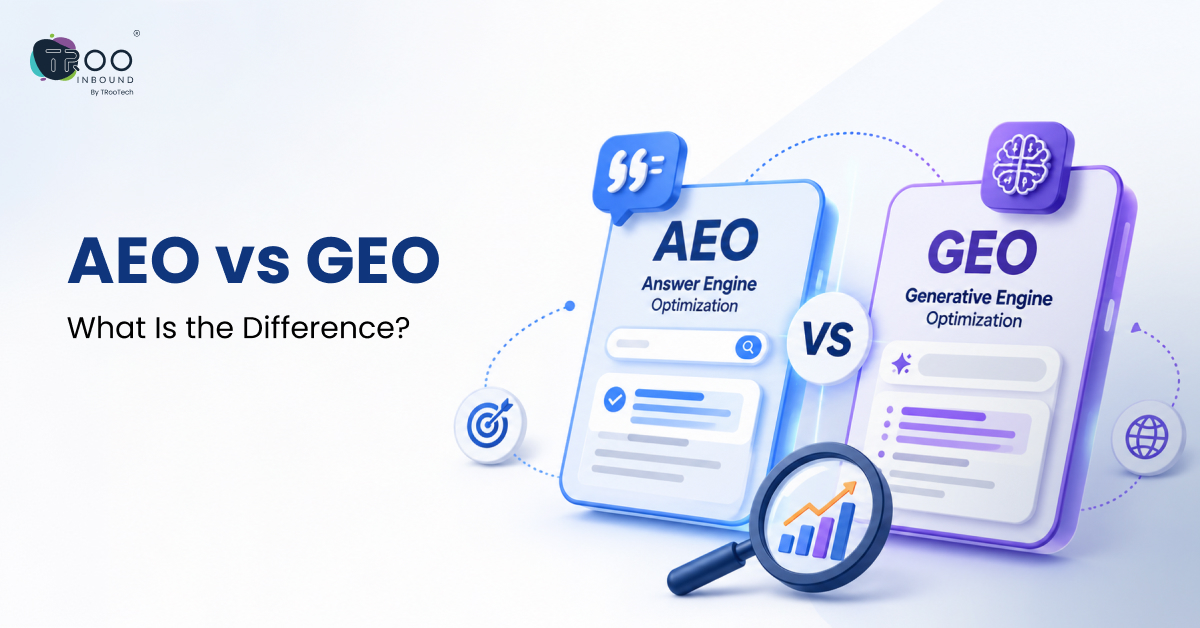
AEO means optimizing content to win specific “answer boxes” like featured snippets, AI overview, and voice search snippets. Meanwhile, GEO means optimizing content to get cited and recommended by AI chatbots like ChatGPT, Claude, etc., in conversational replies.
This is the primary difference between the two SEO-extended strategies for earning AI visibility for your brand. With the changing search behavior, the majority of people no longer search for keywords and scan the first ten links for an answer. Instead, they either find solutions from the Google AI overview or AI assistants like Gemini, ChatGPT, etc.
Due to this shift, Answer Engine Optimization (AEO) and Generative Engine Optimization (GEO) have emerged. However, due to an almost similar goal, getting visibility on AI platforms, these two terms overlap and are used interchangeably. But they are different.
Beyond the primary difference, there are other factors as well that we’ll learn about ahead in the blog that make AEO and GEO different from each other. Let’s explore AEO vs GEO further, along with other verticals, like when to use which and why modern businesses are using both together to stay visible over LLMs and AI tools.
What Is AEO?

AEO is the practice of optimizing and structuring your content so that search engines like Google feature snippets, people also ask boxes, voice assistants like Siri, Alexa, and Google AI Overviews can extract and present it as a direct answer to users’ queries.
AEO is built on a simple assumption: users want an immediate, concise answer, not a reading list. So the discipline focuses on making individual answers easy to find, easy to extract, and easy to trust.
Typical AEO work includes:
- Framing headings as real questions people ask, then answering them in the first one or two sentences below
- Adding FAQ sections that address related queries on the same page
Using structured data (FAQ, HowTo, Article, Organization schema) so machines can parse the page - Writing short, self-contained answer blocks of roughly 40 to 60 words that can be lifted cleanly
- Keeping content factually precise, current, and attributed
In short, what is AEO? It is the practice of making your content the answer, and not just a result hidden inside the blue link.
Partnering with an expert AEO services provider will definitely help if you want to a strategic, result-oriented, and well-implemented AEO strategy to improve your content’s AI presence.
What is GEO?

GEO is the practice of improving your content so that AI-powered search tools and chatbots like ChatGPT, Perplexity, Gemini, Claude, etc. can easily discover, summarize, and cite it in their responses. It helps to improve the overall brand’s visibility inside AI-generated responses.
So what is GEO really optimizing for? It’s for citations and mentions. Its goal is that when an AI tool composes an answer about your category, your brand is one of the sources it draws information from.
GEO work typically includes:
- Building entity authority so AI models associate your brand with your topic
- Publishing original data, statistics, expert quotes, and research that AI systems prefer to cite
- Earning third-party coverage, reviews, and mentions, since a large share of AI citations come from earned media rather than brand-owned pages
- Keeping content fresh, because recently updated pages earn citations at a much higher rate
- Ensuring AI crawlers such as GPTBot and ClaudeBot can access and index your site
In short, what is GEO? It is the practice of making your brand a trusted source that AI engines cite and that search engines crawl.
Partnering with an expert GEO services provider will definitely help if you want a strategic, result-oriented, and well-implemented GEO strategy to improve your brand’s visibility in AI-generated answers.
AEO vs GEO: The Main Difference
The main distinction between AEO and GEO is: AEO optimizes content to be extracted as a direct answer. GEO optimizes a brand to be cited within a synthesized, AI-generated response.
For in-depth analysis, here’s the side-by-side view that makes the answer engine optimization vs generative engine optimization comparison clearer:
| Aspect | AEO (Answer Engine Optimization) | GEO (Generative Engine Optimization) |
|---|---|---|
| Primary goal | Get selected as the direct answer | Get cited or mentioned in AI-generated responses |
| Target platforms | Featured snippets, People Also Ask, voice assistants, AI answer boxes | ChatGPT, Gemini, Claude, Perplexity, Google AI Mode and AI Overviews |
| Level of focus | Page and answer level | Brand and entity level |
| Core tactics | Question-based headings, concise answer blocks, FAQ schema, structured data | Original data, expert quotes, earned media, entity authority, content freshness |
| Success metric | Answer placements and snippet wins | AI citations, brand mentions, share of voice in AI answers |
| Nearest ancestor | On-page SEO | Digital PR and authority building |
As the end goal is almost common – getting visibility on AI, people still confuse over the question: Are AEO and GEO the same?
The answer is: No, they are not the same, but they overlap heavily. Some practitioners treat GEO as the generative-AI subset of AEO. Others treat AEO as the extraction-focused subset of GEO.
In day-to-day work, the debate matters less than it seems, because most of what you do for one also serves the other, meaning a clear, well-structured, well-attributed answer is both easier to extract and easier to cite.
AEO vs GEO vs SEO: How the Three Fit Together
Neither AEO nor GEO replaces Search Engine Optimization (SEO). Think of them as three layers of the same visibility system for business websites.
SEO earns your place in the index. Search engines and AI systems alike still rely on crawlable, indexable, technically healthy websites with genuinely useful content. Research on Google AI Overviews shows that around three-quarters of cited URLs also rank in the top ten organic results, so ranking still feeds citation.
AEO earns your place in the answer. Once your content ranks and gets crawled, an answer-friendly structure determines whether machines can actually lift your explanation and present it.
GEO earns your place in the conversation. When a generative engine composes a response from multiple sources, authority signals, original data, and third-party mentions determine whether your brand gets named at all.
So, is GEO replacing SEO? No. Is AEO better than traditional SEO? No. Both are extensions of SEO for an AI-first search landscape, and they collapse without strong SEO fundamentals underneath.
If your site doesn’t follow primary SEO best practices, this is the right time to partner with an SEO services provider who will help you build a strong base to further implement AEO and GEO easily.
How to Implement AEO & GEO Together: A 6-Step Practical Playbook
Here is how AEO and GEO help with AI search visibility when applied together. These steps cover how to optimize content for answer engines and generative AI without splitting your team into two separate programs:
1. Start every key section with the answer
Use question-based H2s and H3s that mirror real queries, then answer the question directly in the first sentence or two. Research on AI citations shows that a large share of cited passages come from the first third of a page, so front-load your best answers instead of burying them.
2. Add structured data that matches visible content
Implement FAQ, Article, HowTo, and Organization schema. Structured data helps both classic answer engines and AI crawlers understand what your page claims and who is claiming it. Keep the markup honest: it must match what a human sees on the page.
3. Publish statistics, expert quotes, and original data
This is the highest-leverage GEO tactic, validated by the Princeton study. Generative engines prefer sources that give them something concrete to cite. Original benchmarks, survey data, named expert commentary, and clearly attributed statistics all raise your citation odds.
4. Build entity and off-site authority
Analyses of AI citations consistently show that most come from earned media and third-party sources rather than brand-owned pages. Digital PR, guest contributions, industry directories, review platforms, and consistent brand information across the web all strengthen the entity signals AI models rely on.
5. Keep content fresh and technically accessible
Recently updated content earns citations at a significantly higher rate than stale content. Refresh your cornerstone pages on a schedule. On the technical side, make sure your robots.txt does not block AI crawlers you actually want, your pages load fast, and your content is readable without heavy JavaScript rendering.
6. Cover topics in clusters, not one-off posts
AI systems reward topical depth. A cluster of interlinked pages covering a subject from every angle signals authority far better than a single long post. This is also where an AEO and GEO strategy for content marketing pays off, because each cluster page can target its own question set while reinforcing the same entity.
How to Measure AEO and GEO Performance
Traditional rank tracking does not capture AI visibility, so extend your measurement stack:
- Track answer placements: featured snippets, People Also Ask wins, and AI Overview inclusions for your priority queries
- Monitor AI citations and brand mentions by running your key buyer questions through ChatGPT, Gemini, Perplexity, and Claude on a recurring schedule, or by using an AI visibility tracking tool
- Watch AI referral traffic in analytics, and remember it undercounts, since copied links and in-search AI surfaces often arrive without a clean referrer
- Measure quality, not just volume: AI-referred visitors tend to spend more time on site and convert at higher rates, so track engagement and conversions from these sources separately
- Benchmark share of voice against competitors by checking which brands AI tools name for your category queries
Final Verdict: Do Businesses Need Both AEO and GEO?
Yes, and in practice, you cannot cleanly buy one without the other.
AEO without GEO gives you extractable answers that AI systems may never trust enough to cite. GEO without AEO gives you authority that AI systems struggle to quote accurately.
Therefore, the efficient move is a single program built on shared fundamentals: strong SEO hygiene, question-led content structure, original and attributable information, and sustained authority building.
That is exactly how we run AI search programs at TRooInbound. As an expert revenue growth partner of modern B2Bs and enterprises, we combine SEO, AEO, and GEO into one measurable strategy through which driving organic traffic from different channels becomes easier.
If you want to see where your brand currently stands in AI answers and what it would take to change that, book a free consultation with our team, and we will walk you through it.
FAQs
Read Popular Questions
How does AEO help content appear in AI answers?
AEO makes content easy to extract: question-based headings, direct answers in the opening sentences, concise answer blocks, FAQ sections, and structured data all help machines identify and lift the exact passage that answers a query.
How does GEO help brands get cited by AI tools?
GEO strengthens the signals AI systems use to decide which sources to trust: original statistics, expert quotes, earned media coverage, consistent entity information, and fresh, well-attributed content all raise the probability of citation.
How can you optimize a blog for AEO and GEO?
Use question-led headings, answer each question in the first two sentences, add an FAQ section with schema, include cited statistics and expert quotes, interlink related posts in a topic cluster, and refresh the post regularly.
What type of content works best for AEO and GEO?
Definitive explainers, comparison pages, FAQ-rich guides, original research, and data-backed thought leadership perform best. Comparison-style queries trigger AI answers at very high rates, which makes well-structured versus-style content especially valuable.
Does TRooInbound offer both services? AEO and GEO?
Yes, TRooInbound offers complete ranking and AI visibility services from SEO to AEO and GEO. You can connect with our team to discuss your brand visibility requirements, and we will be happy to guide you through the process of what will work best for improving your digital presence.