
A HubSpot Agency helps businesses set up, manage, customize, and grow their revenue using HubSpot. Additionally, they also help build websites, run workflow automation, run campaigns, and align teams to drive HubSpot-powered RevOps and customer retention.
If you have made a decision to invest in and set up HubSpot, hiring an experienced HubSpot agency becomes essential to give your business specialized technical expertise for smoother implementation and a faster return on investment.
TL;DR:
- A HubSpot agency helps businesses plan, implement, customize, integrate, and optimize HubSpot around their actual processes.
- Its work can include CRM setup, data migration, automation, integrations, reporting, training, and ongoing portal support.
- A good agency first understands your sales, marketing, service, data, and team requirements before configuring HubSpot.
- Hiring a HubSpot agency is especially useful when your setup involves multiple teams, complex data, CRM migration, advanced automation, or custom integrations.
- The right HubSpot partner helps reduce implementation risks, improve user adoption, and make the platform easier to manage as your business grows.
What Is a HubSpot Agency?
A HubSpot agency is a service company that helps businesses use HubSpot to support their marketing, sales, service, CRM, and revenue operations.
These agencies are typically part of the HubSpot Solutions Partner Program, which means HubSpot has reviewed their team, certified their skills, and ranked them by client results.
Partners sit in tiers: Gold, Platinum, Diamond, and Elite. A higher tier usually signals more hands-on experience across bigger, more complex accounts. You can check any agency’s tier and reviews directly on the HubSpot Solutions Directory before you decide to work with them.
What Does a HubSpot Agency Actually Do?

Different HubSpot agencies offer different services. Some agencies focus on one area, such as HubSpot website development or marketing automation. Others provide broader services that cover strategy, implementation, integrations, migration, training, and ongoing support.
The exact work a HubSpot Agency will do for you will depend on your business, HubSpot subscription, current setup, and goals.
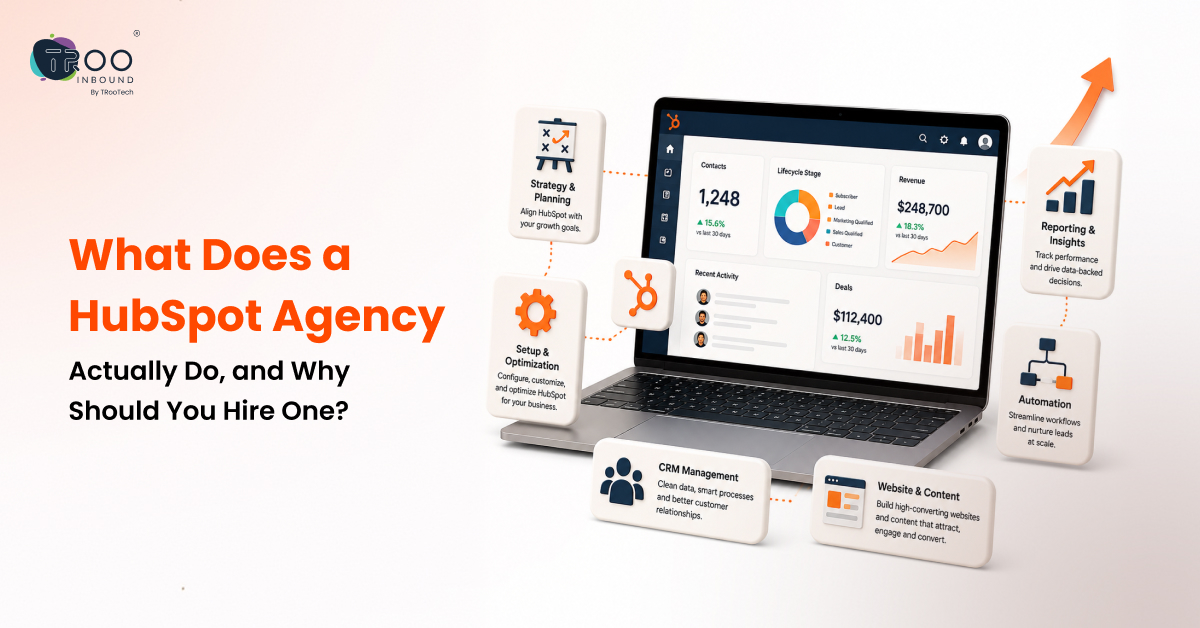
Here are the end-to-end HubSpot services that a reliable HubSpot agency offers:
- Onboarding and initial setup: HubSpot onboarding covers account structure, user permissions, custom properties, and getting Marketing Hub, Sales Hub, Service Hub, or CMS Hub configured to match how your team actually sells and supports customers.
- CRM and website migration: If you are moving from Salesforce, Zoho, Pipedrive, or a legacy system, an agency maps your old data to HubSpot’s structure, cleans up duplicates, and rebuilds your website on HubSpot’s CMS without losing your SEO rankings.
- Workflow automation: Lead routing, lifecycle stage updates, internal notifications, follow-up sequences. Agencies build these workflows so your team spends less time on manual, repetitive tasks.
- RevOps alignment: This is the part most businesses underestimate. A HubSpot agency looks at how marketing, sales, and customer success hand off leads and information, then fixes the gaps so revenue does not leak between teams.
- Integrations: Connecting HubSpot to your ERP, billing system, help desk, or other software so data flows in one direction instead of living in five different spreadsheets.
- Inbound, Outbound marketing and content: SEO, blog content, landing pages, email campaigns, and increasingly, AEO and GEO work to help your content show up in AI-generated answers, not just search results.
- Reporting and dashboards: Building custom reports that answer real business questions, like which channel drives the most closed revenue, not just traffic.
- Training and ongoing support: Teaching your team to use what has been built, then coming back to fix, refine, and expand it as your business grows.
That is a wide range which raises a fair question: should you bring in an agency, build this in-house, or hand it to a freelancer? Which one is right and more cost-efficient?
HubSpot Agency vs. In-House Team vs. Freelancer: Which One Is Right For Your Business?
There is no universally “right” option here. A freelancer can be a great fit for a small landing page. An in-house hire makes sense once your HubSpot needs are large and constant. A HubSpot agency tends to win when you need a full range of skills, fast turnaround, or ongoing optimization without adding headcount.
| Factors | HubSpot Agency | In-House Hire | Freelancer |
|---|---|---|---|
| Skill coverage | Full team: strategy, dev, content, RevOps | Depends on one or two people | Usually one specialty |
| Cost structure | Project or retainer fee | Salary, benefits, training time | Hourly or per project |
| Speed to launch | Fast, team works in parallel | Slower, hiring and ramp-up time | Depends on availability |
| Cost-effectiveness | High for the scope of work: no salary, benefits, or hiring overhead | Lower per-task cost only once volume is high and steady | Cheap upfront, but costs add up across multiple specialists |
| Best for | Ongoing growth and complex builds | Companies with steady, predictable HubSpot needs | Small, one-off tasks |
Why Hire a HubSpot Agency? The Real Benefits
The main reason to hire a HubSpot agency is simple: you want HubSpot to support your business without having to figure out everything yourself.
- You avoid expensive setup mistakes: A poorly configured CRM causes bad data, broken reports, and workflows that fire on the wrong contacts. Fixing this later costs more time and money than doing it right the first time.
- You get a full team, not one generalist: Instead of one person trying to handle strategy, development, content, and reporting, you get specialists in each area working together.
- You move faster: Agencies have already solved most of the problems your business is facing. That experience shortens your timeline significantly.
- You get ongoing optimization, not a one-time setup: HubSpot changes constantly, and so does your business. A good agency keeps refining your setup instead of walking away after launch.
- You get RevOps support built in: If your CRM is not driving the revenue results it should, an agency looks at the whole revenue engine, not just the software, to find where growth is stalling.
When Should You Hire a HubSpot Agency?
Signs that show that your business needs to hire a HubSpot agency are:
1. When you are implementing HubSpot for the first time
If you are new to HubSpot, it is important to build the right foundation from the start. A HubSpot onboarding and implementation service can help you set up your CRM, configure the right Hubs, define your processes, set up automation, and prepare your team to use the platform. This can help you avoid costly changes when your business grows.
2. You are moving from another CRM
Moving from another CRM to HubSpot involves more than importing contacts. You need to map your existing data, migrate records, recreate important processes, test the new setup, and help your team adjust to the new system. HubSpot CRM migration services can manage this process and help you move your data with less disruption to your daily operations.
3. Your HubSpot portal has become difficult to manage
As your business grows, your HubSpot portal can collect unused workflows, duplicate properties, outdated pipelines, and reports that no longer support your goals. A HubSpot CRM audit can review your existing setup, identify issues, remove unnecessary elements, and recommend changes that make the portal easier to manage.
4. Your business needs complex integrations
If HubSpot needs to share data with Salesforce, Shopify, Slack, accounting software, customer support tools, or other business systems, the integration must be planned carefully. HubSpot integration services can connect your systems, define how data should move between them, and reduce the need for manual data entry.
5. Your leadership team does not trust CRM reports
When leadership cannot rely on CRM reports, the problem may start with how your data, properties, pipelines, or tracking processes are configured. HubSpot reporting and analytics services can help structure your data and create reports that give your team a clearer view of sales, marketing, service, and revenue performance.
6. Your teams do not use HubSpot consistently.
If different teams use HubSpot in different ways, your CRM data can become inconsistent, and your processes can break down. HubSpot consulting services can help align the platform with your team’s processes, improve user adoption, and show your employees how to use HubSpot correctly in their daily work.
7. You are expanding your revenue operations
As your business grows, marketing, sales, and service teams need to work from shared processes and reliable customer data. HubSpot-powered RevOps services can help connect these teams, improve handoffs, standardize processes, and build a revenue system that can support your next stage of growth.
How to Choose the Right HubSpot Agency

Before you hire any agency, check for:
- Verified tier and certifications: Look this up directly in the HubSpot Solutions Directory instead of taking it on faith. Choose a higher-tier agency as they have typically managed a much larger volume of complex accounts than an untiered provider.
- Experience with your specific hub or use case: RevOps, CMS migration, and Marketing Hub campaigns all need different expertise.
- Clear scope and pricing: A good agency tells you exactly what is included, not just a vague monthly retainer.
- Real client reviews: Read reviews on the HubSpot directory or third-party sites like Clutch or G2, not just testimonials on the agency’s own homepage.
- A plan for after launch: Ask what ongoing support looks like once the initial project ends.
For example, TRooInbound fits all these criteria and has almost a decade of experience in delivering HubSpot services that match the timely updating requirements of clients.
Why Choose TRooInbound As Your End-to-End HubSpot Agency?
TRooInbound is a HubSpot Diamond Solutions Partner that helps businesses plan, implement, migrate, integrate, and optimize HubSpot.
Our services cover onboarding, implementation and multi-hub setup, CRM and CMS migration, integrations, CRM consulting, automation, reporting, and ongoing optimization.
Our approach starts with your business requirements. We first understand your goals, processes, teams, data, and existing technology. Then we design the HubSpot structure around those requirements.
The goal is simple: build a HubSpot system that your teams can use and your business can grow with.
If you are planning a new implementation or want to improve an existing portal, talk to the TRooInbound team about your HubSpot requirements, and let us help you simplify the process afterwards.
FAQs
Read Popular Questions
What does a HubSpot agency do?
A HubSpot agency helps businesses plan, implement, customize, integrate, manage, and improve HubSpot. Its work can include CRM setup, data migration, automation, integrations, reporting, training, website development, marketing operations, and RevOps.
What is the difference between a HubSpot agency and a HubSpot consultant?
A HubSpot consultant may focus mainly on strategy and recommendations. A HubSpot agency usually has a larger team that can provide both strategy and hands-on implementation. The exact services depend on the provider. TRooInbound offers both. Get in touch with us today for structured and end-to-end HubSpot support.
Is it worth hiring a HubSpot agency instead of doing it in-house?
It depends on how much ongoing HubSpot work your business has. If your needs are constant and large, an in-house hire can make sense over time. If you need a full range of skills quickly, or your needs shift project to project, an agency is usually more cost-effective.
How much does it cost to hire a HubSpot agency?
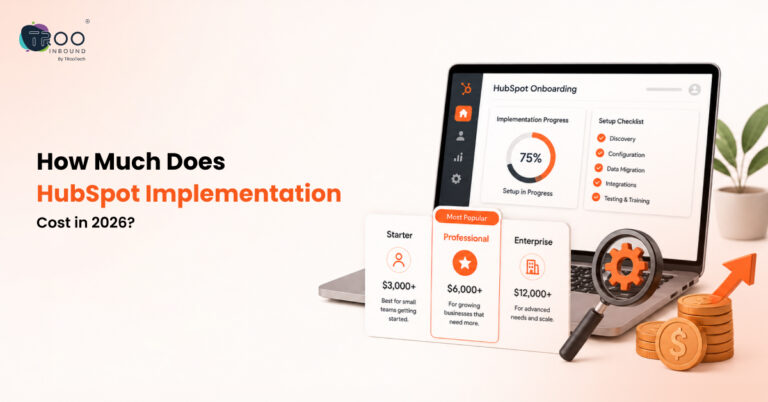
It may cost anywhere between $1,500 and $5,000 per month, minimum. However, the final cost depends on the project scope. A basic implementation costs less than a multi-Hub project with data migration, custom integrations, automation, and RevOps work. Project complexity, data volume, integrations, HubSpot subscription level, and ongoing support requirements all affect the final cost.