
For 15 years, INBOUND has been closely associated with HubSpot’s vision of inbound marketing, content, lead generation, and customer-centric growth.
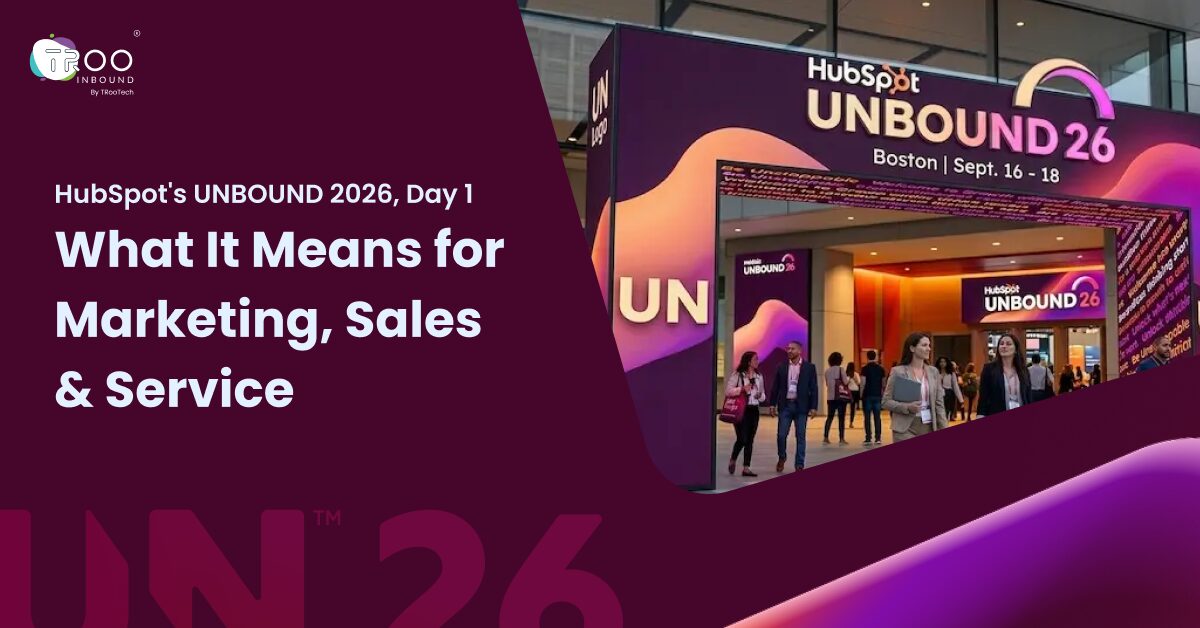
In 2026, HubSpot is expanding that vision with a new name: UNBOUND.
Taking place in Boston from September 16 to 18, UNBOUND 2026 is the first edition of HubSpot’s flagship event under its new identity. But the change is about more than the event name. It reflects how significantly HubSpot itself has evolved.
HubSpot is no longer positioning its platform around marketing alone. Its ecosystem now spans marketing, sales, service, operations, customer data, revenue, CRM, automation, and AI. The company’s latest direction is centred on bringing these functions together through an increasingly AI-powered customer platform.
That makes UNBOUND 2026 particularly important for businesses already using HubSpot or considering it as their core growth platform. The central question is no longer simply how businesses can attract more leads.
It is how HubSpot can help businesses understand customers, create demand, manage relationships, automate work, support buyers, and drive revenue across the entire customer journey.
TL;DR:
- UNBOUND reflects the broader evolution of HubSpot’s customer platform.
- Smart CRM is becoming more than a traditional system of record.
- AI capabilities increasingly depend on accurate and connected business context.
- Marketing Studio connects marketing insights with campaign execution.
- Sales AI can support prospecting, deal progression, and customer context.
- HubSpot is connecting the customer journey across marketing, sales, revenue, and service.
Why Did HubSpot Move From INBOUND to UNBOUND?
INBOUND represented HubSpot’s original growth philosophy. UNBOUND reflects how that philosophy has expanded.
Inbound marketing focused on attracting customers through useful content, building trust, and helping prospects through the buying journey. Those principles remain important, but the systems behind modern growth have become much more connected.
Marketing now depends on CRM data. Sales depends on marketing and buying signals. Service teams need visibility into customer history. Operations connects workflows and systems. And AI is increasingly involved across all of these activities.
HubSpot’s platform has evolved alongside these changes.
The company now brings together Marketing Hub, Sales Hub, Service Hub, Content Hub, Data Hub, Commerce, Revenue Hub, Smart CRM, and AI capabilities within a broader customer platform.
That is the thinking behind UNBOUND.
HubSpot is moving from a platform primarily associated with inbound marketing toward a connected, AI-powered platform designed to support the entire customer journey.
The Biggest Theme at UNBOUND 2026: AI Needs Context

AI is one of the biggest themes running through UNBOUND 2026, but HubSpot’s approach goes beyond simply adding AI features to existing tools.
The bigger idea is context.
AI can generate content, summarize conversations, analyze information, or recommend an action. But the usefulness of that output depends heavily on the information available to the system.
For a B2B company, that context could include customer history, previous conversations, deal information, marketing engagement, products, service interactions, business processes, and CRM data.
This is why HubSpot is putting increasing emphasis on the connection between AI, CRM data, and business context.
The goal is not simply to give businesses another AI assistant. It is to give AI access to the information it needs to participate meaningfully in business processes.
That represents an important shift in how HubSpot sees the CRM.
Self-Updating Smart CRM

Traditionally, a CRM has been used to store information about contacts, companies, deals, activities, and customer interactions.
HubSpot’s Smart CRM is moving toward a more active role. It is called a self-updating CRM.
Instead of relying entirely on users to manually update records, HubSpot is increasingly focused on capturing and connecting information from customer interactions so the CRM can become a more continuously updated source of business context.
That matters because AI is only as useful as the information it can access.
If a salesperson is preparing for a meeting, the CRM should provide relevant account information, previous interactions, deal activity, and engagement signals. If a service team is responding to a customer, they need visibility into the customer’s history rather than a disconnected support ticket.
The more complete and current the CRM becomes, the more useful AI-powered workflows can become.
This is one of the most important changes happening inside the HubSpot ecosystem: the CRM is evolving from a system of record toward a foundation for AI-powered execution.
Growth Context Gives AI More Business Information

HubSpot’s focus on Growth Context builds on the same idea.
AI needs more than isolated customer records to perform useful work. It needs to understand the broader business environment in which those records exist.
Growth Context is designed around giving AI access to relevant information about the company, its customers, teams, processes, and goals.
That can make a significant difference to the quality of AI-powered recommendations and actions.
Consider a simple example. An AI system can draft an email without knowing much about the customer. But an AI system that understands the prospect’s previous interactions, current deal stage, company information, products of interest, and conversations with the sales team can potentially produce a much more relevant output.
For HubSpot users, this means the quality of CRM architecture and business data becomes increasingly important as AI capabilities expand.
Context Home Helps Businesses Manage Their AI Context
As AI becomes more deeply integrated into HubSpot, businesses also need visibility into what information is influencing that AI.
That is where Context Home comes into the picture. The capability provides a centralized way to view and manage the context that informs HubSpot’s AI and agents.
This is important because AI adoption is not simply about turning features on. Businesses also need to understand whether the information available to AI is accurate, complete, and relevant.
If an important business process is missing from the system, if customer information is outdated, or if critical data remains outside HubSpot, the resulting AI experience can be limited.
Context management therefore becomes part of the broader CRM management challenge.
Breeze Assistant Is Moving From Answers to Actions

HubSpot’s Breeze Assistant is another major part of this evolution. Traditional AI assistants are often designed to answer questions or generate content. HubSpot is pushing Breeze toward a more action-oriented role, where it can help coordinate AI-powered work across the platform.
That could include creating campaign plans, generating reports, developing content, supporting prospecting activities, and helping teams complete operational tasks.
The distinction is important. A chatbot primarily responds when someone asks a question. An AI assistant that understands the CRM and business context can potentially help teams move work forward.
This is part of HubSpot’s broader shift toward an agentic customer platform, where AI is not simply an interface layered on top of the CRM but becomes part of how work gets executed.
Marketing Studio Brings AI Into Campaign Execution

HubSpot is also bringing AI deeper into marketing execution through Marketing Studio.
Instead of treating AI as a standalone content-generation feature, Marketing Studio is designed to help teams move from marketing insights to campaign execution.
A business might identify an underperforming segment, an opportunity in its audience, a group of unworked leads, or a visibility gap in AI search. Those insights can then inform campaign planning and execution.
The broader idea is to shorten the distance between identifying an opportunity and acting on it.
HubSpot has also reported early customer results associated with Marketing Studio, including increases in campaign volume and lead generation. These figures are company-reported and should be considered in that context.
For marketing teams, the significance is less about generating more content and more about using AI to help coordinate the larger campaign process.
AEO Is Becoming Part of HubSpot's Marketing Strategy
Another important development is HubSpot’s growing focus on Answer Engine Optimization, or AEO.
Traditional SEO has largely focused on helping businesses appear in search engine results. AI-driven search introduces another discovery environment where buyers may receive synthesized answers instead of clicking through a traditional list of links.
That creates a new question for marketers:
Can your brand, expertise, and content be understood and surfaced by AI systems when buyers ask relevant questions?
HubSpot is bringing AEO visibility into its broader marketing ecosystem, reflecting the changing way buyers discover information.
For B2B marketers, this means content strategy increasingly needs to consider both traditional search visibility and AI-driven discovery.
HubSpot Is Connecting Advertising With the CRM
HubSpot is also expanding the connection between advertising activity and CRM data.
One notable development is its integration with ChatGPT Ads, which HubSpot says connects ChatGPT advertising activity with its CRM and marketing infrastructure.
The significance is the connection between advertising and the rest of the customer journey.
Instead of treating an ad interaction as an isolated marketing event, businesses can connect that activity with landing pages, leads, workflows, and attribution inside the HubSpot environment.
HubSpot is also expanding its Microsoft Advertising integration, giving businesses another way to connect advertising activity with the broader customer and revenue lifecycle.
For B2B companies, this supports a larger shift: advertising data is becoming more valuable when it can be connected to what happens after the click.
Sales AI Is Becoming More Operational
HubSpot’s AI direction extends beyond marketing.
Its Prospecting Agent is designed to help sales teams identify potential buyers using buying signals and CRM information, assemble relevant account and buying-group context, and support personalized outreach.
This moves AI further into the sales process.
Instead of simply helping a salesperson write an email, Breeze can assist with identifying who should be contacted, why they may be relevant, and what information should influence the outreach.
That distinction matters for B2B sales teams because prospecting is not simply a writing problem. It is a research, prioritization, timing, and context problem.
HubSpot’s approach is increasingly focused on helping AI participate across that broader workflow.
Deal Progression Keeps Sales Activity Moving
HubSpot is also applying AI to what happens after sales conversations begin.
Deal Progression uses information from customer conversations and CRM activity to help teams manage next steps, updates, follow-ups, and deal plans.
The goal is to reduce the manual work involved in keeping CRM records and sales activities aligned with what is actually happening in conversations.
This is particularly relevant because CRM accuracy has traditionally depended heavily on sales representatives manually recording information after meetings and calls.
When AI can help translate customer conversations into structured CRM information, the CRM becomes more closely connected to the actual sales process.
Revenue Hub Connects AI With the Final Mile of Revenue
The same principle extends into Revenue Hub.
Generating a quote is not simply an administrative task. It depends on deal information, customer requirements, products, pricing, and the current stage of the opportunity.
By bringing AI and CRM context into quoting and revenue processes, HubSpot is moving AI closer to the final stages of converting opportunities into revenue.
This is an important part of the larger platform story.
HubSpot is not only trying to help companies generate demand. It is connecting the journey from customer interest to sales activity to revenue execution.
Customer Service Is Becoming Part of the Same AI Workflow
The customer journey does not end when a deal closes.
HubSpot is extending AI into customer service through Customer Agent, which can support customer interactions across channels such as chat, email, voice, and social platforms.
Because the agent can work with customer and business context, the goal is to provide more relevant support while handing conversations to human teams when needed.
This creates another important connection within the HubSpot platform.
Marketing can generate the relationship. Sales can convert it. Revenue teams can complete the transaction. Service can continue the relationship afterward.
When these functions operate from connected customer information, the business has a better opportunity to create continuity across the entire customer lifecycle.
The HubSpot Platform Is Becoming More Connected
When viewed individually, Smart CRM, Growth Context, Context Home, Breeze Assistant, Marketing Studio, Prospecting Agent, Deal Progression, Revenue Hub, Customer Agent, and AEO may look like separate developments.
Together, they show a much larger direction.
HubSpot is connecting AI to the systems that businesses already use to manage growth.
Marketing activity can influence sales context. Sales conversations can update CRM information. CRM information can inform AI. AI can support campaigns, prospecting, service, reporting, and revenue processes.
The value therefore does not come only from any individual feature.
It comes from the connections between them.
That is why UNBOUND 2026 matters for HubSpot users. The platform is increasingly being positioned not as a collection of separate Hubs, but as an interconnected system where customer data, teams, automation, and AI can work together.
What Does This Mean for B2B Companies?
For B2B companies, the biggest lesson from UNBOUND 2026 is not that they need to immediately activate every new HubSpot feature.
The more important question is whether their underlying systems are ready for this model of growth.
If customer data is fragmented, AI will struggle to provide useful context. If the CRM is outdated, automated recommendations can rely on outdated information. If marketing and sales operate in separate systems, AI cannot easily connect the full buyer journey. And if processes are poorly defined, automation can simply make inefficient processes run faster.
That makes the fundamentals more important, not less. Clean data, connected systems, clear processes, defined ownership, and reliable CRM information provide the foundation AI needs to deliver useful results. Once that foundation is in place, AI can help teams execute faster, identify opportunities, automate repetitive work, and respond to customers with more relevant context.
This is also where HubSpot implementation and optimization become more important. A business may have access to powerful capabilities, but getting value from them requires configuring the platform around actual business processes. That can include CRM architecture, data migration, integrations, automation, reporting, AI configuration, and ongoing optimization.
For companies looking to make more of the expanding HubSpot ecosystem, TRooInbound provides HubSpot onboarding, implementation, migration, integration, CRM consulting, automation, and optimization services designed around business processes rather than simply configuring individual features.
INBOUND Built the Foundation. UNBOUND Is Expanding It.
The most important thing about UNBOUND 2026 is that HubSpot has not abandoned the principles that made INBOUND successful.
The customer still matters. Useful content still matters. Trust still matters. Relationships still matter.
What has changed is the technology surrounding those principles.
The customer journey is more complex. Businesses have more data and more tools. AI is changing how customers discover information and how teams execute work. And HubSpot is responding by expanding its platform beyond traditional inbound marketing.
The Smart CRM provides the data foundation. Growth Context and Context Home help make that information more useful for AI. Breeze brings AI into everyday work. Marketing Studio connects insights with campaign execution. Prospecting Agent and Deal Progression bring AI into sales. Revenue Hub connects deals with revenue processes. Customer Agent extends AI into service. AEO and new advertising capabilities address how customers discover businesses in an increasingly AI-driven environment.
Together, these developments point to a broader transformation in HubSpot’s platform.
HubSpot is moving from helping businesses manage individual growth functions toward helping them connect the entire customer journey through CRM data, automation, and AI.
That is the real significance of the move from INBOUND to UNBOUND.
INBOUND helped define how businesses could attract and engage modern buyers. UNBOUND is exploring what happens when those principles are combined with AI, connected customer data, automation, and a platform capable of supporting the entire journey.
For B2B companies, the opportunity is not simply to adopt more HubSpot features. It is to build a connected growth system where the technology, data, processes, and teams work together.