
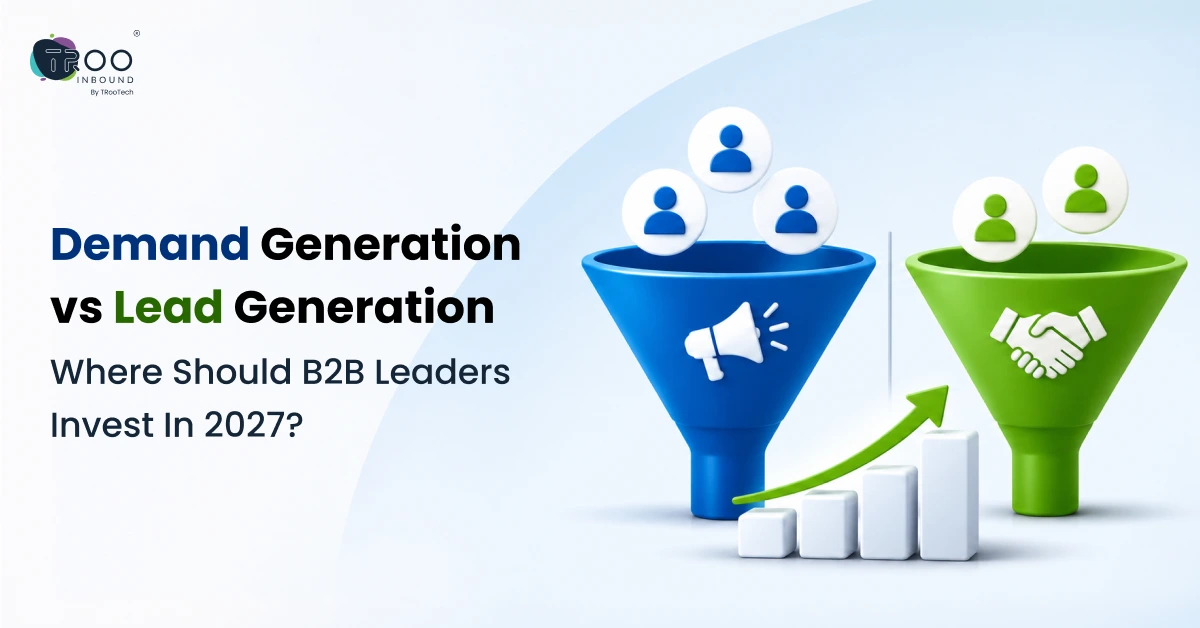
According to LinkedIn’s B2B Institute’s Easy To Find research, 95% of your target audience aren’t aware that they are facing a problem and there’s a solution for it in the market. So, you can invest in demand generation first, and next comes lead generation.
In B2B marketing, demand generation builds brand awareness in your target audience regarding the problem they are facing and how your business is solving it. And lead generation captures contact details from the buyers who are ready to invest in your solutions.
In this article, we will explore demand generation vs lead generation, when to invest in which, and how the two work best together to drive revenue.
Here’s a quick overview of lead generation vs demand generation that can help you make an informed decision before investing in either.
A Quick Tabular Comparison of Demand Generation vs Lead Generation
Comparison factor | Demand generation | Lead generation |
Primary goal | Create awareness and buying interest | Capture potential customer information |
Focus | Entire target market and buying groups | Identifiable prospects |
Approach | Education and trust-building | Conversion and lead capture |
Content | Mostly ungated educational content | Gated resources and conversion-focused content |
Buyer stage | Before and throughout active buying research | When prospects show identifiable interest |
Time horizon | Long-term and compounding | Often produces faster measurable responses |
Key channels | SEO, AEO, GEO, social media marketing, ABM, webinars, email marketing, etc. | SEO, AEO, GEO, PPC, Outreach emails, landing page development, etc. |
Core metrics | Brand awareness, account engagement, pipeline influence | Leads, CPL, MQLs, SQLs, conversion rates |
Business outcome | Stronger brand preference and future demand | Identifiable prospects and sales opportunities |
While demand generation and lead generation serve different purposes, both are essential for building a sustainable B2B sales pipeline. And the right investment depends on your business goals, target audience, current market presence, and sales priorities.
Want to Know Which One Is Best for Your B2B Business?
You are just 1 minute away from the answer. Share your demand generation and lead generation needs, and our revenue generation experts will help you find the right solution for your business.
Share Your RequirementsIf you want to know more and compare both demand generation and lead generation processes in detail, the following sections are for you. Let’s dive in.
What is Demand Generation?
Demand generation is a long-term, data-driven marketing and sales strategy that builds brand awareness, trust, and interest in a company’s products or services across the entire customer lifecycle.
Rather than just pushing for an immediate sale, it educates potential buyers and establishes industry authority so that your B2B business becomes the natural choice when they are ready to purchase.
All of this is possible through demand generation channels like building organic traffic through search optimization techniques, Account-Based Marketing (ABM), and more.
What are the Common B2B Demand Generation Channels?
B2B businesses can use multiple demand generation channels for marketing purpose:
- Search Engine Optimization (SEO): Create informative, keyword-focused content that helps your target audience find your business when searching for solutions for their industry-related challenges.
- Answer Engine Optimization (AEO) and Generative Engine Optimization (GEO): Optimize your website content to improve your brand’s visibility in AI-generated answers and search experiences. This helps potential buyers discover your business easily, even if they are searching on AI tools.
- Social Media Marketing: Share educational posts, industry insights, customer stories, and thought leadership content on different platforms to engage easily with your target audience.
- ABM: Find high-value target accounts and deliver personalized campaigns that address their specific business challenges. This builds good relationships with different stakeholders within your target companies.
- Webinars and Online Events: Host educational sessions, expert discussions, and product-related presentations to demonstrate industry knowledge and help potential buyers understand their challenges and available solutions.
- Email Marketing: Share newsletters, industry updates, educational resources, and relevant insights to maintain regular communication with your target audience and build long-term relationships.
- Content Marketing: Publish blogs, industry reports, guides, case studies, and other educational resources that answer buyer questions and establish your business as a reliable source of information.
What is Lead Generation?
Lead generation is the process of attracting, identifying, and capturing potential customer interest (other businesses in the case of B2B) in a product or service with the goal of turning them into paying clients.
Unlike demand generation, which focuses on building awareness and interest across a broader audience, lead generation aims to identify prospects who have shown interest in your products or services and encourage them to take the next step.
This is achieved through different lead generation channels, such as creating dedicated landing pages, running PPC campaigns, offering downloadable resources, and more.
What are the Common B2B Lead Generation Channels?
B2B businesses can use several lead generation channels to attract potential buyers, collect their information, and generate qualified sales opportunities:
- Search Engine Optimisation (SEO): Target high-intent keywords and create solution-focused website content that attracts prospects actively searching for products or services like yours.
- Answer Engine Optimisation (AEO) and Generative Engine Optimisation (GEO): Improve your brand’s visibility in AI-generated search responses to reach potential buyers researching specific solutions. Include relevant CTAs and conversion paths to encourage interested visitors to connect with your business.
- Pay-Per-Click (PPC) Advertising: Run targeted search and social media ad campaigns to reach potential customers based on their search intent, industry, job roles, and business requirements. Direct them to dedicated landing pages to capture their details.
- Landing Page Development: Create focused landing pages with clear value propositions, relevant information, and simple forms to encourage visitors to request a consultation, book a demo, or enquire about your services.
- Email Outreach: Send personalised emails to relevant prospects based on their industry, business needs, and roles. Use targeted messaging and clear CTAs to encourage responses and initiate sales conversations.
- Gated Content and Lead Magnets: Offer downloadable ebooks, whitepapers, industry reports, templates, and checklists in exchange for visitors’ contact information. These resources help attract prospects interested in learning more about a particular topic or solution.
- Webinars and Online Events: Organise product demonstrations, expert sessions, and educational webinars with registration forms to collect information from interested participants and identify potential sales opportunities.
- Lead Forms and Interactive Tools: Use website enquiry forms, free assessments, calculators, and other interactive tools to capture prospect information while offering something relevant to their business needs.
Demand Generation vs Lead Generation: What Should B2B Leaders Invest In 2027?
Choosing between demand generation and lead generation is not about deciding which strategy is better. It is about understanding what your business needs to achieve at its current stage.
Let’s look at when each approach makes more sense and why combining both can deliver better results.
When Should B2B Companies Prioritise Demand Generation?

Demand generation should be a priority when your business needs to build market awareness, establish credibility, and create interest in its products or services
Consider investing more in demand generation in the following situations:
- When entering a new market or targeting a new audience
- When launching a new product or service
- When operating in a competitive market with limited brand recognition
- When your website receives traffic but struggles to build buying preference
- When relying heavily on outbound sales to create initial interest
- When traditional lead generation campaigns are losing effectiveness
When Should B2B Companies Prioritise Lead Generation?

Lead generation deserves greater attention when your business already has some market visibility and needs to convert existing interest into identifiable prospects and sales opportunities.
Here are some situations where prioritising lead generation makes sense:
- When your business already has established market awareness
- When there is existing demand that needs to be converted
- When sales teams need a consistent flow of qualified opportunities
- When landing pages and conversion paths need improvement
- When your business has a clearly defined Ideal Customer Profile (ICP)
- When marketing needs to improve the conversion of existing website visitors
Why a Combined Demand and Lead Generation Strategy Is the Better Investment?
While demand generation and lead generation have different objectives, relying on only one can leave gaps in your B2B marketing strategy. Combining both approaches helps businesses build a more consistent marketing and sales process.
Here’s how they work together:
- Demand generation builds awareness and trust: SEO, social media, thought leadership, webinars, and educational content introduce your brand to potential buyers and establish credibility before they are ready to purchase.
- Lead generation identifies interested prospects: Once potential buyers become familiar with your business, targeted campaigns, landing pages, forms, and demo requests help capture their information and identify those interested in your offerings.
- Lead nurturing develops relationships with prospects: Not every lead is ready to make a purchase immediately. Email marketing, personalised content, and automated workflows help maintain engagement and educate prospects until they are ready to move forward.
- Marketing and sales alignment improves conversions: Marketing teams can share lead engagement data and qualification insights with sales teams, helping them prioritise relevant prospects and personalise follow-ups. Clear lead qualification criteria also reduce the chances of sales teams spending time on unsuitable leads.
- RevOps connects marketing activities with pipeline and revenue: Revenue Operations (RevOps) brings marketing, sales, and customer-facing processes together. With connected CRM data, automation, and reporting, businesses can track how marketing activities contribute to qualified opportunities, pipeline progression, and revenue.
How to Build a B2B Demand and Lead Generation Strategy for 2027
Building an effective B2B marketing strategy requires a structured approach that connects audience targeting, content creation, lead nurturing, and sales processes to generate measurable revenue.
Here are six steps B2B leaders can follow to build a demand and lead generation strategy for 2027:
1. Define Your Ideal Customer Profile and Buying Groups
A clearly defined Ideal Customer Profile (ICP) helps you focus your marketing efforts on companies that are more likely to benefit from your products or services.
Start by identifying
- Target industries and company sizes
Key decision-makers - Business challenges and purchase motivations
- Buying groups and stakeholders
- Audience segmentation
A well-defined ICP helps demand generation campaigns reach the right audience and ensures lead generation efforts focus on prospects who are more likely to convert.
2. Create Content for Every Stage of the Buying Journey
Not every potential buyer is ready to purchase when they first discover your business. Some are researching a problem, while others are comparing vendors or evaluating specific solutions. Your content strategy should address these different stages with relevant information and resources.
Buying stage | Content recommendations |
Awareness | Educational blogs, LinkedIn posts, industry reports, videos, and informative guides |
Consideration | Comparison guides, webinars, case studies, solution guides, and expert insights |
Decision | Product demos, consultations, ROI calculators, assessments, and customer testimonials |
One important consideration: Avoid gating every piece of content behind a form. Let potential buyers access educational resources without sharing their contact details at every interaction. Reserve gated content and forms for resources that offer additional value, such as detailed reports, customised assessments, or consultation opportunities.
3. Combine Inbound, Outbound, and Account-Based Marketing
A combination of inbound, outbound, and Account-Based Marketing (ABM) helps businesses attract new audiences while engaging high-value prospects through targeted campaigns.
Consider combining the following approaches:
- Inbound marketing: Use SEO, AEO, GEO, and content marketing to attract potential buyers who are actively researching industry-related topics and solutions.
- LinkedIn and thought leadership: Share industry insights, expert opinions, company updates, and educational content on LinkedIn.
- Pay-Per-Click (PPC) advertising: Run targeted Google Ads and social media campaigns to reach prospects searching for specific solutions or services.
- Account-Based Marketing (ABM): Identify high-value companies that match your ICP and create personalised marketing campaigns for them.
- Outbound marketing: Use personalised email outreach and other direct sales communication to connect with relevant decision-makers.
4. Build a Lead Nurturing and Qualification Framework
Some prospects may be ready for a sales conversation, while others need more information before making a decision. A structured lead nurturing and qualification framework helps businesses identify where prospects stand and determine the most appropriate next step.
Here are some important elements to include:
- Define clear lifecycle stages: Establish stages such as Subscriber, Lead, Marketing Qualified Lead (MQL), Sales Qualified Lead (SQL), Opportunity, and Customer.
- Establish MQL and SQL criteria: Work with your sales and marketing teams to agree on what makes a lead qualified.
- Implement lead scoring: Assign scores based on relevant prospect information and engagement activities.
- Create automated email nurturing workflows: Develop email sequences that share relevant resources, case studies, product information, and industry insights based on a prospect’s interests and lifecycle stage.
- Set up lead routing and sales follow-up rules: Automatically assign qualified leads to the appropriate sales representatives based on factors such as territory, industry, company size, or service requirements.
- Identify disengaged leads and create re-engagement campaigns: Not every prospect will continue interacting with your business.
5. Connect Marketing, Sales, and CRM Data
If marketing and sales operate with disconnected data, it becomes difficult to understand which activities are contributing to business growth.
Focus on the following areas:
- Establish shared lead qualification criteria
- Track interactions across marketing and sales channels
- Use CRM dashboards to monitor pipeline progression
- Establish consistent attribution and reporting processes
- Review campaign performance against revenue goals
6. Review Performance and Reallocate Marketing Budgets
Regular performance reviews help identify which activities are contributing to pipeline growth and where your marketing budget can deliver better results.
Consider the following practices:
- Evaluate channels contributing to qualified pipeline
- Compare demand creation and demand capture performance
- Identify campaigns generating engagement but limited conversions
- Invest more in channels attracting the right accounts
- Review results quarterly
How HubSpot Can Support Your Demand and Lead Generation Strategy
Managing demand generation and lead generation across multiple channels requires a connected marketing and sales system. This is where HubSpot can help B2B businesses bring their marketing activities, customer data, and sales processes together.
With HubSpot Marketing Hub, businesses can manage email campaigns, create landing pages, publish content, segment audiences, and automate lead nurturing workflows. Its CRM helps centralise contact information, track prospect interactions, manage lifecycle stages, and give sales teams better visibility into potential opportunities.
Businesses can also use HubSpot’s automation and reporting capabilities to streamline lead qualification, assign leads to the right sales representatives, monitor campaign performance, and understand how marketing activities contribute to the sales pipeline.
However, getting the best results requires more than simply using HubSpot’s features. As a HubSpot Diamond Solutions Partner, TRooInbound helps businesses build and optimise their HubSpot ecosystem through CRM consulting, implementation, marketing automation, and RevOps services. We help align marketing and sales processes, improve lead management, and connect campaign performance with business goals.
Whether you want to strengthen demand generation, improve lead conversion, or build a more predictable sales pipeline, TRooInbound can help you make better use of HubSpot to support sustainable revenue growth.
Conclusion: Build a B2B Marketing Strategy That Drives Revenue
Demand generation and lead generation are not competing marketing strategies. Both play an important role in building a sustainable B2B sales pipeline. While demand generation helps your business build awareness, credibility, and buying interest, lead generation turns that interest into identifiable prospects and sales opportunities.
As B2B buying behaviour continues to evolve in 2027, businesses need to focus on reaching the right audience, creating valuable content, nurturing prospects, and aligning marketing and sales activities. The right combination of both strategies will depend on your business goals, market position, and pipeline requirements.
At TRooInbound, we help B2B businesses connect their marketing, sales, and CRM processes through HubSpot consulting, implementation, marketing automation, and RevOps services.
Ready to Build a Demand and Lead Generation Strategy That Supports Your Revenue Goals?
Discuss your requirements with TRooInbound and let our experts help you identify the right approach for your business.
Share Your RequirementsFAQs
Read Popular Questions
What is the main difference between demand generation and lead generation?
Demand generation focuses on creating brand awareness, educating potential buyers, and building interest in your products or services. Lead generation focuses on capturing contact information from interested prospects and converting them into potential sales opportunities. Both strategies work together to support B2B revenue growth.
Is demand generation better than lead generation for B2B businesses?
Neither strategy is universally better. Demand generation is more suitable for businesses looking to build market awareness and create buying interest, while lead generation is useful for capturing existing demand and generating qualified prospects. Most B2B businesses benefit from combining both approaches.
What are the most effective B2B demand generation channels?
Some effective B2B demand generation channels include:
- Search Engine Optimisation (SEO).
- Answer Engine Optimisation (AEO) and Generative Engine Optimisation (GEO).
- LinkedIn and social media marketing.
- Account-Based Marketing (ABM).
- Content marketing and thought leadership.
- Webinars and industry events.
- Email newsletters and educational campaigns.
The right channel mix depends on your target audience, industry, and marketing objectives.
What are the most effective B2B lead generation strategies?
B2B businesses can generate leads through targeted PPC campaigns, SEO, dedicated landing pages, gated resources, personalised email outreach, webinars, product demos, and consultation forms. A combination of these channels can help attract relevant prospects and capture their information.
How do you measure demand generation success?
Demand generation success can be measured using metrics such as brand awareness, branded search traffic, website engagement, target account engagement, share of voice, and marketing-influenced pipeline. These metrics help businesses understand whether their campaigns are building awareness and influencing potential buyers.
How do you measure lead generation success?
Common lead generation metrics include total leads, Marketing Qualified Leads (MQLs), Sales Qualified Leads (SQLs), cost per lead (CPL), landing page conversion rate, lead-to-customer conversion rate, and customer acquisition cost (CAC). Tracking these metrics helps businesses evaluate campaign effectiveness and lead quality.
How can HubSpot help with demand generation and lead generation?
HubSpot helps businesses manage marketing campaigns, capture leads, automate email nurturing, segment audiences, track prospect interactions, and monitor campaign performance. Its CRM connects marketing and sales data, helping teams manage the lead lifecycle and gain better visibility into pipeline progression.
Can TRooInbound help businesses build a demand and lead generation strategy?
Yes. TRooInbound helps B2B businesses improve their marketing and sales processes through HubSpot consulting, CRM implementation, marketing automation, and RevOps services. Our team can help you build a connected strategy that improves audience engagement, lead management, sales alignment, and revenue generation.