


Customer support is a resource-intensive operation in a business. As companies scale, support tickets increase, expectations rise, and operational costs grow faster than teams can handle. Meeting all of these demands without breaking the budget is a long-standing challenge for businesses of every size. Here’s where Salesforce Agentforce changes the game.
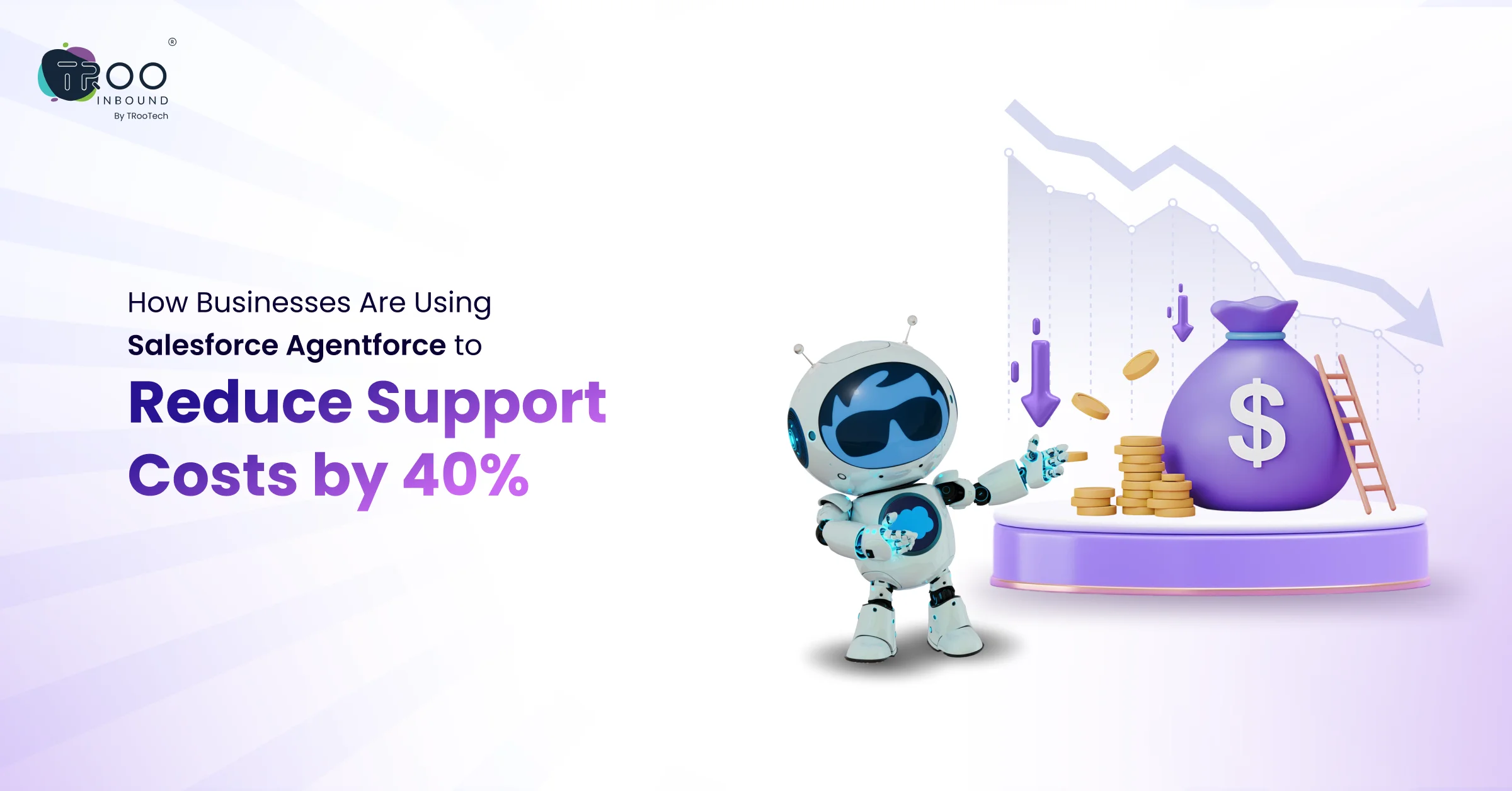
Agentforce helps companies rethink what customer support can look like by introducing a new model of AI-powered, autonomous support that goes beyond simple chatbots. Enterprises can handle more queries with fewer resources and significantly reduce support costs by 40%.
In this blog, we will explore how Agentforce works, why it is effective, and how businesses are using it to transform their support operations.
This blog breaks down what Salesforce Agentforce is, how it works, and how organizations are reducing support costs with it.
What is Salesforce Agentforce And Its Features?
Salesforce Agentforce is a ‘complete and open platform’ designed to build and deploy autonomous AI agents that work alongside employees or serve customers. It uses the Atlas Reasoning Engine to understand, plan, and execute complex, multi-step tasks using CRM data, that too without manual oversight.
As it’s deeply integrated with Salesforce, Agentforce works across other platforms in the ecosystem like Data Cloud, Service Cloud, Einstein AI, etc., pulling all their data together to deliver contextual responses to the customer.
For example:
When a customer asks a question, instead of a scripted response, Agentforce reasons through the query, checks account history, understands the user’s intent, and acts accordingly.
Since its first launch in September 2024, the platform has evolved through many major updates released subsequently in 2025. But with the launch of Agentforce 360 at Dreamforce 2025, Salesforce took this further by introducing a unified system where AI agents and humans work together across business operations.
For enterprises already using Salesforce, adopting Agentforce builds an intelligence layer on the tools they already have in place, which makes their ROI more predictable.
Salesforce Agentforce Features
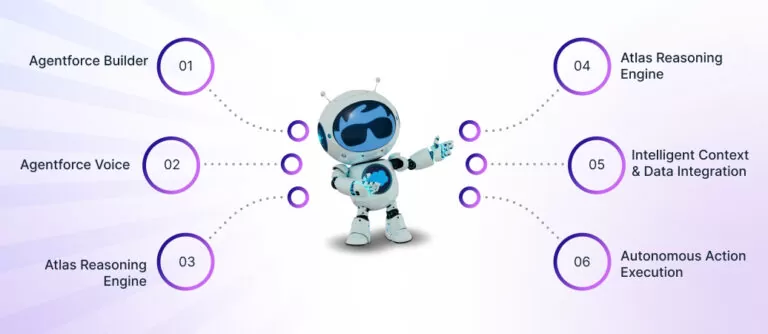
- Agentforce Builder: It’s a conversational, low-code interface that helps you create, customize, and deploy AI agents, allowing users to define agent roles, capabilities, and guardrails.
- Agentforce Voice: It offers voice-enabled AI capabilities for natural conversational service interactions across web, telephone, and mobile channels.
- Atlas Reasoning Engine: It uses AI to interpret, reason, and make decisions to handle complex tasks using Retrieval Augmented Generation (RAG).
- Intelligent Context & Data Integration: Agents have direct access to real-time data, both structured and unstructured, via Data Cloud, to understand customer history with ease.
- Autonomous Action Execution: Agents can perform tasks such as updating CRM records, scheduling follow-ups, sending emails, etc., independently – without manual efforts.
Why Support Costs Are Rising Rapidly
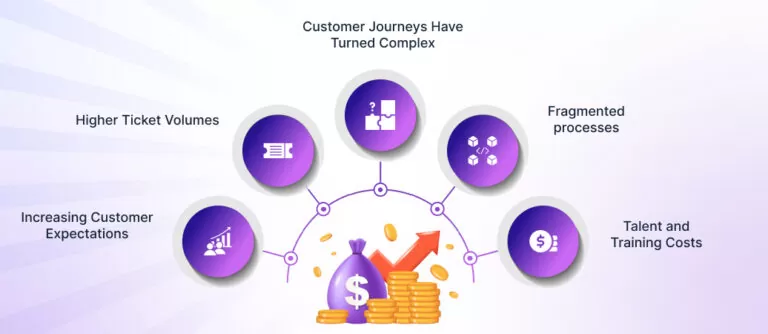
Before understanding how Agentforce helps in reducing the support cost, it is important to look at why they are rising rapidly.
1. Customer Journeys Have Turned Complex
Today, customer journeys involve multiple touchpoints, and support reps often need to access several systems to resolve a single issue, increasing the time and resources they spend.
2. Higher Ticket Volumes
As businesses grow, so does the number of support queries. Even minor issues can flood support queues. And when ticket volumes rise, companies either hire more people or let response times slip. Neither outcome is ideal.
3. Increasing Customer Expectations
Customers expect instant responses, personalized interactions, and 24/7 availability from a business. Meeting these expectations with a human team alone is expensive.
4. Fragmented processes
Many support teams still rely on manual case handling. Agents spend time logging data, categorizing tickets, and following up on routine issues. That time is expensive and often underutilized.
5. Talent and Training Costs
Hiring, onboarding, and retaining support agents require significant investment. Continuous training adds to the cost.
This is precisely the gap that Agentforce is designed to fill. As highlighted through AI in Salesforce advancements, the platform brings intelligence to automation across sales, marketing, and support, rather than just rules-based scripting.
How Agentforce Reduces Support Costs by 40%
Agentforce solves these challenges with a combination of automation, intelligence, and integration. Let’s break down how:
1. Automating High-Volume Routine Queries
The fastest way to reduce support costs is by automating regular queries that do not need human interaction.
A large percentage of support tickets are repetitive, for example: password resets, order status checks, billing questions, appointment scheduling, etc. Agentforce can handle these queries autonomously. It understands user intent, retrieves relevant data, and provides accurate responses without human intervention.
This reduces the number of tickets that require human agents, which directly lowers staffing costs.
2. Intelligent Case Routing
Even for inquiries that require human attention, Agentforce reduces cost by eliminating manual sorting. It automatically categorizes new tickets and routes them to the right agent or team based on real-time context and predefined logic.
For instance:
Salesforce Flow Builder, working alongside Agentforce, can trigger task assignments, escalate cases, update records, etc., without any manual efforts.
As a result, the human agents spend more time solving problems rather than managing queues – improving overall productivity and reducing cost-per-case significantly.
3. Enhancing First Contact Resolution
Repeated interactions also drive cost in support operations. When a customer’s issue isn’t resolved in the first contact, they create additional workload for the whole team.
Agentforce uses CRM data and contextual understanding to provide accurate solutions in a single interaction. This improves the first contact resolution rates and reduces repeat tickets.
4. Real-Time Agent Assistance
During a conversation with customers, Agentforce surfaces relevant knowledge articles, suggests next-best actions, and generates case summaries so agents can respond faster.
This feature has a direct impact on average handle time (one of the leading cost drivers in support costing). When agents have the right information available, first-contact resolution rates improve, reducing the need for follow-up interactions.
RBC Wealth Management offers a concrete example of this efficiency. After deploying Agentforce across more than 4,500 financial advisors, meeting preparation time dropped from over an hour to under a minute per client session.
While this example is within financial services, the same logic applies to customer support functions where pre-interaction research and data gathering consume significant agent time.
5. Reducing Average Handling Time
Even when human agents are involved, Agentforce assists them by providing real-time suggestions, knowledge articles, and recommended actions.
This reduces the time agents spend on each ticket. Faster resolution means agents can handle more queries in less time, improving overall efficiency.
6. Self-Service at Scale
Agentforce makes self-service genuinely useful by connecting customers to accurate, personalized answers rather than generic FAQ pages.
On Salesforce’s Help site, customers interact with Agentforce through a conversational interface. The agent understands context, asks clarifying questions where needed, and delivers specific answers grounded in account data and product documentation.
This quality of self-service reduces call center volume without frustrating customers.
Industry-Specific, Real-World Use Cases of Agentforce
Agentforce is not a one-size-fits-all solution. Its architecture allows companies to build agents tailored to their industry and specific workflows. Across sectors, businesses are deploying it with strong results.
E-commerce Companies
E-commerce brands deal with high volumes of customer queries related to orders, returns, and payments.
Agentforce helps by:
- Automating order tracking and status updates
- Handling return and refund requests
- Providing personalized product support
This reduces the need for large support teams during peak seasons.
SaaS Enterprises
SaaS companies often face technical queries that require quick resolution.
Agentforce can:
- Guide users through troubleshooting steps
- Provide contextual help within the product
- Escalate complex issues with full context
This improves customer satisfaction while reducing support workload.
Financial Services
In financial services, accuracy and compliance are critical.
Agentforce assists by:
- Answering account-related queries securely
- Providing transaction details
- Supporting onboarding processes
This reduces operational costs while maintaining high service standards.
Healthcare and Insurance
These industries require handling sensitive information and complex queries.
Agentforce helps by:
- Managing appointment scheduling
- Answering policy-related questions
- Providing claim status updates
This ensures efficient service delivery without overburdening staff.
These examples illustrate something important. Agentforce delivers its strongest results when it is matched to the actual workflows and pain points of a specific business. This is where working with experienced Salesforce Services partners makes a significant difference in implementation quality and time-to-value.
What the Numbers Say About Agentforce Adoption
The growth of Agentforce adoption reflects genuine business confidence in what it delivers. Salesforce closed over 18,500 Agentforce deals since launch, with more than 9,500 paid.
Salesforce’s State of Service report found that service professionals estimate that AI currently handles 30% of service cases, a figure expected to rise to 50% by 2027
The platform’s speed of deployment is also notable. A study by Valoir in 2025 found that organizations using Agentforce took an average of 4.8 months to go from strategy to full deployment. Businesses that tried to build a comparable agentic stack on their own took an average of 75.5 months. That difference in time-to-value is enormous when you consider the cost savings that start accumulating from the moment the platform goes live.
From these statistics, we can definitely conclude that companies that adopt Agentforce now are not just reducing costs today. They are positioning themselves ahead of where the entire enterprise technology market is heading.
Steps to Implement Agentforce Successfully
Adopting Agentforce requires a strategic approach. Here are the key steps enterprises follow:
1. Identify High-Impact Use Cases
Start by analyzing your support data. Identify repetitive queries and high-volume interactions that can be automated.
2. Define Clear Objectives
Set measurable goals such as reducing ticket volume, improving resolution time, or lowering support costs.
3. Integrate with CRM and Data Sources
Ensure that Agentforce has access to accurate and complete data. This is critical for effective decision-making.
4. Train AI Models
Use historical data and knowledge bases to train the system. This helps improve accuracy and relevance.
5. Monitor and Optimize
Continuously track performance and refine the system based on insights and feedback.
Getting Started with Agentforce: What to Consider
Businesses exploring Agentforce often wonder where to begin. The most effective implementations start with a clear understanding of which workflows are costing the most and delivering the least.
So, starting with automating repetitive, high-volume interactions is the best starting point. They offer the fastest return and the lowest risk.
From there, the key is configuration. Agentforce is powerful out of the box, but its real impact comes from aligning agent behavior to your specific data, your specific customers, and your specific escalation logic. This is why choosing the right implementation partner matters as much as choosing the platform itself.
At TRooInbound, we work with enterprises to design and deploy Salesforce solutions that deliver measurable results. Whether you are taking your first steps with Agentforce or looking to optimize an existing deployment, the path forward starts with understanding your specific support costs, your customer experience goals, and where AI can make the biggest impact.
Final Thought
The 40% cost reduction that businesses are achieving with Salesforce Agentforce comes from deploying intelligent automation at the right points in the support workflow, integrating AI agents with unified data, and freeing human teams to focus on work that actually requires them.
Agentforce represents a genuine shift in what customer support can look like. It is not just about answering questions faster. It is about building a support operation that scales intelligently, operates continuously, and improves over time. For businesses ready to take that step, the evidence is clear, and the tools are ready.
The cost savings are real. The capabilities are proven. And the window to get ahead of the curve is now.