
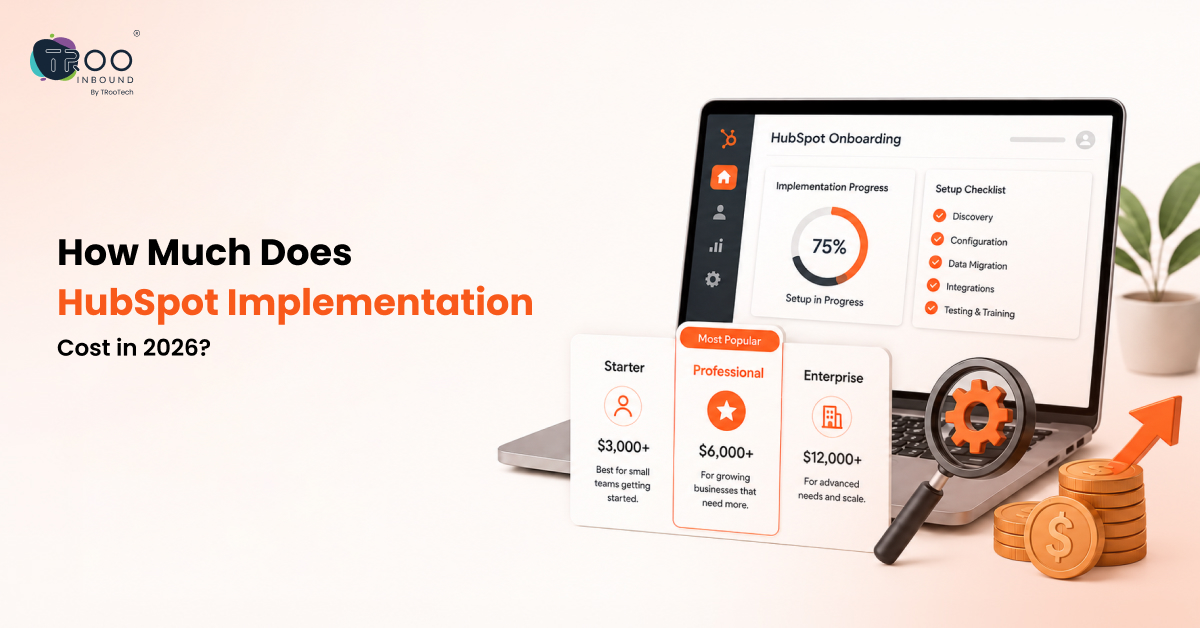
The overall HubSpot Implementation cost can be anywhere from about $1,500 to $150,000+, depending on how many Hubs you buy, how complex your current data is, and who does the implementation work. For a small business with a simple setup, HubSpot implementation can cost around $3,000 to $7,000 with a partner. For a mid-size B2B company with Sales and Marketing Hub, the cost can land between $7,000 and $25,000. And for enterprises with heavy data and complex custom requirements, the cost can cross $75,000.
This guide breaks down what you actually pay for, what drives the price up or down, how to estimate your own implementation cost budget, and more. It also explains the difference between two costs people often confuse: your HubSpot license (the software subscription) and your implementation (the work to set it all up).
TL;DR:
Here’s the short version if you’re pressed for time:
- HubSpot's own onboarding: roughly $1,500 for Sales/Service Pro, $3,000 for Marketing Pro, and $3,500 to $7,000+ for Enterprise plans. This is guidance, not hands-on setup.
- Partner implementation: $3,000 to $7,000 (basic), $8,000 to $25,000 (standard multi-Hub), and $25,000 to $150,000+ (enterprise).
- CRM migration: $500 to $5,000 for simple data moves, $8,000 to $30,000 for standard migrations, and $50,000+ for multi-system enterprise moves.
- Timeline: most projects run 6 to 16 weeks. Simple CRM setups can go live in under two months.
- License is separate: your monthly subscription (seats plus contacts) is a different line item from the one-time setup cost.
- DIY looks free but rarely is: Broken workflows and dirty data cost more to fix later, with developer rates at $75 to $250+ per hour.
What Does HubSpot Implementation Actually Include?
Your HubSpot CRM implementation cost covers CRM setup, data migration, integration, process setup and automation, reporting, and training.
Knowing the importance of each step will help you make a more informed investment decision:
- CRM Configuration: Setting up your account, record types, and custom properties to match how your business works. This is the foundation everything else sits on.
- User Permissions: Giving each role the right level of access early, so people see what they should and nothing they shouldn’t as the build takes shape.
- Sales Pipeline Setup: Building deal stages around your real sales process, so reps always know the next step and managers get an accurate pipeline view.
- Data Migration: Moving your contacts, companies, deals, and history into HubSpot with no duplicates or lost records, mapped into the structure you just built.
- Integrations: Connecting your other tools, like email, calendar, and accounting software, so data flows both ways without manual work.
- Marketing Automation: Creating workflows that nurture leads, score them, and pass them to sales at the right time.
- Email Templates: Ready-to-use, on-brand templates so your team never writes the same email from scratch.
- Reporting Dashboards: Live views of pipeline, revenue, and campaign results for the people who need them.
- QA Testing: Checking every workflow, form, and integration before launch, so nothing breaks on day one.
- Training: Hands-on sessions at go-live that get your team confident and actually using the system.
How Much Does HubSpot Implementation Cost in 2026?
There is no uniform HubSpot setup cost, but most projects fall into one of four bands.
| Business type | HubSpot Implementation Pricing | Implementation Timeline | Complexity |
|---|---|---|---|
| Starter Business | $3,000 to $7,000 | 2 to 4 weeks | Low |
| Small Business | $7,000 to $18,000 | 4 to 8 weeks | Medium |
| Mid Market | $18,000 to $50,000 | 8 to 14 weeks | High |
| Enterprise | $50,000 to $150,000+ | 12 to 24 weeks | Very high |
Below is what each tier covers, so you can find your fit before you look at HubSpot implementation services cost in detail.
1. Starter Business
This is the entry point for very small teams getting on HubSpot for the first time. At this level, many teams can do parts of the setup themselves, though a short paid engagement keeps the foundation clean.
- Cost: $3,000 to $7,000
- Deliverables: CRM configuration, one clean sales pipeline, a handful of key properties, basic user permissions, and light training. Data migration is usually a single tidy import.
- Recommended Hub: Sales Hub Starter, or the free CRM paired with a Starter plan.
- Timeline: 2 to 4 weeks
- Complexity: Low. One Hub, little to no custom work.
2. Small Business
This is the most common starting point for growing B2B companies.
At this level and afterwards, a HubSpot implementation consultant cost pays for itself fast, since a partner sets up automation that would otherwise take months to figure out alone.
- Cost: $7,000 to $18,000
- Deliverables: Full CRM configuration, a proper sales pipeline, marketing automation, contact and deal migration, email templates, reporting dashboards, one or two integrations, QA testing, and team training.
- Recommended Hub: Sales Hub Professional, or Marketing Hub Professional if lead generation is the priority.
- Timeline: 4 to 8 weeks
- Complexity: Medium. Usually one or two Hubs working together.
3. Mid Market
For established companies with more moving parts and higher stakes.
- Cost: $18,000 to $50,000
- Deliverables: Everything in the Small Business tier, plus custom objects, multiple integrations, advanced workflows, lead scoring, revenue reporting, and deeper data cleanup.
- Recommended Hub: Sales and Marketing Hub Professional, moving to Enterprise where you need more control.
- Timeline: 8 to 14 weeks
- Complexity: High. Two or more Hubs, custom builds, and real change management.
4. Enterprise
For large or global organizations replacing complex legacy systems.
- Cost: $50,000 to $150,000+
- Deliverables: Full data re-architecture, custom objects and APIs, multi-team rollout, advanced permissions, attribution reporting, and heavy migration from systems like Salesforce.
- Recommended Hub: HubSpot Customer Platform, the full Enterprise Suite.
Timeline: 12 to 24 weeks - Timeline: 8 to 14 weeks
- Complexity: Very high. Multiple Hubs, many integrations, and strict compliance needs.
The ranges above give you an estimation, but your final cost depends on your data and goals. Working with a reliable HubSpot implementation partner gets you an accurate estimate and a clean build from day one.
What Factors Affect The HubSpot Implementation Cost?
Here are the 12 factors that have a major impact on HubSpot onboarding cost:
- Number of Users: More users means more seats to license and more permissions, roles, and profiles to set up. Larger teams add cost on both the license and the setup side.
- Number of Pipelines: One simple sales pipeline is quick to build. Multiple pipelines for different products, regions, or teams take more time and push the price up.
- Custom Objects: Standard records like contacts and deals come ready to use. Custom objects for things like properties, subscriptions, or shipments need extra design work, so they cost more.
- Workflow Automation: A few basic workflows are cheap. Complex automation with branching logic, lead scoring, and routing rules takes real build time and raises the cost.
- Marketing Hub: Adding Marketing Hub brings email, forms, landing pages, and campaigns to set up. The more marketing assets you migrate and build, the higher the cost.
- Sales Hub: Sales Hub setup covers pipelines, quotes, sequences, and forecasting. Heavier sales processes mean more configuration and a bigger bill.
- Service Hub: Service Hub adds tickets, help desk, knowledge base, and customer feedback tools. Each one you turn on adds setup work.
- CMS Migration: Moving your website or blog onto HubSpot CMS is a project on its own. Page count, design complexity, and SEO preservation all drive this cost.
- Third-party Integrations: Simple native integrations are fast to connect. Custom or many-tool integrations take more time to build and test, so they cost more.
- API Development: When your systems need custom connections that no ready-made integration covers, you pay for developer time. This is one of the biggest cost drivers.
- Data Quality: Clean data imports fast. Messy, duplicated, or incomplete data needs cleanup before migration, and that work adds hours and cost.
- Training Requirements: A small team needs a couple of sessions. A large or multi-department rollout needs more training, documentation, and support, which raises the total.
These factors shape your HubSpot setup cost. But that build cost is only half the picture. The other half is what you pay HubSpot every month for the software itself, and people mix up the two all the time. Let’s clear that up next.
What's the Difference Between HubSpot License Cost vs HubSpot Implementation Cost?
People often confuse the costs and consider them as one number. But they are different.
Your HubSpot license cost is what you pay HubSpot for the software itself. It is a recurring fee, billed monthly or yearly, based on your Hubs, your plan tier, the number of seats, and your contact count. You pay it for as long as you use HubSpot. This is the “HubSpot monthly cost” most people search for.
Your HubSpot implementation cost is what you pay to set the software up so it actually works for your team. It is usually a one-time cost, paid to a partner or to HubSpot, covering configuration, migration, automation, and training.
Here’s the difference at a glance:
| Differences | HubSpot License Cost | HubSpot Implementation Cost |
|---|---|---|
| What it pays for | The software subscription | The setup and build work |
| Paid to | HubSpot | A HubSpot Partner or HubSpot |
| How Often | Recurring (monthly/yearly) | One-time |
| Based on | Hubs, tier, seats, contacts | Complexity, data, and custom work |
| Example | $6,000 per year | $10,000 once |
What Does HubSpot Actually Cost in Your First Year?
The total first-year cost will be your license plus one-time setup expense. Here is how it stacks up for a typical small business:

The key takeaway:
Your first year is always the most expensive because setup costs land only once. From year two on, your main cost drops back to the license, around $6,000 in this example, plus any optimization work you choose.
How Much Does HubSpot Implementation Cost by Industry Type?
As every industry uses HubSpot a little differently, here are typical implementation ranges based on industry types:
- Professional services like legal, consulting, and agencies usually sit at the low end, around $5,000 to $15,000. Pipelines are simple, automation is light, and there are few tools to connect.
- Real estate tends to run $7,000 to $20,000, since it needs lead routing, listing data, and setup that handles high contact volume.
- E-commerce and retail typically land between $10,000 and $35,000. The cost comes from store integrations, abandoned cart flows, and large contact lists that need careful handling.
- SaaS and technology companies often pay $15,000 to $50,000. Long sales cycles, product usage data, custom objects, and API work all add to the build.
- Manufacturing falls around $15,000 to $45,000, driven by multiple pipelines, dealer or distributor networks, and ERP integrations.
- Healthcare and financial services are the most expensive, commonly $20,000 to $60,000. Both deal with strict compliance rules, sensitive data, and secure integrations, and all of that takes extra care during setup.
How to Estimate Your HubSpot Implementation Budget?
You can size your HubSpot implementation budget in five simple steps:
Step 1: Pick your Hubs and tier: Decide which Hubs you need (Sales, Marketing, Service) and whether Starter, Professional, or Enterprise fits. This sets your recurring license cost.
Step 2: Count your seats and contacts: More paid seats and higher contact tiers raise your monthly bill, so get a real headcount before you estimate.
Step 3: Judge your data: Look at where your data lives now and how clean it is. A tidy spreadsheet is cheap to move. Years of messy records in Salesforce cost far more. A solid HubSpot CRM setup starts with honest data cleanup.
Step 4: List your custom needs: Write down every integration, custom object, and complex workflow you need. Each one adds to the build cost, and these are where budgets usually grow.
Step 5: Add training and a buffer: Include team training, then add 10 to 20 percent on top for the surprises every project hits.
Here’s a simple way to think about the math:

For example:
A small business on Sales Hub Pro might plan for a $6,000 license, a $10,000 implementation, and a $2,400 buffer, for a first-year budget of about $18,400.
What Are The Hidden Costs Of HubSpot Implementation?
The hidden costs of HubSpot implementation that most businesses forget about are:
- Training: Getting your team confident on HubSpot takes real sessions and time. Skip it and adoption stalls, which quietly wastes the money you already spent.
- Internal Resources: Someone on your side has to answer questions, review the build, and make decisions. That internal time is a real cost, even if it never shows on an invoice.
- Integrations: Connecting your other tools is rarely one click. Some integrations need custom work or carry their own subscription fees on top of HubSpot.
- Data Cleaning: Most companies underestimate how messy their data is. Deduping and fixing records before migration often adds hours nobody planned for.
- User Adoption: A tool only pays off when people use it. Driving adoption often needs extra support, reminders, and follow-up traininfter launch.
- Custom Reports: Standard dashboards are quick. Custom reports and revenue attribution take extra build time, and most teams want them once they see what’s possible.
- Custom Development: Anything HubSpot can’t do out of the box needs a developer. Custom objects, portals, and special features all add cost here.
- API Costs: Deep connections between HubSpot and your other systems use API work, and higher usage can push you into paid limits or added development time.
- Change Management: Moving a whole team to a new system takes planning and buy-in. Underestimate this, and you pay for it in slow adoption and rework.
DIY vs HubSpot Direct Onboarding vs Hiring a HubSpot Partner: Which One Is Better?
When it comes to setup, you have three real options: do it yourself, use HubSpot’s direct onboarding, or hire a HubSpot partner. Each fits a different situation.
| Do It Yourself (DIY) Cost | HubSpot Direct Onboarding Cost | HubSpot Implementation Partner Cost |
|---|---|---|
| Doing it yourself looks free, and for a very small team on a Starter plan, it can work. You handle the setup, the imports, and the learning curve. The catch is time and risk. Most DIY setups end up with messy data, half-built workflows, and features nobody uses. Fixing that later often costs more than doing it right the first time, since developer rates run $75 to $250+ per hour. | HubSpot’s direct onboarding sits in the middle, usually $1,500 to $7,000+ depending on your plan. You get a specialist who guides you and gives you a roadmap. The important thing to know: they advise, but your team still does the actual work. It suits companies with internal resources and time to spare. | Hiring a HubSpot partner costs more upfront, typically starting around $5,000 and scaling with complexity, but the partner does the hands-on work for you. They build the portal, migrate your data, set up automation, and train your team. You get to value faster and avoid expensive mistakes. This is the right call for most growing and mid-market companies. |
So how do you choose?
- Go DIY if you’re tiny, simple, and not in a hurry.
- Use HubSpot Direct if you have the internal hands to execute.
- Hire a partner if your setup is complex, your time matters, or you can’t afford to get it wrong. If you go the partner route, your HubSpot implementation services cost buys hands-on experience for easy & smooth setup.
If you’re unsure where you fall, a short session of HubSpot CRM consulting can point you to the right path.
What Are the Common Mistakes That Increase Implementation Cost?
A few avoidable mistakes quietly push implementation costs up. Watch for them as early as possible:
- Skipping data cleanup: Migrating messy data means paying to fix it later. Clean first, then move.
- Buying more than you need: Extra Hubs and higher tiers add cost fast. Start with what you’ll actually use.
- No clear plan: Vague goals lead to scope creep and rework. Define what success looks like before you build.
- Doing it all yourself to save money: A rushed DIY setup often costs more to repair than a proper build would have cost upfront.
- Ignoring user adoption: If your team doesn’t use the system, you pay for software that sits idle. Budget for training from the start.
- Over-customizing early: Complex custom work you don’t need yet inflates the bill. Add it later, once you know you need it.
Why Businesses Choose a HubSpot Partner For Implementation?
Plenty of companies could set up HubSpot alone; most still choose a partner, and for good reasons:
A partner brings in years of experience they’ve had with different clients. They know the pitfalls and skip the trial and error that slows internal teams down. That means you get to value faster, with a system that works from day one instead of months of tinkering.
A partner also protects your data. Clean migration and smart setup keep your CRM trustworthy. And because they build with your goals in mind, you avoid the expensive mistakes like broken workflows and features nobody adopts.
Just as important, a good partner sticks around after launch to optimize and support your setup as your business grows. HubSpot is a system you maintain, and having an expert on call saves you from figuring everything out alone.
If you’re exploring your options, it helps to see what a strong partner looks like. Our guide to the 7 best HubSpot implementation partner agencies is a good place to compare before you decide.
Final Thoughts
HubSpot implementation pricing in 2026 runs anywhere from about $1,500 to $150,000+, but for most businesses the real number sits somewhere in the middle, shaped by your size, your data, and how much custom work you need.
The most important thing to remember is the split between your two costs. Your license is what you pay HubSpot every month for the software. Your implementation is the one-time work to set it all up properly. Keep those separate and your budget stays clear.
Two moves will save you the most money. Clean your data early, because messy records drive up both cost and timeline more than anything else. And be honest about whether you have the time and skill to do it yourself, since a rushed setup usually costs more to fix than to build right the first time.
However you go about it, treat HubSpot as a system you invest in and maintain, not a one-time purchase. Done well, the setup pays for itself in a team that actually uses the tool. That’s where a reliable HubSpot partner like TRooInbound can help.
Connect with our experts today to size the right plan for your HubSpot implementation vision.
* The implementation costs mentioned in this article are approximate; the cost varies depending on business requirements.
FAQs
Read Popular Questions
Is HubSpot implementation worth it?
For most businesses, yes. A proper setup turns HubSpot from expensive software into a system your team actually uses, with clean data, working automation, and reporting leaders trust. The cost pays for itself in time saved and mistakes avoided. It’s only “not worth it” when a tiny team overbuys tiers and features they never use.
How long does HubSpot implementation take?
Most projects take 6 to 16 weeks. A simple single-Hub setup can go live in 2 to 4 weeks, while a large enterprise rollout with heavy migration can run 4 to 6 months. Dirty data is the biggest reason timelines stretch, so cleaning records early speeds everything up.
How much does CRM migration to HubSpot cost?
It depends on where you’re coming from. Moving from spreadsheets runs about $500 to $3,000. Standard CRMs like Pipedrive or Zoho land around $3,000 to $10,000. A full Salesforce migration usually costs $10,000 to $40,000, and multi-system moves can pass $80,000. Data volume, data quality, and custom objects drive the price.
Can I implement HubSpot myself?
You can, especially on a Starter plan with simple needs. The trade-off is time and risk. DIY setups often end up with messy data and half-built workflows, and fixing that later can cost more than hiring help upfront, with developer rates at $75 to $250+ per hour.
Does HubSpot charge for implementation?
Yes, for Professional and Enterprise plans, HubSpot requires paid onboarding. It runs roughly $1,500 for Sales/Service Pro, $3,000 for Marketing Pro, and $3,500 to $7,000+ for Enterprise. Note that this is guidance, not hands-on setup. Your team still does the actual work.
Do I need a HubSpot Partner?
Not always, but most growing and mid-market companies benefit from one. A partner does the hands-on build, protects your data, and gets you to value faster. Choose one if your setup is complex, your time matters, or you can’t afford to get it wrong.
How much does migration cost?
For a quick benchmark, a typical small-to-mid business migration falls between $8,000 and $30,000 once you include cleanup, rebuilding workflows, and reporting. Simple imports cost far less, and large enterprise moves cost more. See the migration ranges above for a breakdown by source system.
How much does onboarding cost?
Your HubSpot onboarding cost depends on the route. HubSpot’s direct onboarding ranges from about $1,500 to $7,000+ depending on your plan and Hubs. A partner-led onboarding usually starts around $5,000 and scales with complexity, but it includes the hands-on work HubSpot’s own onboarding does not.