
HubSpot CRM consulting helps B2B companies align their CRM with their sales, marketing, data, and revenue processes. As systems and processes become more complex, a consultant can help with implementation, migration, automation, integrations, reporting, and ongoing optimization. This guide explains when B2B companies may need a HubSpot CRM consultant, what they can help with, and how to choose the right one for your business.
TL;DR:
- A HubSpot CRM consultant helps B2B companies align HubSpot with their sales, marketing, data, automation, reporting, and integration needs.
- Common reasons to hire a consultant include first-time setup, CRM migration, portal cleanup, workflow complexity, reporting gaps, integrations, and business growth.
- An in-house team provides business context and ownership, while a consultant adds specialized HubSpot expertise, implementation capacity, and support for complex projects.
- When choosing a consultant, evaluate HubSpot expertise, B2B experience, implementation and migration capabilities, integrations, automation, reporting, training, and understanding of your business.
- TRooInbound helps B2B companies plan, implement, onboard, migrate, integrate, automate, report on, and optimize HubSpot around their business and revenue processes.
What is a CRM consultant?
A HubSpot CRM expert is a trusted adviser who guides you to create and execute scalable digital and CRM strategies based on your business objectives. A consultant will consider how technology, business processes, and strategy all fit together within your entire sales funnel, not just in terms of setup and technical configuration, as is often the case with a traditional CRM agency.
Your consultant can facilitate understanding of how HubSpot should be used in the following areas:
- Lead generation and qualification
- Sales pipeline management
- Marketing and sales alignment
- CRM data and automation
- Customer management
- Reporting and revenue visibility
- Integrations with other business systems
The job doesn’t necessarily involve configuring HubSpot. Your consultant will first understand the way your business works, what needs are lacking in your current processes, and then show you how HubSpot will help your business grow and thrive within those processes.
If you’re a B2B business, this translates to more than a configured CRM. You receive a strategic plan for using HubSpot as a scalable system that brings your teams, processes, data, and revenue goals together.
What Does a HubSpot CRM Consultant Do for B2B Companies?

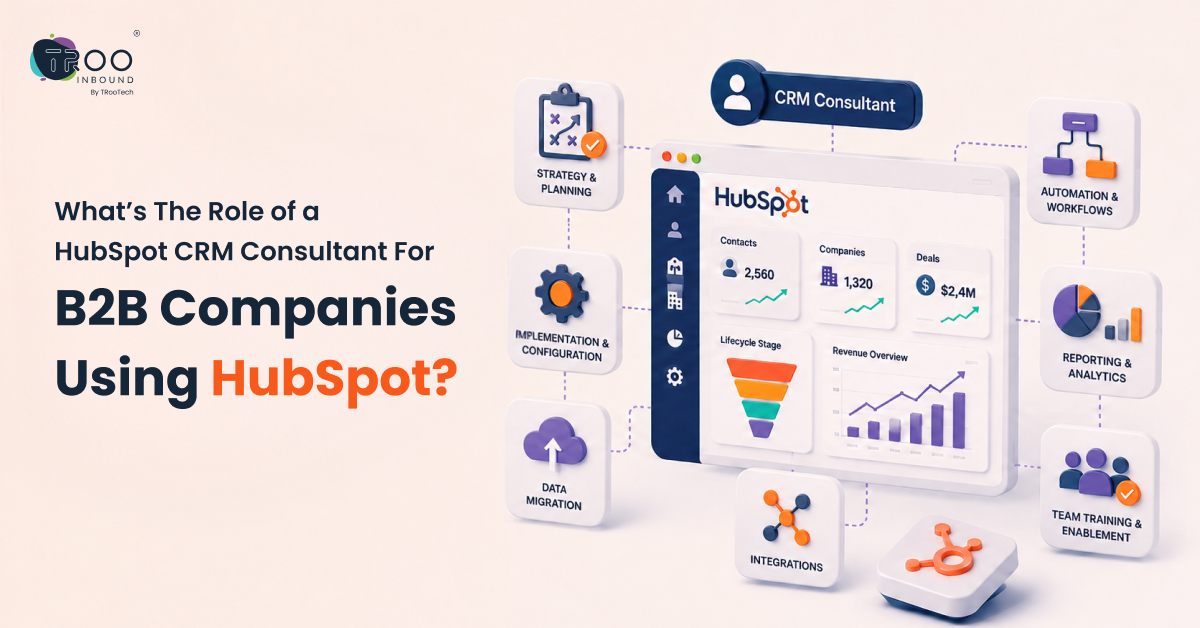
A HubSpot CRM consultant is responsible for planning, configuring, implementing, integrating, and optimizing HubSpot to ensure it aligns with your sales, marketing, customer, and revenue operations. Your consultant will not just configure CRM features, but will also analyze how your business works and build HubSpot to align with your processes and objectives.
When you work with a HubSpot CRM consultant, you can expect support with:
- Developing your CRM strategy: Your consultant aligns HubSpot with your sales processes, customer journey, revenue objectives, and business goals.
- Configuring and implementing HubSpot: You can get support with setting up pipelines, lifecycle stages, lead statuses, properties, permissions, views, and other CRM components.
- Migrating and organizing your data: Your consultant can map, clean, and migrate contacts, deals, companies, and activities from spreadsheets or another CRM while maintaining data quality.
- Automating your business processes: You can automate repetitive activities such as lead assignment, follow-ups, notifications, lifecycle updates, and sales handoffs.
- Integrating your business systems: Your consultant can connect HubSpot with your ERP, customer support, finance, communication, sales, and other business platforms to lower disconnected data.
- Improving your reporting: You can get dashboards and reports that give your sales, marketing, and leadership teams better visibility into pipeline and revenue performance.
- Supporting your team’s adoption: Your consultant can provide documentation, training, and process guidance to help your teams use HubSpot effectively.
- Optimizing your existing portal: You can identify issues such as unnecessary properties, complex workflows, inconsistent pipelines, duplicate data, and reporting gaps through regular CRM audits.
Why Do B2B Companies Need a HubSpot CRM Consultant?
A HubSpot CRM consultant might be required if your CRM is becoming more difficult to manage, your data is becoming inconsistent, or your sales and marketing teams are using HubSpot differently. The value of consulting is not in creating more workflows or dashboards. It’s about creating a CRM that allows you to have cleaner data, cleaner processes, less manual labor, and more visibility of your revenue.
Better CRM Data
Reliable CRM data is crucial for your reports, workflows, and sales decision-making. A consultant assists you in organizing properties, stages of the life cycle, ownership rules, contacts, companies, and deals in a consistent way. They can also detect duplicate, incomplete, or incorrect records that will impact the reporting.
Less Manual Work
Your teams could take some time to assign leads, mark up records, create tasks, send notifications, or migrate data from one system to another. A consultant will determine which repetitive processes can be automated, while keeping room for humans where it adds value.
Improved Marketing and Sales alignment
Leads, qualifiers, and handoffs may be defined differently by your marketing and sales department, which can result in missed opportunities. A consultant works with both teams to define common lifecycle phases, qualification criteria, ownership requirements, and handoff procedures, ensuring everyone understands their requirements and knows what happens next.
Greater Pipeline Visibility
A list of open deals is not enough to be knowledgeable about your revenue pipeline. With a well-designed CRM, well-defined deal stages, trusted data, and relevant dashboards, you will gain greater visibility of pipeline value, conversions, sales activity, bottlenecks, and revenue opportunities.
A CRM that Promotes Growth
As your business expands, you can create new teams, products, business units, or technology systems. A consultant can help you build a scalable CRM foundation that evolves with your business, reducing the need for frequent restructuring.
When Should a B2B Company Hire a HubSpot CRM Consultant?

You should consider hiring a HubSpot CRM consultant when your CRM decisions start affecting multiple teams, systems, or revenue processes. This is often the case when you are implementing HubSpot, scaling your operations, or when your existing CRM no longer meets your business needs.
Implementing HubSpot for the First Time
Your initial CRM decisions can affect how easily you manage HubSpot later. A consultant will help you establish the appropriate properties, pipelines, lifecycle stages, permissions, workflows, and reporting structure from the very beginning. This HubSpot CRM setup approach can help save time and money for reworking.
Migrating From Another CRM
Transferring contacts is only one part of migrating to HubSpot. You may also need to migrate companies, deals, activities, owners, products, custom fields, and historical data while preserving the relationships between records.
HubSpot Portal Has Become Difficult to Manage
If you’ve got unused properties, duplicate workflows, lists that are outdated, naming inconsistencies, or unclear pipelines, then it might be time for a CRM audit. A consultant can spot the areas that need to be cleared up, streamlined, or reorganized.
Teams Still Rely on Spreadsheets
Your HubSpot setup might not accurately represent your sales and marketing practices if you routinely export your CRM data to manage leads, deals, or to create reports. A consultant will help uncover these gaps and decide which processes can be introduced into HubSpot.
Sales and Marketing Lack a Shared Customer View
Leads, qualification criteria, lifecycle stages, and ownership may be defined differently across teams, leading to inefficient handoffs. A consultant can help establish shared processes that ensure both teams understand where each prospect is in the customer journey and what action should be taken next.
Workflows Are Difficult to Maintain
With increased automation, workflows can become complex or conflicting. A consultant can analyze your automation, uncover redundant or conflicting workflows, define the business logic, and then redesign processes based on the business logic.
Reporting Doesn't Give Leadership Useful Answers
If your leadership team is still dependent on spreadsheets to track pipeline, conversions, or revenue, it may be time to enhance your reporting. A consultant can review your dashboards, reporting needs, and data to provide better visibility into your sales performance.
Need to Connect HubSpot With Other Systems
When you need to connect HubSpot to ERP, finance, customer service, or other business systems, your consultant can help you plan for the integration by mapping, syncing, owning, and governing the data before you start.
Business Is Growing Faster Than Your CRM
As your business expands across teams, markets, products, territories, or sales processes, your existing CRM may struggle to keep up. A B2B CRM consultant can help you restructure and optimize the portal to meet your current requirements while preparing for future growth.
Now a question might arise whether you should hire a specialist HubSpot CRM consultant or manage the requirements in-house. The following section helps you understand the difference and applications of both.
HubSpot CRM Consultant vs. Managing It In-House
If your CRM setup is relatively simple and your team has the time and expertise to manage it, handling HubSpot in-house can work well. However, as your business grows, your CRM requirements can become more complex, affecting sales, marketing, reporting, automation, integrations, and data management.
| Your in-house Team | HubSpot CRM Consultant |
|---|---|
| Understands your customers, teams, and internal processes | Brings specialized HubSpot and CRM expertise |
| Knows your business priorities and day-to-day requirements | Brings experience across different CRM environments and B2B use cases |
| May have limited experience with complex implementations | Supports implementation, migration, automation, reporting, and integrations |
| Often manages HubSpot alongside other responsibilities | Focuses specifically on CRM strategy and project requirements |
| Handles day-to-day CRM administration | Provides specialist guidance and recommendations |
| Addresses issues as they arise | Evaluates how CRM changes affect the wider system |
For many B2B companies, the decision does not have to be an either-or choice. Your internal RevOps, Sales Ops, Marketing Ops, IT, or CRM team understands your business, processes, reporting requirements, and how your teams use HubSpot. This internal knowledge is valuable when making CRM decisions.
A HubSpot CRM consultant brings additional expertise in areas such as CRM architecture, implementation, data migration, workflows, integrations, reporting, and broader optimization initiatives. They can also help you assess how changes to one process may affect other teams, workflows, or systems.
For many B2B companies, the most practical approach is to combine internal ownership with external expertise. Your team retains ownership of the CRM and business processes, while a consultant provides specialized HubSpot expertise, additional capacity, or support for complex CRM projects.
How to Choose the Right HubSpot CRM Consultant

Selecting the right HubSpot CRM consultant is not just about finding someone who knows how to configure the platform. You need a consultant who can understand how your HubSpot CRM strategy connects with your sales process, marketing operations, data, automation, reporting, and integrations.
When evaluating a consultant, consider the following:
1. HubSpot Expertise
Look for a consultant with experience across the HubSpot Hubs relevant to your business, such as Sales Hub, Marketing Hub, Service Hub, Operations Hub, and Commerce Hub. They should also understand your HubSpot subscription and be able to determine which features and capabilities are available to you. Their recommendations should align with your subscription, business requirements, and growth plans.
2. B2B Experience
Your consultant should understand the complexities of the B2B sales cycle, including longer buying cycles, multiple decision-makers, lead qualification, account ownership, opportunity management, and marketing-to-sales handoffs. This experience helps ensure that HubSpot is configured to reflect how your B2B sales process works accurately.
3. Sales and Marketing Operations Knowledge
A good consultant should first understand how you capture leads, qualify prospects, manage opportunities, hand leads to sales, and measure performance. HubSpot should be configured around your business processes and requirements rather than forcing your teams to adapt to an inflexible CRM setup.
4. CRM Implementation Experience
Ask about the consultant’s implementation methodology. A well-structured HubSpot CRM implementation process will typically include discovery, requirements gathering, solution design, configuration, testing, deployment, and post-launch support. This helps reduce implementation risks and ensures the CRM is aligned with your business requirements before launch.
5. Integration Capabilities
Your HubSpot CRM may need to connect with your ERP, accounting software, customer service platform, marketing applications, or internal business systems. Evaluate the consultant’s experience with native integrations, APIs, middleware, field mapping, data synchronization, and integration governance.
6. Data Migration Experience
Ask how the consultant approaches data mapping, cleansing, deduplication, relationship mapping, testing, and validation. The goal is not simply to move data into HubSpot but to ensure that the migrated data is accurate, structured, and usable without carrying unnecessary problems from the previous system.
7. Automation Expertise
Automation should be built around your business logic and specific operational requirements. Ask how the consultant determines what should be automated, how exceptions are handled, and how unnecessary workflow complexity is avoided. Effective automation should simplify processes rather than create additional maintenance challenges.
8. Reporting and Analytics Knowledge
Your consultant should be able to translate business and leadership questions into the right CRM structure, dashboards, and reports. This requires a strong understanding of data quality, lifecycle stages, pipelines, attribution, activity tracking, and reporting requirements.
9. Training and Ongoing Support
Your CRM implementation does not end when the portal goes live. Ask about user training, documentation, administrator support, troubleshooting, and ongoing optimization. A consultant who provides post-launch support can help your team maintain the CRM and adapt it as your business evolves.
10. Understanding of Your Business
Above all, your consultant should take the time to understand your goals, teams, processes, challenges, and existing technology environment before recommending changes. The right consultant should provide recommendations based on how your business operates, rather than applying a generic HubSpot setup.
How TRooInbound Helps B2B Companies Get More From HubSpot
TRooInbound is a HubSpot Diamond Solutions Partner that works with B2B companies to plan, implement, migrate, integrate, and optimize HubSpot around their business and revenue processes. Its HubSpot CRM services include CRM consulting, implementation and onboarding, CRM migration, integrations, automation, reporting, and optimization.
We begin by understanding your business needs and requirements, including your objectives, sales and marketing processes, teams, data, existing systems, and CRM challenges. We then configure HubSpot around these requirements, whether you are implementing HubSpot for the first time, migrating from another CRM, restructuring an existing portal, or improving automation and reporting.
The goal is to build a scalable HubSpot CRM that connects your teams, processes, and data while supporting your business growth.
Final Thoughts
A HubSpot CRM consultant helps B2B companies align HubSpot with their sales, marketing, data, and revenue processes. From CRM setup and migration to automation, integrations, reporting, and optimization, the focus is on making HubSpot work effectively for the business.
Whether you are implementing HubSpot, restructuring Sales Hub, or improving an existing portal, the right approach starts with understanding your processes and requirements.
If your HubSpot setup is difficult to manage or no longer supports your teams, TRooInbound can help identify gaps and recommend the right improvements. Talk to our experts to discuss your requirements.
FAQs
Read Popular Questions
What does a HubSpot CRM consultant do?
A HubSpot CRM consultant helps B2B companies align HubSpot with their sales, marketing, customer, and revenue processes. Their work can include CRM strategy, implementation, data migration, workflow automation, system integrations, reporting, user training, and ongoing portal optimization. Their role goes beyond technical configuration to ensure HubSpot supports real business processes and goals.
When should a B2B company hire a HubSpot CRM consultant?
A B2B company should hire a HubSpot CRM consultant when CRM requirements become complex or start affecting multiple teams and systems. Common situations include implementing HubSpot for the first time, migrating from another CRM, improving an existing portal, connecting business systems, automating processes, or creating a shared customer view across sales and marketing.
What's the difference between a HubSpot CRM consultant and managing HubSpot in house?
An in-house team brings detailed knowledge of your business, customers, and internal processes, while a HubSpot CRM consultant provides specialized expertise in implementation, migration, automation, integrations, and CRM optimization. Many B2B companies use a combination of both, with internal teams managing daily CRM operations and consultants supporting complex projects and strategic improvements.
How much does HubSpot CRM consulting cost?
HubSpot CRM consulting costs depend on the scope and complexity of the project. Factors such as data migration, number of integrations, automation requirements, customization, reporting needs, and user training can influence the overall cost. Most consultants provide a project estimate after understanding the company’s CRM requirements and business processes.
What should you look for when choosing a HubSpot CRM consultant?
Look for a HubSpot CRM consultant with relevant Hub expertise, B2B experience, and a proven approach to implementation, migration, automation, integrations, and reporting. You should also evaluate their understanding of your business processes, communication approach, and ability to provide a CRM strategy tailored to your goals rather than relying on a standard setup.