
For 15 years, HubSpot’s flagship event was known as INBOUND. In 2026, that changed. The new name was more than an event rebrand. HubSpot said the shift reflects how growth now extends across the entire customer journey and increasingly depends on AI, connected systems, and coordination between teams.
UNBOUND 2026 took place in Boston from September 16 to 18, bringing together marketing, sales, service, operations, product, AI, and growth leaders across an agenda with 296 listed sessions.
That broader definition of growth was visible throughout all three days.
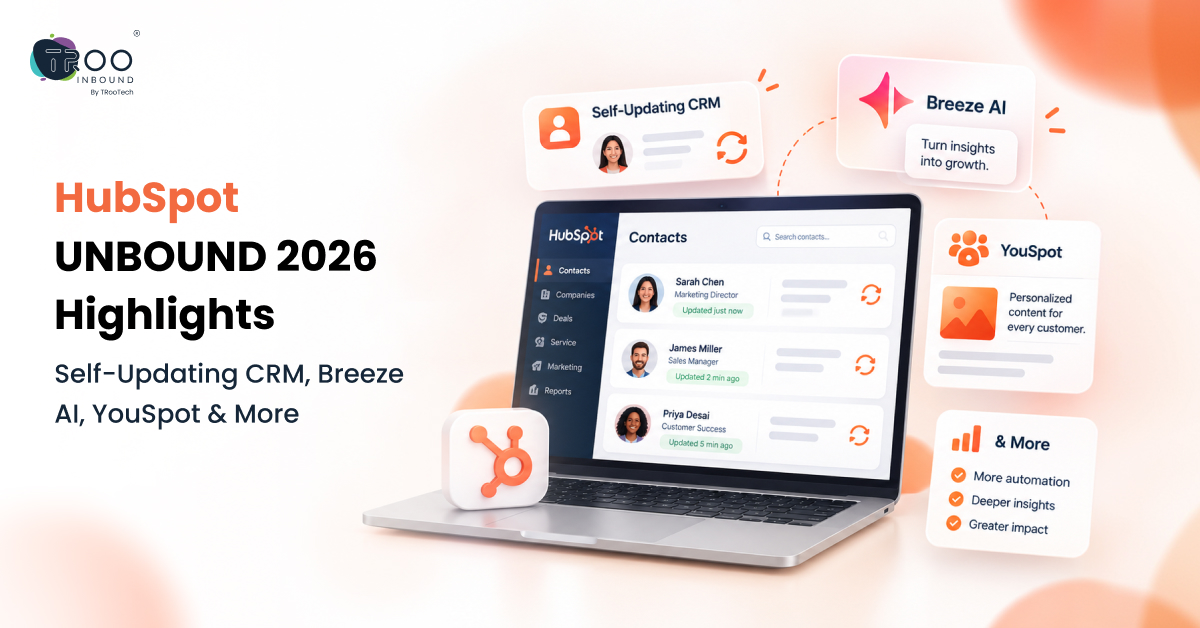
HubSpot introduced a self-updating Smart CRM, Growth Context, Context Home, a rebuilt Breeze Assistant, Marketing Studio, updates for sales and customer service, and an expanded partnership with OpenAI.
Dharmesh Shah spoke about the “Age of the Builder” and introduced a different way of thinking about CRM through YouSpot. Kipp Bodnar and Kieran Flanagan presented Loop Marketing. Sessions examined AEO, AI-era buyer journeys, GTM design, data infrastructure, leadership, and the growing role of AI in demand generation.
Trying to recap every session would miss the bigger story. Instead, these are the HubSpot UNBOUND 2026 highlights that matter most for businesses using HubSpot and for marketing, sales, RevOps, and GTM teams planning what comes next.
TL;DR:
- HubSpot is making a self-updating Smart CRM, so customer context does not depend entirely on manual data entry.
- Growth Context and Context Home are intended to give HubSpot's AI a clearer understanding of a company's customers, business, teams, and processes.
- Breeze Assistant is shifting from primarily answering questions toward helping users execute work.
- Marketing Studio connects campaign planning, content, automation, customer data, and AI-supported execution.
- YouSpot offers a glimpse at what an AI-native CRM designed around automatically built business context could look like.
- Loop Marketing reframes marketing around continuous cycles of Express, Tailor, Amplify, and Evolve.
- AEO is moving into the wider demand-generation conversation as buyer research spreads across traditional search and AI platforms.
- HubSpot's partnership with OpenAI now extends to a ChatGPT Ads integration.
- Better AI does not reduce the importance of CRM architecture, data quality, RevOps, governance, or human judgment. It increases it.
Why Did INBOUND Become UNBOUND?
INBOUND reflected HubSpot’s original growth philosophy, which was largely focused on inbound marketing. But as buyer behavior and go-to-market strategies have evolved, HubSpot has expanded to support the full customer journey across marketing, sales, service, and operations. The shift from INBOUND to UNBOUND reflects that broader vision of helping businesses connect teams, data, technology, and customer experiences across the entire growth process.
That doesn’t mean that their foundation has disappeared; instead, it means that HubSpot wants to offer its customers:
- Unexpected connection
- Unleashed potential &
- Unmatched opportunities
all within one platform.
And the 2026 event reflected that shift clearly.
UNBOUND was not simply three days of marketing tactics. It became a conversation about how companies need to organize data, technology, teams, channels, and AI around the complete growth system.
Day 1 Set t he Tone: HubSpot Wants the CRM to Do More of the Work
Yamini Rangan, HubSpot’s CEO, opened one of the biggest conversations of Day 1 with a gap that is hard to ignore. She shared that while roughly 90% of companies are already using AI, only 6% are seeing truly transformative results from it.
That raises an obvious question: what are those 6% doing differently?
The companies getting more value from AI tend to do three things right:
- The fundamentals
- Staying focused on business outcomes
- Then invest in AI alongside the people who will use it
That idea became a useful lens for many of HubSpot’s UNBOUND 2026 announcements. The message was not simply to add more AI tools. It was to create a connected system where CRM data, customer context, automation, teams, and AI can work together.
And that is where HubSpot’s product direction becomes especially interesting.
Instead of treating CRM as a system that waits for people to constantly update it, HubSpot is moving toward a platform that can capture more information automatically, understand what is happening across the customer journey, and help teams decide what to do next.
One of the clearest examples of that shift is the new self-updating Smart CRM.
The Self-Updating Smart CRM Reduces Dependence on Manual Updates

CRMs have traditionally required substantial manual maintenance. But HubSpot’s self-updating Smart CRM is designed to reduce some of that administrative work.
According to HubSpot, it can automatically capture calls, emails, and meetings so records remain more current as people work.
The significance of this CRM goes beyond saving data-entry time. If AI is going to recommend a next step, personalize outreach, analyze a deal, answer a service question, or execute a workflow, the quality of that action depends on the information available to it.
A CRM that becomes more current through everyday activity can therefore serve two roles: maintaining customer records and supplying the context AI needs to work.
Here’s where two important concepts of this smart CRM comes into play:
1. Growth Context
Growth Context is a core component of the self-updating Smart CRM. It brings together information about the business, customers, teams, processes, and GTM activity so HubSpot has more than isolated contact or company records to work with.
That broader context can help AI understand how a business operates, what matters to a customer, where an opportunity stands, and which actions may be relevant next. Instead of relying only on individual CRM fields, HubSpot can use connected business and customer information to support more informed recommendations and automation.
But collecting context is only useful if teams can see what HubSpot knows, identify what is missing, and correct information when needed. That is where Context Home comes in.
2. Context Home
Context Home gives teams a centralized place to review and manage the business context that HubSpot uses across its AI capabilities.
It helps users understand what information is available, spot gaps or outdated details, and improve the context that AI relies on when supporting marketing, sales, service, and other GTM activities.
Together, Growth Context and Context Home make the Smart CRM more useful as an AI foundation. One brings more connected business information into the CRM, while the other gives teams greater visibility and control over that context.
Once that foundation is in place, HubSpot can do more than simply organize information. It can use that context to help users complete work, which is where the rebuilt Breeze Assistant becomes important.
Breeze Assistant Is Moving From Answering to Doing

The rebuilt Breeze Assistant is intended to work throughout HubSpot and use business context when helping users create and execute work.
HubSpot’s examples include starting campaign plans, drafting nurture emails, creating landing pages, and performing other GTM activities using the information the platform already has about the brand, customers, and campaigns.
Instead of switching among separate AI tools for content, research, reporting, prospecting, and analysis, HubSpot is attempting to make AI part of the environment where the customer data and workflows already exist.
Marketing Studio Connects Insight With Campaign Execution

HubSpot Marketing Studio takes the same idea into demand generation.
HubSpot positions it as a shared workspace where marketing teams can move from an insight to an active campaign while coordinating AI agents through Breeze Assistant. Campaign planning, content, automation, customer information, and performance learning can increasingly sit within the same workflow.
That matters because marketing technology has become fragmented.
Teams may research in one tool, plan campaigns in another, create content somewhere else, build landing pages in a CMS, manage audiences in the CRM, run ads in another platform, and then bring the resulting data back together for reporting.
HubSpot’s direction is to reduce the distance between recognizing an opportunity and acting on it.
The wider goal is not simply to create more content with AI. It is to use customer and performance context to improve how campaigns are planned, executed, and refined.
Sales and Service Are Becoming More Agentic Too

Day 1 wasn’t only focused on marketing.
The Prospecting Agent can monitor target accounts for buying signals, evaluate those accounts against an ICP, source contacts, and prepare personalized outreach. Deal Progression analyzes emails, calls, and meetings to recommend actions, draft follow-ups, and update CRM information.
Customer service follows the same pattern.
HubSpot says Customer Agent can respond across chat, email, voice, and social while drawing on purchase and support history. When human involvement is required, the conversation can be handed over with the surrounding context attached.
Viewed separately, these can look like individual AI features. Viewed together, they show the larger strategy.
Dharmesh Shah's “Age of the Builder” Added Another AI Perspective - YouSpot
HubSpot co-founder and CTO Dharmesh Shah took the Main Stage on Day 1 for “Growing Better In The Age Of The Builder.”
He introduced YouSpot, an AI-native Solo CRM from HubSpot Next.
It is specifically designed for one-person businesses such as founders, consultants, freelancers, creators, authors, and investors. Dharmesh Shah has explicitly said that it is not designed for GTM teams, for which he recommends HubSpot.
So why should larger HubSpot customers care about it? Because the design idea behind YouSpot is worth watching.
Traditional CRMs assume the user maintains the record. YouSpot instead aims to construct what it calls a CRM second brain from the context surrounding a person’s business relationships and activities. HubSpot’s Marketplace similarly describes YouSpot as an AI-native application for building a CRM second brain.
Users can connect sources and let the system retain information about relationships, conversations, follow-ups, and potential opportunities. The context can also be accessed through compatible AI applications using MCP.
The CRM is becoming less dependent on people documenting every interaction and more capable of interpreting business activity for itself.
For RevOps teams, that does not mean administration disappears.
It means administration may increasingly focus on data architecture, permissions, processes, governance, context, agent access, and rules for when people remain responsible for the final decision.
Day 2: The Main Focus Was On GTM Teams
Day 2 shifted much of the conversation from product announcements toward how GTM teams should operate.
AI Broke The Old Marketing Playbook. Here's What Replaces It
One of the most important sessions came from HubSpot CMO Kipp Bodnar and Kieran Flanagan: “AI Broke the Old Marketing Playbook. Here’s What Replaces It.”
Their answer was Loop Marketing.
The Loop Marketing framework contains four recurring stages:
- Express establishes what the brand stands for and how it communicates.
- Tailor adapts messaging using customer context.
- Amplify distributes that message across the channels where buyers and answer engines encounter it.
- Evolve uses performance information and AI-supported analysis to improve the next cycle.
The key idea is not that marketing funnels suddenly cease to matter. It is that modern marketing cannot be managed effectively as a series of isolated campaigns.
Buyers may move between Google, ChatGPT, LinkedIn, Reddit, YouTube, comparison pages, newsletters, review sites, sales conversations, and a company’s website in no predictable order.
Marketing therefore needs faster feedback between audience insight, messaging, distribution, and performance.
What Today's Winning GTM Leaders Do Differently
The operating model behind GTM was another recurring theme on Day 2.
Michael Hartman of Anthropic appeared in “What Today’s Winning GTM Leaders Do Differently,” while Tasso Argyros of Databricks and HubSpot’s Adam Cuzzort discussed “From Data Strategy to AI Execution.”
The two conversations connect.
Giving marketing an AI content tool, sales an AI prospecting tool, and service an AI agent does not automatically create an AI-ready revenue organization.
If lifecycle stages are inconsistent, account ownership is unclear, integrations are unreliable, sales and marketing disagree on definitions, customer data is duplicated, or important activity sits outside the CRM, AI inherits those weaknesses.
The more responsibility companies give AI, the more important the underlying operating system becomes.
For RevOps, this creates a larger role rather than a smaller one.
Someone still has to determine what should happen, which system owns which information, when automation should trigger, how teams hand work to one another, and where human review remains necessary.
The Databricks and HubSpot Conversation
Data hygiene used to be discussed mainly in the context of reporting.
Poor data produced poor dashboards, weak segmentation, unreliable attribution, duplicate outreach, and frustrated salespeople. Those problems still exist. But AI adds another consequence.
An agent that works from incomplete customer context may recommend the wrong action. An assistant using outdated product or process information can produce an inaccurate response. Automation built on unreliable lifecycle information can send a customer down the wrong path.
That is why the Databricks and HubSpot conversation about data infrastructure matters.
Most organizations are not short of data. The harder problem is making that data trustworthy, connected, and usable by the systems expected to act on it.
For many businesses, preparing for AI may therefore begin with something much less glamorous than launching another agent:
Day 3: AI Is Changing The Way We Used To Stay Visible on the Internet
By Day 3, another major shift was impossible to ignore: AI is changing not only how teams work, but also how buyers find information.
Inside HubSpot's AI Search Lab: 7 AEO Experiments
The session covered seven real Answer Engine Optimization experiments, including what worked, what failed, what surprised the team, how tests were prioritized, and how successful ideas became repeatable practices.
That level of attention is important.
AEO is moving beyond an experimental SEO topic and into mainstream marketing strategy. But that doesn’t mean SEO is dead.
Traditional SEO still matters. People continue to use Google and other search engines. But the fact is: the research journey is expanding.
A prospect might ask ChatGPT for software recommendations, search Google for alternatives, read Reddit discussions, watch a YouTube comparison, check LinkedIn commentary, and visit several vendor websites before making contact.
Brands therefore need to think beyond rankings and website traffic alone.
They also need to ask whether their expertise, positioning, products, services, proof, and brand information can be understood and represented accurately across AI-driven research environments.
HubSpot and OpenAI Are Taking ChatGPT Further Into Demand Generation
One of the biggest Day 3 conversations came from HubSpot CMO Kipp Bodnar and OpenAI CMO Colin Fleming in “Beyond the Click: AI, Ads, and What’s Next.”
The session focused on the partnership behind ChatGPT Lead Gen Ads and what AI-native buyer journeys could mean for demand generation.
At UNBOUND, HubSpot also announced an expansion of its OpenAI partnership that includes a CRM integration for ChatGPT Ads. HubSpot says customers can build, manage, and measure campaigns while connecting advertising activity with CRM context and outcomes.
This is worth watching because conversational AI could change more than the location of an advertisement.
The traditional paid search path often looks something like:
Search → Ad → Landing Page → Form → CRM
Conversational environments create different possibilities.
A buyer may already be asking detailed questions, comparing solutions, narrowing options, or expressing commercial intent within an AI conversation before reaching a company’s website.
For marketers, that creates new questions around first-party data, audience strategy, attribution, conversion, messaging, CRM integration, and the relationship between paid AI visibility and organic AEO/GEO.
ChatGPT Ads should therefore be viewed as another emerging demand channel, not as a replacement for Google Ads, SEO, paid social, or existing acquisition strategies.
UNBOUND 2026 Was Also About Execution, Adaptability, and Leadership
Not every important lesson at UNBOUND was a HubSpot product announcement.
Former NASA astronaut Sunita Williams spoke about operating in situations where conditions can change quickly, and the margin for error is extremely small. Jay Schwedelson focused on speed, visibility, and action as knowledge becomes easier to access. Max Junestrand of Legora discussed how a company can compete without being first by learning from earlier entrants and making product velocity part of its culture.
The event concluded with Tom Brady and HubSpot co-founder Brian Halligan discussing what sustained performance at scale requires, including leadership, reinvention, decision-making, and building organizations that can perform under pressure.
These sessions may sound separate from conversations about CRM and AI, but they reinforce the same point.
When technology makes more capabilities widely available, execution becomes a larger differentiator.
AI can increase capacity.
It cannot determine the right strategy, organizational structure, customer promise, operating principles, or risk tolerance for a company.
The Biggest UNBOUND 2026 Highlights Takeaway: AI Needs a Better Growth System Around It
HubSpot UNBOUND 2026 covered a lot.
- A self-updating CRM
- Growth Context
- Context Home
- A rebuilt Breeze Assistant
- Marketing Studio
- Sales and service agents
- YouSpot
- Loop Marketing
- AEO
- ChatGPT Ads
- New approaches to GTM, data, experimentation, execution, and leadership
But underneath all of these announcements is one consistent direction.
CRM is becoming a source of context, AI is becoming part of execution, and the boundaries between marketing, sales, service, operations, and revenue are becoming harder to maintain as separate systems.
At TRooInbound, we see HubSpot in the same way. Access to more functionality alone does not create a better revenue system. The platform needs to be configured around how the business actually markets, sells, serves customers, manages data, and measures growth.
As a HubSpot Diamond Solutions Partner, we help businesses connect HubSpot implementation, CRM architecture, integrations, automation, RevOps, demand generation, SEO, AEO/GEO, and ongoing optimization into a system designed around measurable business outcomes.
UNBOUND 2026 showed where HubSpot is heading.
The next question is whether your HubSpot environment is ready to go there.