
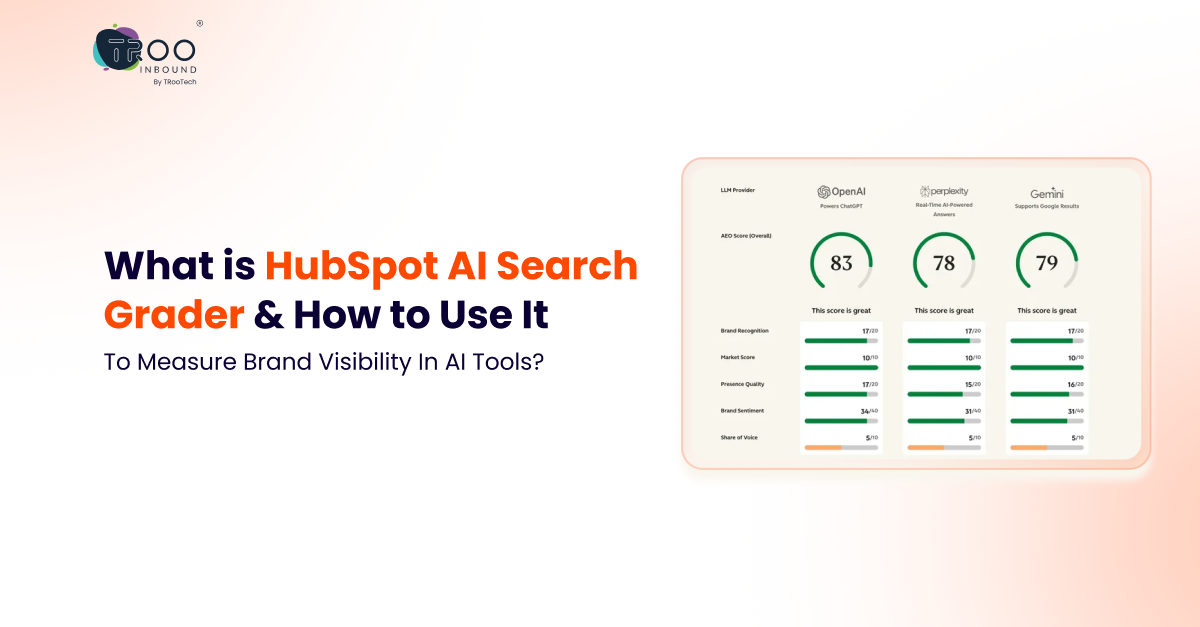


HubSpot’s AI Search Grader, formerly known as AEO Grader, is a free tool designed to analyze and improve your brand’s recognition, market score, presence quality, brand sentiment, and share of voice across AI-powered platforms like ChatGPT, Perplexity, and Gemini. It generates a score out of 100 based on how frequently and positively your brand is cited.
In this blog, we will understand in depth what this tool is built for and the simple steps to use it to measure your brand’s AI-visibility.
Let’s Start With Basics: What Is AEO? Why Does AI Search Visibility Matter?
AEO, or Answer Engine Optimization, is the practice of creating and structuring website content so that AI-powered search and answer engines can understand, reference, and present it when users ask relevant questions.
Traditional SEO focuses on helping webpages rank prominently in search results and drive clicks to the website. AEO focuses on making your content and brand more likely to appear in answers generated by platforms such as ChatGPT, Perplexity, and Google’s AI search features.
This shift matters because search is becoming less dependent on users clicking through a list of links. According to a 2026 SparkToro study reported by Search Engine Land, 68.01% of Google searches in the U.S. ended without a click during the first four months of 2026, up from 60.45% in 2024. The research also found that AI Overviews appeared on more than 20% of Google searches, with click-through rates falling by nearly 60% when they appeared.
This creates a new visibility challenge for businesses. It is no longer enough to ask, “Does my website rank?”
Businesses also need to ask:
“Does my brand appear when potential customers ask AI tools questions related to what we offer?”
This is where AI search visibility and AEO measurement tools become important. Businesses need ways to understand how AI platforms represent their brand, how they compare with competitors, and where visibility gaps exist.
One such tool is HubSpot’s AI Search Grader, which can help businesses assess their visibility across AI search platforms and understand how their brand is represented in AI-generated answers.
The goal is not simply to rank higher. It is to make your brand visible, relevant, and credible when your potential customers are looking for answers.
What Problem Does The HubSpot AI Search Grader Solve?
The AI Search Grader tool solves the problem of knowing how your brand is visible on AI-driven search platforms by scoring your business based on different metrics like how often it is cited, the sentiment of those mentions, and how it is compared to competitors.
It helps SEO experts bridge the gap between traditional SEO and AEO by providing actionable insights on how to improve visibility in conversational search queries and close gaps that are hindering the brand’s AI visibility.
The 5 Dimensions the AI Search Grader Measures
1. Sentiment Analysis (Maximum 40 Points)
Sentiment analysis is AEO Grader’s highest-weighted dimension that assesses the complete tone of answer engines use for characterizing your brand. This score is based on three layers:
- General sentiment: It shows the overall negative, positive, or neutral tone of AI descriptions about your brand.
- Contextual sentiment: It shows how sentiments differ across topics and use cases
- Source-based sentiment: It shows the credibility and reliability of sources that are influencing how AI tools represent your brand.
A high sentiment score means AI platforms describe you in good, favorable terms. Phrases like “praised for intuitive interface” or “recognized for strong customer support” show positive indicators.
On the other hand, a low score might mean AI is echoing negative reviews, forum complaints, or outdated press coverage that made its way into training data.
2. Presence Quality (Maximum 20 Points)
Presence quality means scoring your website beyond AI mentions. It measures how substantively AI discusses your brand.
Presence quality measures your brand based on three components:
- Mention depth: It shows how considerably AI search engines discuss your brand in depth.
- Source quality: It shows the authority of sources that AI is trained on to understand your brand.
- Data richness: The completeness and variety of content, data and information available about your brand in the AI training data.
A low presence quality score often points to thin website content, limited third-party coverage, or inconsistent messaging across channels. It means AI knows your name but not much else.
A low presence quality score can indicate that your brand has limited website content, weak third-party coverage, or inconsistent information across channels. It means AI knows your name but not much else.
3. Brand Recognition (Maximum 20 Points)
Brand recognition means how widely your brand is recognized and known across AI training data.
A high score means answer engines can speak and discuss your brand in depth and specificity. It can describe what you do, who you serve, what you are known for, and how you compare to competitors.
Meanwhile, a low recognition score usually means AI can confirm you exist but cannot say much more. For newer companies, niche businesses, or brands that have not yet generated substantial third-party coverage in high-authority publications, getting a low recognition score is common.
4. Share of Voice (Maximum 10 Points)
Share of Voice helps to assess your brand’s competitive presence in AI responses relative to your genre/category.
For example: If someone asks an AI about, say, HubSpot onboarding services or inbound marketing agencies, what percentage of category-level responses include your brand?
This score includes your estimated percentage of category voice plus a rank bonus for appearing consistently near the top of AI-generated category mentions. A strong share of voice score indicates that AI frequently includes your brand when discussing your market segment.
5. Market Position (Maximum 10 Points)
Market position score shows how AI platforms classify your competitive standing. There are two components that contribute to this score:
There are two components that contribute to this score:
- Category role: It shows whether AI sees you as a Leader, a Challenger, or a Niche Player in your market
- Innovation perception: It shows whether AI characterizes you as an Innovator, a Disruptor, or a Traditionalist
A low market position score typically means AI has inconsistent or insufficient signals about where your brand stands competitively. It may know you exist without being sure where to place you on the competitive landscape.
After understanding how HubSpot AEO Grader scores your brand based on 5 different factors, let’s see how to use it to measure your AI visibility.
After understanding how HubSpot AI Search Grader scores your brand based on 5 different factors, let’s see how to use it to measure your AI visibility.
How to Use the HubSpot AI Search Grader: Step-by-Step
Step 1: Go to hubspot.com/aeo-grader
Step 2: Enter Your Brand Information
You will fill in four fields. Enter your company name, your location or geographic market (this can be a city, country, region, or global), your product or service described as your customers would describe it, and your industry. The more specific and accurate your entries, the more relevant your results will be.
You can also enter a competitor’s information to run a side-by-side comparison.
Step 3: Let the Analysis Run
The tool sends your brand information to leading AI models simultaneously, currently including an OpenAI model based on GPT 5.4, Perplexity, and Gemini. Each model evaluates and characterizes your brand based on the information available to it. The tool then applies deterministic scoring and schema validation to generate a composite AEO score.
Step 4: Access Your Full Report
How to Interpret Your HubSpot AI Search Grader Score
Scoring interpretations will vary by industry and competitive set, but here is a general framework for reading your results.
- A score between 70 and 100 suggests that your brand is well-represented in AI search engines. This is the range where brands appear consistently in AI-generated recommendations and comparisons.
- A score between 40 and 69 suggests that your brand has some recognition, but gaps exist. You may score well on sentiment but poorly on presence quality, or vice versa. This is where most mid-sized businesses currently land.
- A score below 40 suggests significant under-representation. AI platforms either have limited information about your brand or the information they have is incomplete, inconsistent, or coming from lower-quality sources.
If your brand’s score is below 40, it is not a setback. It is a starting point. Instead of focusing only on the overall score, look at the specific dimensions bringing it down. Addressing those gaps systematically can help strengthen your AI search visibility and improve your score over time.
You can hire SEO experts who can help you with foundational SEO as well as advanced AEO to improve your brand’s discovery among different AI tools.
Limitations of Free HubSpot AI Search Grader:
The free AI Search Grader is a useful starting point for understanding how AI platforms perceive your brand and where visibility gaps may exist. However, it is important to understand what it can and cannot tell you.
1. It Provides a Snapshot, Not Continuous Monitoring
The score reflects your brand’s AI search visibility at a particular point in time. AI models, search results, and the information available to them can change, so a single assessment cannot show how your visibility evolves. Periodic reassessment is important if you want to track progress over time.
2. You Have Limited Control Over Prompts
The free grader uses predefined prompts to evaluate your brand. This means you cannot fully customize the questions based on your specific products, services, target audience, or search priorities.
3. Suggested Competitors Need to Be Validated
The grader may suggest competitors for comparison, but these recommendations should not be treated as automatically accurate. Review whether the suggested companies actually compete for the same market, audience, and business opportunities before using the comparison to make decisions.
Free AI Search Grader vs. Paid HubSpot AEO Platform
The AI Search Grader, also referred to as AEO Grader, serves as a useful starting point for benchmarking your AI search visibility. It provides a quick, no-login assessment of how your brand appears across AI search platforms and where potential visibility gaps may exist.
However, a single assessment is only a snapshot of your brand’s visibility at a specific point in time. For businesses that want to track changes over time, HubSpot also offers a paid AEO tool designed for ongoing monitoring and analysis.
The paid platform provides greater control over prompt tracking, more detailed competitor analysis, and prioritized recommendations. This makes it more suitable for businesses looking to continuously monitor and optimize their AI search visibility rather than rely on occasional snapshots.
HubSpot recommends running the free analysis regularly because AI models, search behavior, and the information available to these platforms can change over time.
Think of it this way:
Free AI Search Grader: Establish your baseline and identify visibility gaps.
Paid HubSpot AEO: Continuously track, analyze, and improve your AI search visibility.
If you are just getting started with AEO, the free grader can be a practical first step. As your strategy matures, ongoing monitoring can help you understand whether your efforts are actually improving how your brand appears in AI-generated answers.
Why This Matters Specifically for HubSpot Users and Partners
If you are a HubSpot customer or working with a HubSpot agency, the stakes here are particularly high.
Buyers researching HubSpot onboarding partners or inbound marketing strategies are increasingly turning to AI platforms as part of their research process. They ask ChatGPT which HubSpot partners are best for their industry. They ask Perplexity to compare inbound marketing approaches. They ask Gemini to explain what makes a good RevOps setup.
The AI Search Grader gives you a measurable baseline for where you stand today. It lets you track progress over time. HubSpot recommends running the analysis at least monthly, since AI models update regularly and training data shifts.
The AEO Grader gives you a measurable baseline for where you stand today. It lets you track progress over time. HubSpot recommends running the analysis at least monthly, since AI models update regularly and training data shifts.
As a HubSpot Diamond Partner, TRooInbound works closely with brands on their full marketing presence, including the content strategy, website development, and messaging consistency that directly shape AEO’s performance.
The brands we see winning in AI-generated discovery are the ones producing authoritative, specific, and frequently updated content that leaves no ambiguity about who they are and what they do.
Final Thoughts
The shift toward AI-powered discovery is happening across every industry and every buyer segment.
The brands that build measurement habits today, know their baseline AEO score, track it over time, and actively work to improve that, will have a significant advantage over competitors who are waiting until AI visibility becomes a widely understood priority.
HubSpot AI Search Grader is one of the most reliable tools available, specifically for measuring this. It is free, it takes minutes to run, and the insights it surfaces are the kind you simply cannot get from any traditional SEO or analytics tool.
Run your analysis, see where you stand today, and then build the content and coverage strategy that shapes how AI describes you tomorrow.
And if you want expert help translating your AEO results into a concrete action plan, TRooInbound’s team is ready to help. As a HubSpot Diamond Partner with deep expertise in HubSpot CMS development, content strategy, and inbound marketing, we know exactly how to build the kind of digital presence that earns strong representation in both traditional search and AI-powered discovery.
Talk to our team to get started.
FAQs
Read Popular Questions
Is the HubSpot AI Search Grader Free?
Yes. The free AI Search Grader provides a one time assessment of your brand’s AI search visibility without requiring a HubSpot account or login.
How Often Should I Run the HubSpot AI Search Grader?
HubSpot recommends running the free analysis regularly, including at least once a month. AI models, search behavior, and the information available to them can change over time, which may affect your visibility and score.
What Is the Difference Between the AI Search Grader and HubSpot AEO?
The AI Search Grader provides a one time snapshot that you can use to benchmark your current AI search visibility. HubSpot’s paid AEO capabilities are designed for ongoing monitoring, with features such as continuous prompt tracking, competitor analysis, and recommendations to help improve AI search visibility over time.
Is the AEO Grader the Same as the AI Search Grader?
Yes. HubSpot uses both AEO Grader and AI Search Grader to refer to its free AI search visibility assessment. The tool evaluates factors such as sentiment, presence quality, brand recognition, share of voice, and market position.