
![Why Every Startup Needs a CRM_ [HubSpot for Startups Explained]](https://www.trooinbound.com/wp-content/uploads/2026/06/Why-Every-Startup-Needs-a-CRM_-HubSpot-for-Startups-Explained.webp)


Every startup begins with momentum. Founders build products, close early customers, and push hard to grow revenue. In the beginning, spreadsheets, emails, WhatsApp chats, sticky notes, and shared documents may seem enough to manage operations. But later, those scattered systems begin to create problems. This is where CRM becomes a must-have software for your team.
Startups that delay CRM adoption often face poor visibility, broken processes, low conversion rates, and customer churn. And to keep these things aligned, teams are highly adopting HubSpot, like professional CRM platforms.
In this blog, we will explore why startups fail without a CRM, the operational gaps that slow growth, and how HubSpot helps startups build scalable systems from day one.
Why Many Startups Struggle During Growth
Most startup founders focus heavily on product development and customer acquisition during the early stage. While those priorities are important, operational systems are often ignored.
Initially, this may not create visible problems. A small team can manually manage leads and customer communication. But once the lead volume increases, the cracks start appearing quickly.
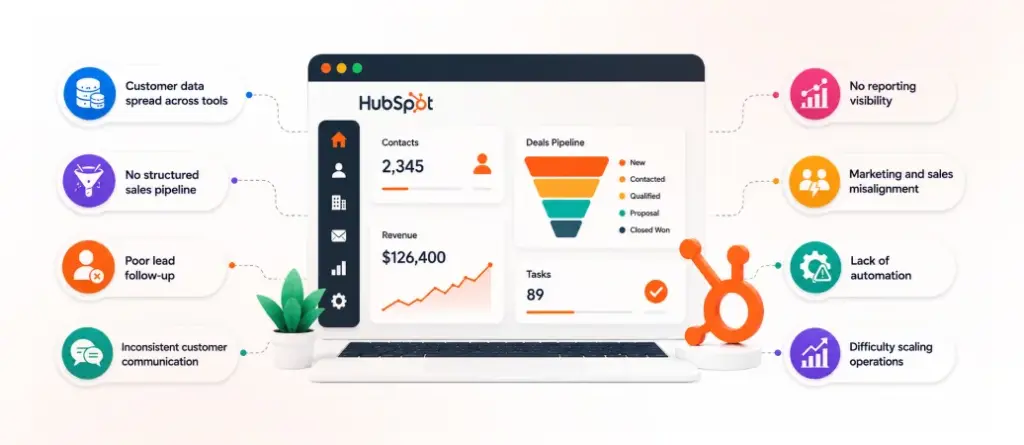
Here are some of the most common startup challenges without a CRM:
- Customer data is spread across tools
- No structured sales pipeline
- Poor lead follow-up
- Inconsistent customer communication
- No reporting visibility
- Marketing and sales misalignment
- Lack of automation
- Difficulty scaling operations
This shows that without a CRM, startups often operate reactively instead of strategically.
The Cost of Running a Startup Without a CRM
Many startups assume CRM implementation can wait until later stages. In reality, delaying CRM adoption creates hidden operational costs that compound over time.
Spreadsheets that were used earlier do not scale with time. They do not send automated reminders, cannot tell you which lead visited your pricing page three times this week, and can’t segment your contacts by multiple filters.
And when a salesperson leaves the team, their spreadsheet goes with them, along with all the context, notes, and relationship history they carried in their head.
Due to this, the hidden costs of not having a CRM rise, such as:
1. Lost Leads and Missed Revenue Opportunities
When leads are tracked manually through spreadsheets or inboxes, follow-ups become inconsistent. Sales reps forget callbacks. Important emails go unanswered. Warm leads become cold. Over time, these missed opportunities directly affect revenue.
2. Poor Visibility Into the Sales Pipeline
Without a CRM, top management often lacks real-time visibility into the sales process, such as which deals are active, what the average sales cycle is, etc. And these unclear answers slow down further decisions.
3. Marketing and Sales Teams Become Disconnected
In many startups, marketing and sales operate separately. As a result, the outcomes are inefficient for both end-users and businesses, affecting the customer experience and profitability of your business.
4. Manual Work Slows Down Productivity
Every hour a sales rep spends manually updating a spreadsheet is an hour not spent talking to customers, closing deals, or building relationships. Many startup teams spend hours on repetitive administrative tasks like updating spreadsheets, sending manual follow-ups, assigning leads, tracking conversations, etc. This reduces productivity significantly.
Businesses generally implement a CRM within the first five years of operations, but the ones that wait too long often find that fixing a chaotic data environment later is far more expensive and disruptive than simply building on a proper system from the start.
How HubSpot Solves Each of These Problems
1. A Free, Powerful Starting Point
One of the biggest reasons startups skip CRM tools is cost. But HubSpot addresses this gap directly with a generous free tier that includes contact management, deal tracking, email templates, and basic reporting.
This means a startup can build its customer database, structure its sales pipeline, and start capturing data long before it has budget for paid tools. And when the time comes to scale, HubSpot’s paid tiers unlock automation, advanced analytics, and multi-hub integrations that grow with the business.
2. Contact and Deal Management
At its core, HubSpot is a centralized contact and company database that every team member can access. Every email, call, meeting, and note is logged automatically or with minimal manual effort. Sales reps walk into every call with full context, and managers can see exactly where every deal stands.
With a proper HubSpot CRM setup, you get custom properties tailored to your business model, pipeline stages that reflect your actual sales process, and views that give each team member exactly the information they need to do their job well.
3. Marketing and Sales Alignment
HubSpot connects marketing, sales, and service in a single ecosystem. When a lead downloads an ebook, fills out a contact form, or clicks on an email campaign, that activity is recorded against their contact record in the CRM. Sales can see exactly what content a prospect engaged with before reaching out.
This feature fundamentally changes the quality of conversations sales teams can have with prospects.
4. Automation Eliminates the Grunt Work
Sales reps spend only 28 to 53% of their week actually selling. HubSpot’s automation tools flip that ratio. Workflows can automatically assign leads to the right rep, send follow-up emails based on deal stage, update contact properties when certain actions are taken, and notify team members when a deal has gone cold.
For a startup with a lean team, using this type of HubSpot workflow automation allows three people to do the work of ten without burning out.
5. A Sales Pipeline You Can Actually See and Trust
HubSpot gives every startup a visual, drag-and-drop pipeline where deals move through clearly defined stages. Managers can filter by rep, by deal value, by close date, or by any custom property. Forecasting becomes data-driven rather than gut-driven.
More importantly, every lead that enters the pipeline gets tracked. Nothing slips through. Automated reminders fire when a deal has not been touched in a defined period. The pipeline becomes a living document that reflects the real state of the business’s revenue trajectory.
6. Reporting That Answers Real Business Questions
HubSpot’s reporting suite allows startups to build dashboards that track the metrics that actually matter to their stage of growth. Deal conversion rates, average deal size, time in pipeline, lead source performance, and email engagement rates are all available out of the box.
This data is what founders need to make confident decisions and what investors want to see when evaluating traction. It also helps sales and marketing teams identify what is working and double down on it, rather than continuing to invest in channels or tactics that are not converting.
7. Onboarding That Gets You Running Fast
One of the most common barriers to CRM adoption is the fear of a complicated setup process. HubSpot is built to minimize that barrier, but even the most intuitive platform benefits from expert configuration.
Our HubSpot onboarding services are designed to get startups operational quickly. From importing existing contacts and mapping data fields to building your first automation workflows and training your team, the onboarding process is structured to deliver value within days of implementation.
8. Scaling Without Starting Over
Perhaps the most important advantage HubSpot offers startups is scalability. Many early-stage tools work well at a small scale but force companies to migrate to something else as they grow. That migration is expensive and disruptive.
But HubSpot’s architecture is built to scale. If your startup ever needs to migrate from another CRM or website platform to HubSpot, our CRM migration services ensure the process is smooth, with no data loss and minimal disruption to ongoing operations.
How and Where to Start?
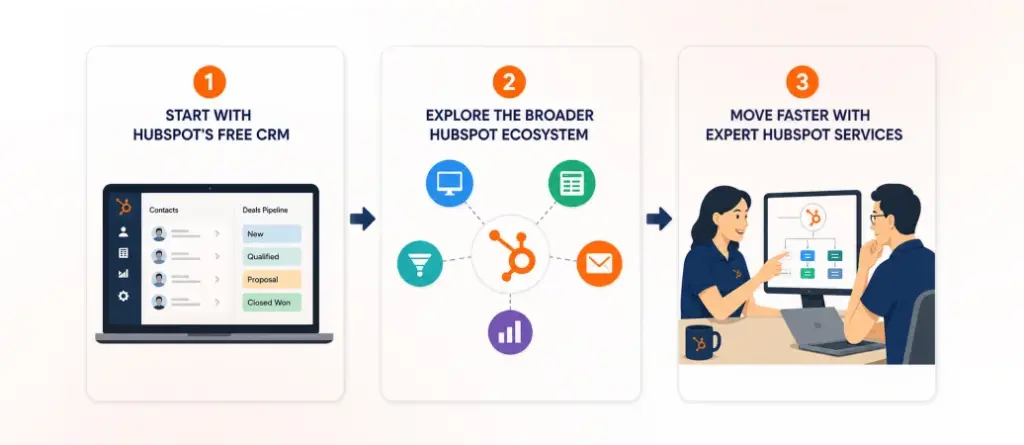
If your startup is still managing customer relationships through spreadsheets or a patchwork of disconnected tools, the path forward is straightforward:
Start with HubSpot’s free CRM. Centralize your contacts. Build a pipeline that reflects your actual sales process. Set up even one or two automations to eliminate the most time-consuming manual tasks.
Then, explore the broader HubSpot ecosystem. HubSpot’s website development capabilities, landing page tools, email marketing, and reporting dashboards all feed into the same CRM, creating a unified view of your customer journey that becomes more valuable with every passing month.
For startups that want to move faster, TRooInbound offers expert and full-spectrum HubSpot services that cover everything from initial CRM setup and automation configuration to full-platform implementation and ongoing optimization.
As a HubSpot Diamond Solutions Partner with 1,000+ clients and 5,000+ projects delivered, TRooInbound brings the kind of real-world implementation experience that helps startups avoid the mistakes that derail most CRM rollouts.
Final Thoughts
The reason most startups fail without a CRM is the slow accumulation of missed follow-ups, lost context, wasted effort, and decisions made on incomplete information. Over time, these small gaps compound into a serious competitive disadvantage.
HubSpot closes those gaps. It gives startups the structure, visibility, and automation they need to grow without chaos. And with the right HubSpot implementation specialist, the setup process is far less daunting than most founders expect.
Ready to build a customer management system that scales with your startup? Schedule a call with the TRooInbound team and start turning your customer data into a genuine growth engine.