
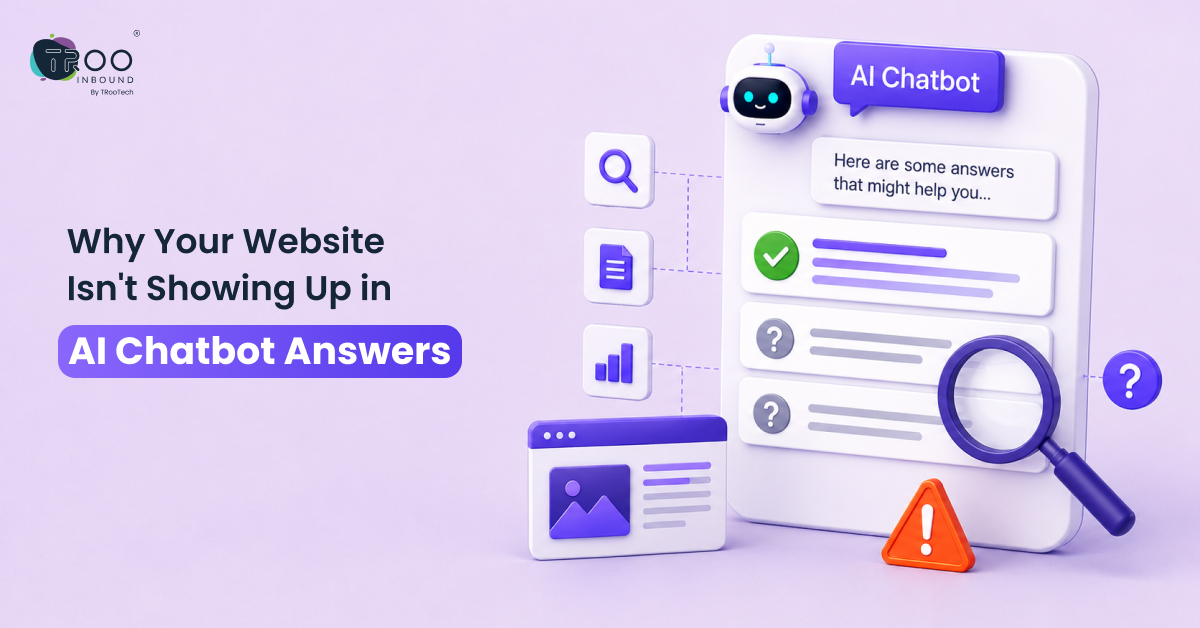
Your website may not be showing up in AI chatbot answers because AI platforms evaluate and select sources differently from traditional search engines. Ranking well on Google does not guarantee visibility in ChatGPT, Gemini, or Perplexity. These platforms look for content that directly answers user questions, demonstrates expertise, provides reliable information, and is easy to understand and reference. If your content lacks clarity, authority signals, or a structure that AI systems can easily interpret, competing websites may be cited instead.
To improve your AI search visibility, create content that directly addresses customer questions, use clear headings and structured data, and demonstrate expertise consistently across your website and third-party sources. Maintaining accurate business information and building credible brand mentions can also strengthen your online presence and increase the likelihood of your website being referenced in AI-generated responses.
TL;DR:
- Google rankings do not guarantee visibility in AI-generated answers.
- AI platforms evaluate relevance, clarity, credibility, accessibility, and how well a source answers a specific question.
- Answer Engine Optimization (AEO) helps structure content so AI systems can understand, retrieve, and reference it more easily.
- The strongest approach combines useful content, sound technical SEO, clear brand authority, and ongoing AI visibility monitoring.
Why Doesn't My Website Show Up in ChatGPT, Gemini, or Perplexity?

AI chatbots do not simply reproduce a search engine results page. When they generate an answer, they may draw on multiple sources, choose only a few of them, summarize information, and sometimes cite the pages they consider most useful for the question.
That means a page can perform well in traditional search and still be absent from an AI-generated response. The page may not answer the question directly enough, the information may be difficult to extract, the source may not demonstrate enough credibility for that topic, or a competitor may provide a clearer and more complete explanation.
The practical takeaway is simple: SEO search visibility and AI search visibility overlap, but they are not identical. To understand why your site is being overlooked, you first need to understand how the search experience itself has changed.
How AI Shift Differs From Traditional Search
Traditional search is designed primarily to help users discover webpages. AI search is designed to produce an answer. That changes what visibility looks like and what your content needs to accomplish.
| Traditional Search | AI Search |
|---|---|
| Users receive a list of ranked webpages | Generates a direct answer using information from selected sources. |
| Ranking position is a major visibility metric | Visibility can come from brand mentions, citations, summaries, and referenced pages. |
| Keywords and search intent are important | The AI system may synthesize information before the user visits a source. |
| Users typically choose which result to visit | Question relevance, answer quality, context, clarity, and trust are especially important. |
| SEO focuses on improving organic search performance | A source can influence an answer even when the user never sees a traditional results page. |
This does not mean traditional SEO has stopped mattering. Crawlability, indexability, useful content, authority, and strong site architecture still form the foundation. The difference is that AI search adds another layer: your information must also be easy to interpret, extract, summarize, and connect to the user’s intent.
Why Do AI Chatbots Cite Your Competitors and Not You?
When a competitor appears in an AI answer, and your business does not, it is rarely because of one missing tactic. More often, the competitor gives the system a stronger combination of relevance, structure, depth, authority, and accessibility.
For example, two companies may offer the same service, but one may have a detailed page that answers common buyer questions, explains its process, includes proof, uses clear headings, and is supported by credible third-party mentions. The other may have a short service page built mainly around promotional copy. The first source gives an AI system more usable material.
| Visibility Factor | What Stronger Sources Usually Do |
|---|---|
| Relevant content | Answer the specific question or problem clearly instead of speaking only in broad marketing language. |
| Clear structure | Use descriptive headings, concise paragraphs, lists, tables, and logical page organization. |
| Topical depth | Cover the main question plus the supporting details a user needs to make sense of the answer. |
| Credible information | Use accurate explanations, examples, evidence, case studies, expert input, or other proof where appropriate. |
| External authority | Build consistent brand mentions, links, reviews, partnerships, and third-party references. |
| Technical accessibility | Keep important pages crawlable, indexable, renderable, and easy for search systems to discover. |
What Does AI Search Look for in Website Content?
No single checklist guarantees that an AI platform will cite a page. Different systems use different retrieval methods, models, indexes, and ranking signals. Still, the factors that make content useful to people also make it easier for AI systems to work with.
1. Content Relevance and Clarity
Your content should answer the question a user is actually asking. Pages that bury the answer under long introductions, generic claims, or keyword-heavy copy force both readers and machines to work harder.
- Use headings that reflect real customer questions and topics.
- Give the core answer early, then add explanation and context.
- Use specific examples instead of vague claims.
- Cover the topic deeply enough that the page is genuinely useful.
- Keep information current when the subject changes frequently.
2. Technical Accessibility
Useful content cannot contribute much to search visibility if systems cannot reliably access it. Important pages should be crawlable, indexable, and rendered correctly, with a site structure that makes the relationship between topics easy to understand.
Technical setup should support the content, not replace it. Schema markup, robots directives, internal linking, page performance, and clean rendering can improve discoverability and interpretation, but no single technical file or markup type guarantees inclusion in AI answers.
3. Authority and Credibility
AI systems need reasons to treat a source as dependable. Strong authority comes from what you publish on your own site and how your brand is represented elsewhere.
- Original expertise and practical experience
- Case studies and measurable outcomes
- Accurate, consistent business information
- Expert commentary and proprietary insights
- Relevant backlinks, reviews, partnerships, and industry mentions
These factors form the foundation of Answer Engine Optimization (AEO), which focuses on making website content clear, accessible, and useful enough to be understood and surfaced in direct answers.
What Is AEO?
Answer Engine Optimization (AEO) is the practice of creating and optimizing website content so that it can be clearly understood, retrieved, and surfaced in direct answers provided by search engines and AI-powered platforms. Instead of focusing only on where a webpage ranks in traditional search results, AEO focuses on whether your content can become a useful source when users ask questions.
What's the Difference Between SEO vs AEO vs GEO
| Area | SEO | AEO | GEO |
|---|---|---|---|
| Primary goal | Improve visibility in traditional search results | Increase visibility in direct answers | Improve visibility in generative AI responses |
| Focus | Rankings, search intent, technical performance, and authority | Clear answers, question-based content, structure, and relevance | AI visibility, brand mentions, citations, context, and authority |
| Content approach | Optimize pages around keywords and search intent | Provide direct, useful answers to specific questions | Create authoritative content that AI systems can understand and potentially reference |
| User experience | Users browse search results and visit webpages | Users may get an answer directly in the search experience | Users receive synthesized answers generated from available sources |
| Measurement | Rankings, organic traffic, impressions, and clicks | Answer visibility, mentions, and citations | AI mentions, citations, AI referral traffic, and share of AI visibility |
| Technical foundation | Crawlability, indexability, site speed, architecture, and structured data | Accessible content, clear structure, internal linking, and relevant structured data | Strong technical SEO combined with accessible, well-structured, authoritative content |
Common Mistakes That Hurt Your AI Search Visibility
A website can follow traditional SEO practices and still struggle to appear in AI-generated answers. The following common mistakes can reduce your chances of being discovered, understood, or referenced by AI search systems.
Thin, Repetitive, or Nonspecific Content
Pages that repeat similar claims without adding practical detail give AI systems little reason to select one passage over another. Generic copy such as “we provide tailored solutions” may describe a service, but it does not answer the specific questions buyers ask.
Strengthen these pages with clear explanations, process details, examples, comparisons, decision criteria, and answers to the questions customers raise during sales conversations.
Blocking AI Crawlers Without Realizing It
Robots directives, security settings, rendering problems, or site-level restrictions can reduce access to important content. Because AI platforms do not all retrieve information in the same way, technical accessibility should be reviewed alongside normal search-engine crawlability and indexability.
Content That Isn't Customer-Centric
Many websites are organized around internal service terminology rather than the language customers use. If the page explains what your team sells but does not address what the buyer wants to know, the content can miss both user intent and AI retrieval opportunities.
Use sales questions, support conversations, search queries, customer objections, and comparison needs to shape your content plan. The goal is not to write for a machine. It is to answer people so clearly that machines can also recognize the value.
How to Optimize Your Website for AI Search

Improving AI visibility is easier when you treat it as three connected workstreams: content, technical accessibility, and authority. Each one strengthens the others.
Structure Content Around Real Customer Questions
Lead with the answer. When a heading asks a question, the first sentence or two should give the reader a useful response before expanding into detail.
- Map pages to the questions buyers ask at each stage of the journey.
- Use descriptive, question-led headings where they fit naturally.
- Keep answer blocks concise, then support them with examples and context.
- Use lists and tables when they make complex information easier to scan.
- Build topic clusters so related pages reinforce one another.
- Refresh information when facts, products, processes, or market conditions change.
Make Your Website Technically Accessible
- Keep priority pages crawlable and indexable.
- Review robots.txt and other access controls for unintended restrictions.
- Make sure important content renders correctly without depending on fragile client-side behavior.
- Use clear internal linking and logical site architecture.
- Implement accurate structured data where it genuinely describes the page.
- Maintain strong page performance and a reliable user experience.
- Treat emerging AI-specific files or conventions cautiously. They may help particular tools in certain contexts, but they should not be presented as a substitute for strong content, crawlability, or established search fundamentals.
Build Authority Signals and Trust Signals
Authority becomes stronger when your website demonstrates real expertise and the broader web supports that reputation.
- Publish case studies that explain the problem, approach, and outcome.
- Add expert opinions, first-hand experience, and original insights where appropriate.
- Use proprietary data or research when you can support it.
- Earn relevant mentions and backlinks from credible industry sources.
- Maintain consistent brand, service, and company information across trusted third-party profiles.
- Encourage genuine reviews, partnerships, and expert contributions that reinforce your real-world reputation.
- Over time, these signals create a clearer digital reputation: what your company does, what topics it is associated with, and why its information should be considered credible.
Quick Visibility Checklist for AI
How to Measure Your AI Search Visibility
- Does each priority page answer a clear customer question?
- Can important pages be crawled, indexed, and rendered correctly?
- Is the content specific, current, and supported by real expertise?
- Do third-party sources reinforce your brand and topical authority?
- Are you actively checking whether your brand and pages appear in AI answers?
How to Measure Your AI Search Visibility
You cannot improve AI visibility consistently if you never measure it. Start with a controlled set of prompts that reflect how buyers research your category, problems, solutions, competitors, and services.
Test Your Website in ChatGPT, Perplexity, and Gemini
Start by creating a consistent set of prompts based on the questions your potential customers are likely to ask. Include questions about your product or service category, common industry problems, comparisons between providers, and direct searches for your brand. Run the same prompts across ChatGPT, Perplexity, and Gemini, then record whether your brand appears, which competitors are mentioned, whether your website is cited, and whether the information provided about your business is accurate and current.
What Should You Track?
| Metric | What It Tells You |
|---|---|
| Brand mentions | Shows whether your business appears in relevant AI answers |
| Website citations | Shows whether your website is being referenced as a source |
| Competitor mentions | Helps you understand your position against competing brands |
| Information accuracy | Identifies incorrect or outdated information about your business |
| Cited pages | Shows which pages AI systems find useful or relevant |
| Prompt visibility | Reveals which customer questions generate visibility for your brand |
AI Visibility Monitoring Tools
Several AI visibility monitoring tools now help businesses track how their brands appear across AI platforms such as ChatGPT, Gemini, Perplexity, and Google’s AI search experiences. These tools can help businesses understand whether their brand is being mentioned, which competitors are appearing instead, and what topics or prompts influence their visibility.
HubSpot’s AI Search Grader can be used as a starting point for establishing an AI visibility baseline. The free tool analyzes how ChatGPT, Perplexity, and Gemini represent a brand and provides scores across areas such as sentiment, brand recognition, share of voice, market position, and presence quality. This makes it useful for understanding how AI platforms currently perceive and represent your brand before you begin ongoing optimization.
For ongoing monitoring, platforms such as Ahrefs Brand Radar and Semrush’s AI Visibility Toolkit can provide broader visibility tracking, including brand mentions, citations, competitor visibility, and other AI search metrics.
These tools can reduce the need for completely manual testing by helping you monitor brand mentions, website citations, competitor visibility, and the questions or topics that trigger your brand’s appearance. However, they should be treated as monitoring and measurement tools, not as a guarantee of AI visibility. Their data is based on the prompts and AI platforms they monitor, so it represents a structured view of your visibility rather than every AI conversation happening online.
How to Appear in AI Search Results: DIY or Hire an AEO Strategy Partner?
If you have the right content and technical expertise in-house, along with the time to keep up with changes in AI search, you can manage AEO internally. This approach may work well for smaller websites or teams that already have experience with SEO and content optimization. Your team will need to optimize existing content around specific user questions, improve page structure, implement relevant schema markup, review crawler access, and regularly monitor how your brand appears across AI platforms.
If your team lacks the time or expertise to manage these activities, partnering with a dedicated AEO services provider can offer a more efficient and structured approach. An experienced provider can help identify content gaps, improve existing pages, address technical issues, strengthen your overall AEO strategy, and monitor AI search visibility over time. This can be especially valuable as AI platforms continue to evolve and the factors influencing visibility change.
What Results Can You Expect From AEO?
There is no fixed timeframe or guaranteed number of AI mentions. AI-generated answers are dynamic, and visibility can change as platforms update their models, retrieval systems, indexes, and source-selection methods.
What You Can Improve First
- Clearer answers to high-value customer questions
- Better coverage of topics that matter to buyers
- Stronger technical accessibility for priority pages
- More consistent brand and authority signals
- A repeatable way to measure AI mentions and citations
What Stronger Long-Term Visibility Looks Like
Over time, a mature AEO program aims to increase the consistency of your brand’s presence across relevant AI-generated answers, expand the number of prompts where your expertise is represented, and improve the accuracy of how your business is described.
The key is continuous improvement. Content needs change, competitors publish new material, brand authority evolves, and AI platforms themselves keep changing. AEO should therefore be treated as an ongoing visibility program rather than a one-time optimization project.
Conclusion: Stop Guessing, Start Getting Cited
Your website not appearing in ChatGPT, Gemini, or Perplexity does not mean your visibility cannot improve. Traditional SEO remains important, but AI search also depends on clear answers, well-structured content, relevant expertise, and credible trust signals.
You can start by improving your content, strengthening your website structure, reviewing crawler access, and monitoring how your brand appears across AI platforms. If you lack the time or expertise to manage these activities internally, working with a dedicated AEO services provider can help you develop and implement a more structured strategy.
AI search is becoming an important part of how people discover and evaluate businesses. Starting now can help you build a stronger foundation for long-term AI search visibility and increase your chances of being referenced when potential customers ask relevant questions.
Ready to understand where your brand stands and identify opportunities to improve its AI visibility? The TRooInbound AEO services team can assess your current content, technical setup, and visibility gaps, then help you build a practical strategy for stronger AI search performance. Book a consultation with our team to discuss the right next steps for your business.
How Long Does It Take to Start Appearing in AI Answers?
FAQs
Read Popular Questions
Can a website rank on Google but not appear in AI chatbot answers?
Yes. Traditional rankings and AI visibility overlap, but they are not the same. An AI system may select different sources based on the question, source clarity, relevance, credibility, accessibility, and the information available to that platform.
How do I know if ChatGPT, Gemini, or Perplexity is citing my website?
Test a consistent set of buyer-focused prompts and record whether your brand is mentioned, whether your pages are cited, which competitors appear, and whether the information about your business is accurate. Repeat the same tests over time rather than relying on one result.
Does AEO replace SEO?
No. AEO builds on SEO fundamentals such as crawlability, indexability, useful content, internal linking, technical performance, and authority. It adds more focus on direct answers, question-led structure, extractability, and visibility in answer-driven experiences.
How long does AEO take to show results?
There is no fixed timeline. Results depend on your starting point, the quality and accessibility of your content, the authority of your brand, competition, how quickly changes are discovered, and how individual AI platforms select sources.
Can I improve AI visibility without creating entirely new content?
Often, yes. Existing pages can be improved by answering questions more directly, reorganizing headings, removing repetitive copy, adding missing context, improving internal links, updating outdated information, strengthening proof, and fixing technical access issues.
Do I need an AEO agency or service provider?
Not necessarily. An in-house team can manage AEO if it has the required SEO, content, technical, analytics, and authority-building capabilities. A service provider becomes useful when those responsibilities are fragmented, specialized expertise is missing, or ongoing monitoring is difficult to maintain.