
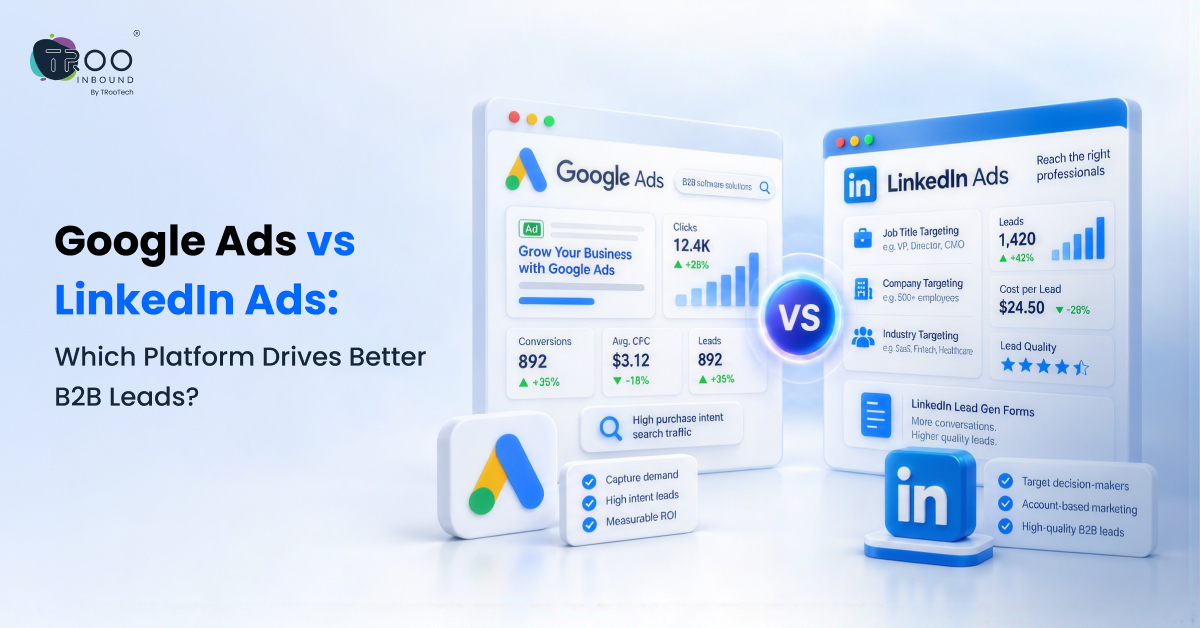
Google Ads is typically the more effective option if your buyers are on the lookout for the solutions you supply. Meanwhile, LinkedIn Ads may be more effective when you have to reach a specific professional audience, specific companies, or create a requirement for a solution that a prospect may not be looking for. Many B2B businesses find it most effective to leverage each platform where it is most effective, instead of picking a winner.
TL;DR:
- Google Ads has the advantage in general in cases where there is an existing demand from prospects already looking for a solution.
- LinkedIn Ads is beneficial for targeting specific companies and professionals based on attributes like job role, industry, seniority, and company.
- When there is search demand for your category, and buyers are on the verge of making a purchase, Google can work well.
- LinkedIn can be more valuable when your audience is highly specific, your category requires education, or you want to reach prospects before they actively search.
- The lower the cost per lead, the better the campaign is not necessarily. When assessing leads, opportunities, pipeline, and revenue, B2B marketers should consider lead quality.
- Google and LinkedIn can be mutually effective at a variety of points in a B2B customer's purchasing cycle.
- The right platform will depend on your ICP, search demand, sales cycle, deal value, buying behavior, and what you'll be able to measure.
Google Ads vs LinkedIn Ads: What Is the Real Difference?
Google Ads is a great way to connect with people who are already searching for what you’re offering. Professional attributes like job title, company, industry, seniority, and company size make LinkedIn Ads a valuable tool for targeting specific B2B audiences and generating demand. The table explains that Google Ads and LinkedIn Ads use different ways to reach B2B audiences:
| Factor | Google Ads | LinkedIn Ads |
|---|---|---|
| Core strength | Demand capture | Audience targeting and demand creation |
| Primary signal | Search behavior and intent | Professional and company attributes |
| Strong use case | Active solution research | Reaching defined B2B audiences |
| Audience approach | Keywords and audience signals | Job, company, industry, seniority, and related attributes |
| Bottom funnel | Strong potential | Strong when audience and offer are highly relevant |
| Main challenge | Competition and irrelevant searches | Audience size and cost |
| Best measurement | Qualified leads, pipeline, revenue | Qualified leads, engagement, pipeline, revenue |
Neither platform is automatically better. The better platform is the one that matches how your buyers discover and evaluate solutions.
How Do Google Ads and LinkedIn Ads Work Across the B2B Buying Journey?
Google and LinkedIn do not have to compete for the same role. They can support different stages of the same B2B buying journey.
LinkedIn is often more effective for creating awareness, educating prospects, and reaching specific accounts before they begin actively searching. At this stage, prospects may recognize a business problem but may not yet know which solution or vendor to consider. So they may begin searching on Google for the same.
Google is particularly useful for capturing this existing demand when prospects are actively researching solutions or comparing providers.
In short, LinkedIn can continue supporting account-based engagement and retargeting, while Google captures high-intent searches.
For businesses with long sales cycles, using both platforms across different stages is often more effective than expecting either platform to generate an immediate sale.
What Is the Best Advertising Platform for B2B Lead Generation?
The best advertising channel for B2B lead generation will vary based on your target audience, sales cycle, budget, and buyer intent. Google Ads and LinkedIn Ads can each produce great leads, but they do so in various ways.
Google Ads works well when it comes to prospects who are actively looking for a solution. It can generate high-intent leads when someone is searching for a certain product, service, vendor, or solution to a business problem. That is why Google can be really useful for bottom-of-the-funnel (BOFU) campaigns, especially when the search volume for your offer is already high.
A well-crafted LinkedIn ad can be more useful if you’re trying to target a specific professional group or generate leads that will start looking for you. You can target people based on factors such as job title, seniority, industry, company size, and employer. This can be beneficial when targeting decision-makers in specialized industries, sharing educational material, and showcasing new or unknown solutions that buyers are not aware of.
For example,
A B2B technology company could use LinkedIn to promote a report about the costs of disconnected systems. An operations leader might download the report and visit the company’s website without requesting a demo. Weeks later, that person may search Google for software vendors. The company can then reach them with a high-intent Search campaign that directs them to a service page, case study, or consultation request.
If you measure only the final conversion, Google may appear to have generated the entire result. LinkedIn may have introduced the company and influenced the prospect earlier in the buying process.
For many B2B companies, the best approach is to use both platforms with clearly defined roles. LinkedIn can build awareness and reach relevant decision-makers, while Google can capture demand when prospects are ready to take action. The right platform is the one that aligns with your audience’s buying behavior and supports your broader lead generation strategy.
When Does Google Ads Become Harder to Scale than LinkedIn Ads for B2B?
When there’s not enough search demand for your solution, Google Ads can be more difficult to scale. This is common when you introduce a new product or service category, an extremely niche B2B solution, or when you are addressing a problem that a buyer isn’t yet associating with a particular product or service. Even if you increase your budget, you cannot create more searches when people are not actively looking for what you offer.
It is also prevalent whenever the purchaser recognizes that he has a problem, but he is not yet aware of the solution. A company may have a problem with forecasting its sales efficiently, but might not be looking for a particular AI-driven forecasting solution because they are just assuming that the problem is the sales forecast. There may be less relevant search traffic, making Google Ads less of an opportunity to catch this audience. This is where LinkedIn Ads can help: Target the professionals who will recognize the issue and make the solution a reality for them.
Thus, LinkedIn can prove to be more helpful when you want to establish awareness before search happens. You don’t need to wait for prospects to search for your solution; you can identify the right people, based on job, industry, seniority, company, etc., and use educational content to generate interest. For new categories, niche solutions, low-awareness markets, and B2B products that buyers may not be aware of, LinkedIn is especially useful.
Common Mistakes When Comparing Google Ads and LinkedIn Ads

Google Ads and LinkedIn Ads should not be compared using cost per lead alone. A low-cost lead may have little buying potential, while a more expensive lead may come from a senior decision-maker who closely matches your ideal customer profile.
Common mistakes include:
- Judging performance by lead volume instead of lead quality
- Treating all leads as equally valuable
- Comparing platforms without considering their different roles in the buying journey
- Ignoring sales progression, pipeline value, and revenue
- Sending every visitor to the same landing page
- Failing to connect advertising data with CRM and sales outcomes
To compare performance accurately, connect campaign data with CRM and sales data. Evaluate each platform based on:
- Lead quality and fit with the ideal customer profile
- Seniority and decision-making authority
- Qualified opportunities created
- Sales progression
- Pipeline value
- Revenue generated
This approach shows which platform contributes most to business growth instead of simply identifying the source of the cheapest or largest number of leads.
When Should B2B Companies Use Google Ads vs LinkedIn Ads?
The easiest way to choose between Google Ads and LinkedIn Ads is to ask one question: Are your buyers already looking for a solution, or do you need to reach them first?
If your buyers are already searching for your product, service, or solution, Google Ads is usually the better choice. For example, someone searching for “Salesforce implementation partner” already has a need and is actively exploring options. Google helps you capture that existing demand when the prospect is closer to making a decision.
If your buyers are not actively searching but you know exactly who you want to reach, LinkedIn Ads can be the better option. You can reach professionals based on factors such as job role, seniority, industry, and company. This makes LinkedIn useful when you want to introduce a solution, educate potential buyers, or reach specific decision-makers.
A simple way to decide is:
| Your Situation | Better Fit |
|---|---|
| Buyers are actively searching | Google Ads |
| Strong commercial search demand | Google Ads |
| You want bottom funnel leads | Google Ads |
| You have a clearly defined B2B audience | LinkedIn Ads |
| You want to reach specific decision makers | LinkedIn Ads |
| Your solution is new or unfamiliar | LinkedIn Ads |
| You need to create demand | LinkedIn Ads |
| You need both demand creation and demand capture | Both |
How TRooInbound Approaches B2B Paid Advertising
TRooInbound takes a business-first approach to paid advertising. Rather than selecting a platform based on reach or cost alone, we align Google Ads and LinkedIn Ads with the target audience, buying journey, market demand, and revenue objectives.
The approach emphasizes aligning audience, intention, messages, and conversion journeys throughout the entire buyer’s journey. Google Ads can be used to grab the demand that’s already there, and LinkedIn Ads can be used to generate demand that may be limited on Google.
Performance marketing is measured beyond clicks and lead volume. By connecting campaign data with CRM and sales outcomes, TRooInbound focuses on qualified leads, opportunities, pipeline, and revenue. This creates a paid advertising strategy that is measurable, scalable, and aligned with broader business growth objectives.
Conclusion
There is no universal winner between Google Ads and LinkedIn Ads. Google Ads is most effective when potential buyers are already searching for a solution, making it valuable for capturing existing demand and driving high-intent traffic. LinkedIn Ads, on the other hand, helps businesses reach specific professional audiences based on factors such as job title, industry, company size, and seniority.
The right platform depends on your business goals, target audience, sales cycle, and position in the buying journey. In many cases, the strongest strategy combines both: Google Ads captures active demand, while LinkedIn Ads builds awareness and engages decision-makers earlier in the process. Performance should be measured by qualified opportunities, pipeline contribution, and revenue rather than clicks or cost per lead alone.
FAQs
Read Popular Questions
Is Google Ads or LinkedIn Ads better for B2B lead generation?
Neither platform is universally better. Google Ads can be more powerful when people are actively looking for your solution, and LinkedIn Ads can be more useful when you want to speak to a specific type of professional, a specific account, or generate interest.
Why is Google Ads effective for B2B?
Google Ads can help businesses reach prospects when they actively search for relevant products, services, solutions, or vendors. This is especially applicable to capture current demand and to target buyers who have further progressed in the research process.
Why is LinkedIn Ads useful for B2B?
Businesses can find targeting options on LinkedIn based on their profession, company, industry, and their seniority in the organization. It is advantageous for specific B2B campaigns, demand generation, and account-based marketing.
Can Google Ads and LinkedIn Ads be used together?
Yes. As businesses engage with relevant audiences and drive demand, LinkedIn can play a role, and when prospects start to seek out solutions, Google can help capture demand. Using both can be useful for longer B2B buying journeys.
Can LinkedIn Ads generate bottom-of-funnel leads?
Yes. When the audience, offer, messaging, and landing experience are relevant to the buyer, then LinkedIn can be a source for bottom-funnel leads. But the results must be judged on the quality of the opportunities and the pipeline, not just the number of leads.
What strategies can I use to get better B2B leads from Google Ads?
Pay attention to high-intent keywords, relevant ad messaging, clear landing page alignment, negative keyword management, clear conversion criteria, and CRM based measurement. Linking qualified lead information to advertising systems can additionally assist in determining which campaigns deliver worthwhile possibilities.
What are some ways to generate better B2B leads with LinkedIn Ads?
Set up a dedicated ICP and target audiences based on relevant professional and company attributes. Communicate with a buyer’s problem, align the offer to the buyer’s stage in the sale, and measure the performance of the campaign based on lead quality and bottom-of-funnel sales results.