


Before ChatGPT was launched, users used to type in keywords into Google and scroll through blue links in the SERPs to search for the answer. But today, the search behavior has changed. They type in queries in AI tools and get direct answers without opening any link. If your content isn’t fetched by these tools, you are losing your visibility and traffic. Here’s where implementing AI SEO matters.
Companies that adapt AI SEO early are already seeing stronger visibility, better topical authority, and more qualified organic traffic. Businesses that ignore it are at risk of losing discoverability even if they rank well on traditional search engines.
In this blog, we break down what AI SEO is, how it works, and the specific ways it can grow your organic traffic today and beyond.
What is AI SEO?
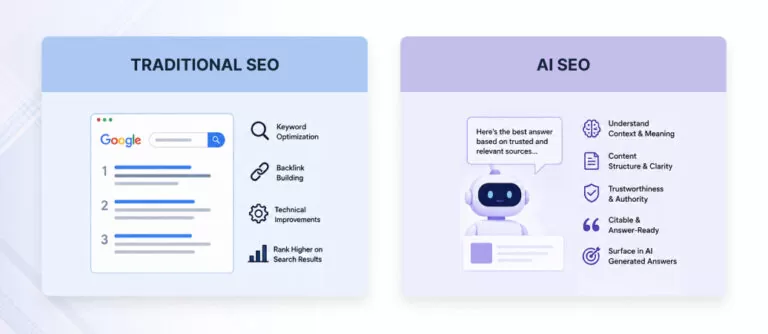
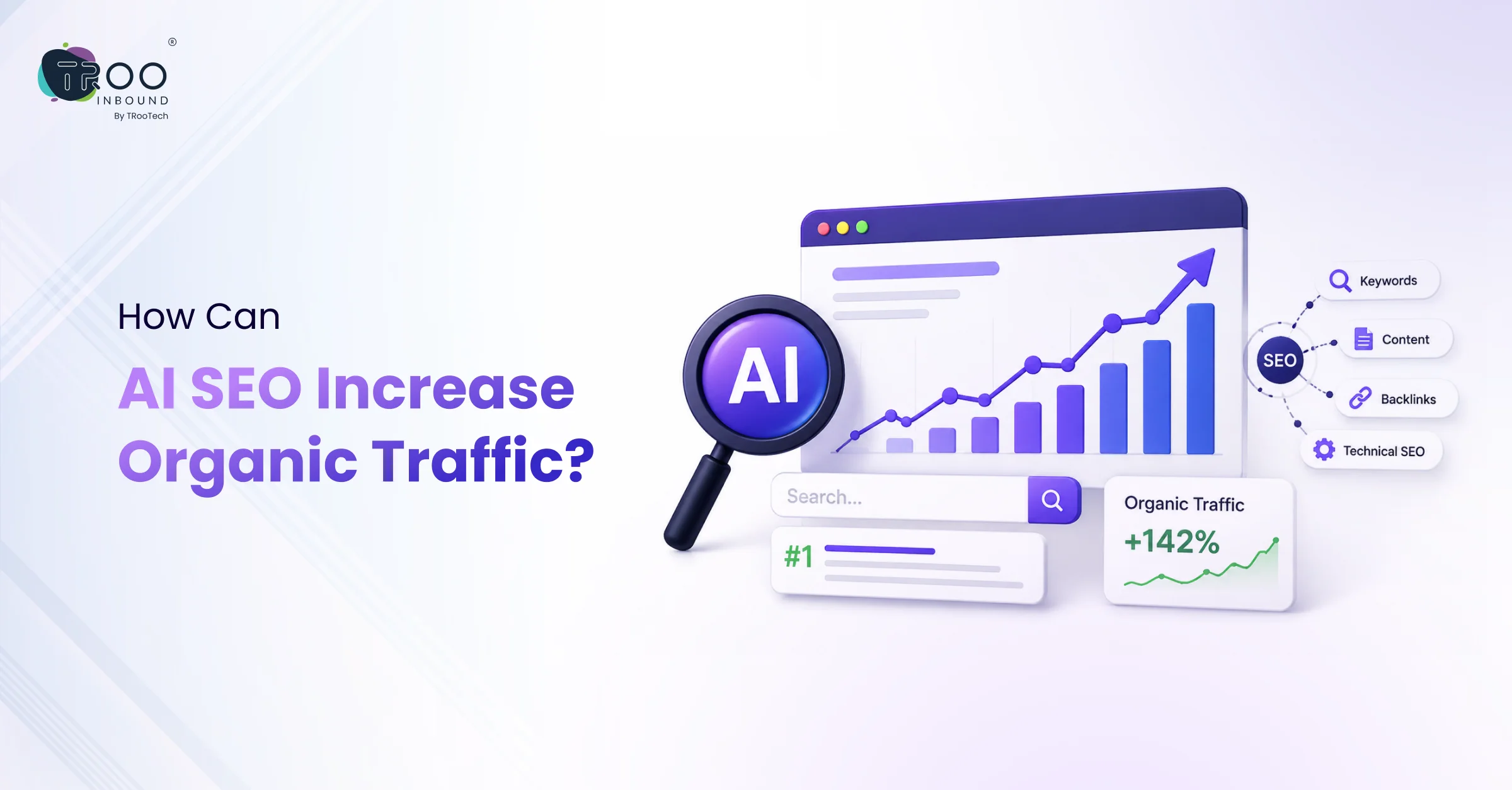
AI SEO means optimizing your website and content so that it performs well across large language models (LLMs), traditional search engines, and AI-powered platforms such as ChatGPT, Google’s AI Overview, Perplexity, Claude, and Gemini.
Traditional SEO focused on ranking your pages on Google’s search results pages through keyword optimization, backlink building, and technical improvements. AI SEO builds on that foundation, but it also accounts for how large language models (LLMs) read, interpret, and surface content when generating answers for users.
In simple terms, AI SEO means making sure your content is not just findable by search engines but also understandable, trustworthy, and citable by AI tools.
This is not a replacement for traditional SEO; it is an evolution of it. The brands that want to win visibility will have to optimize their site and content for both.
Why AI SEO Matters for Organic Traffic Right Now
According to Semrush research, AI search visitors could surpass traditional search visitors by 2028. Google has already begun defaulting to AI Mode for an increasing number of queries. Voice search, AI assistants, and zero-click answers are collectively reshaping how people discover content.
Here is what that means practically:
- A user asking ChatGPT, “What is the best CRM for a small business?” gets a direct answer with source citations.
- Someone searching Google for “how to migrate my website” may see an AI-generated summary before any organic results.
- A brand mentioned consistently in AI answers builds trust and recall, even if the user never clicks through.
This means visibility in AI answers is quickly becoming as important as a page-one ranking on Google. That is the foundation of why an AI SEO strategy is no longer optional for brands serious about organic growth.
If you are also planning your broader digital presence, partner with an expert digital marketing services provider who covers the full spectrum from SEO to content marketing and paid channels.
How AI SEO Increases Organic Traffic: 6 Core Strategies
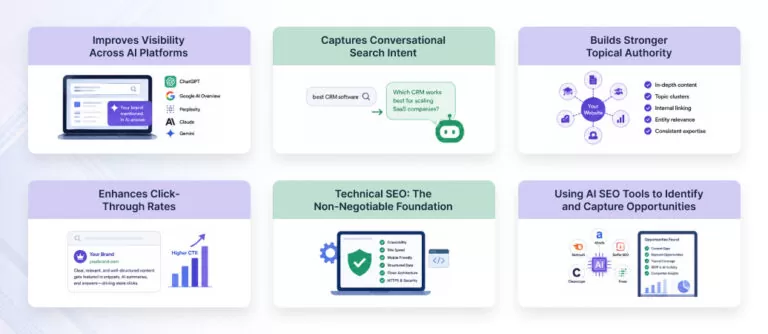
1. Improves Visibility Across AI Platforms
AI SEO helps your content appear inside:
- AI-generated answers
- AI summaries
- Conversational recommendations
- Featured snippets
- Voice search results
- Google AI Overviews
This dramatically expands your visibility beyond traditional rankings. Businesses optimizing only for traditional SEO are missing a growing segment of organic discovery.
Our guide on LLM SEO best practices explains how LLM visibility is becoming critical for future organic growth.
2. Captures Conversational Search Intent
Users now search differently. Instead of typing: “best CRM software,” they ask: “Which CRM works best for scaling SaaS companies?” AI SEO helps businesses optimize for these conversational search behaviors.
This often leads to:
- Better-qualified traffic
- Higher conversion intent
- More relevant visitors
- Improved engagement
3. Builds Stronger Topical Authority
One of the most powerful AI SEO strategies is establishing deep topical authority in your niche. LLMs are trained to trust sources that demonstrate consistent expertise across a subject, not just single pages that rank for isolated keywords.
A content cluster approach works like this: you create a comprehensive pillar page on a broad topic, then build a set of supporting blog posts and pages that cover related subtopics in detail. All of these interlink with each other.
For example, if your niche is inbound marketing, a pillar page on inbound strategy would be supported by articles on SEO, content marketing, CRM tools, HubSpot automation, and lead generation. Each piece reinforces the others, and collectively they signal to both Google and AI systems that your site is a reliable, authoritative source on the topic.
4. Enhances Click-Through Rates
AI SEO improves how your content appears within:
- Snippets
- Summaries
- AI recommendations
- Search previews
When content answers questions clearly and directly:
- Users trust it faster
- AI systems reference it more often
- Click-through rates improve
Well-structured AI-friendly content often earns stronger visibility positions across search experiences.
5. Technical SEO: The Non-Negotiable Foundation
All the content strategy in the world will not help if your website has fundamental technical problems. For AI SEO, technical health is even more important because AI crawlers need to be able to access, read, and understand your pages efficiently.
Core technical SEO priorities include:
- Fast page load speeds (Core Web Vitals compliance)
- Mobile-friendly design and responsive layouts
- Clean site architecture with logical internal linking
- An accurate, up-to-date XML sitemap
- Canonical tags to prevent duplicate content issues
- HTTPS security across the entire site
If you are also considering a platform move as part of your SEO improvement plan, our website migration services ensure technical SEO is preserved during the transition, preventing the traffic drops that poorly managed migrations often cause.
6. Using AI SEO Tools to Identify and Capture Opportunities
AI SEO tools have made it significantly easier to identify the gaps and opportunities that manual keyword research would miss. Tools like Semrush, Ahrefs, SurferSEO, and Clearscope now incorporate AI-driven analysis to help marketers understand:
- Which questions are users asking AI tools in your niche?
- What topics do your competitors rank for that you have not covered?
- How to optimize existing content for featured snippets and AI Overviews.
- Which pages on your site have declining organic traffic and need to be refreshed?
Pairing these insights with a strong content production process allows you to build and maintain organic visibility at scale. The key is using AI SEO tools not as a replacement for strategic thinking but as a way to make better, faster decisions about where to focus your efforts.
Building an AI SEO Strategy: Where to Start
If you are starting from zero, here is a practical sequence for building an AI SEO strategy that drives organic traffic:
Step 1: Audit your existing content. Identify what is performing well, what has dropped in traffic, and what gaps exist in your topic coverage. Use AI SEO tools to benchmark your current visibility in AI-generated answers.
Step 2: Define your topical authority pillars. Choose 3 to 5 core topics that align with your business and audience. Build content clusters around each one.
Step 3: Fix technical issues. Before you produce more content, make sure your site is technically sound. Speed, crawlability, and schema markup all need to be in order.
Step 4: Produce high-quality, structured content consistently. Focus on depth, accuracy, and readability. Every piece of content should answer a specific question your audience is asking.
Step 5: Build your digital footprint. Expand beyond your website by contributing to external platforms and earning quality backlinks.
Step 6: Monitor and iterate. Use analytics and AI SEO tools to track your visibility in both traditional search and AI-generated answers. Adjust based on what is working.
Final Thoughts
AI SEO is not a trend to watch from a distance. It is an active shift in how search works, and the brands that adapt now will be the ones capturing organic traffic as traditional search continues to evolve.
The good news is that the fundamentals of great SEO still apply. Quality content, technical health, and genuine authority are as important as ever. What AI SEO adds is a new layer of optimization that makes your content readable, citable, and trustworthy for the AI systems that are increasingly shaping what users see and read.
Whether you are just starting to explore AI SEO or looking to take your existing strategy to the next level, TRooInbound works with businesses to build digital marketing strategies that perform across both traditional and AI-powered search. From content strategy and technical SEO to full-scale inbound marketing, the expertise is available when you are ready to grow.