


Search Engine Optimization has long been viewed as the most reliable way to generate consistent online visibility. Businesses invest heavily in SEO strategies to bring in organic traffic, improve keyword rankings, and strengthen their digital presence. When done correctly, SEO can drive thousands of visitors to a website every month without paying for ads.
However, many businesses face a frustrating reality. Their analytics show steady organic traffic growth, yet leads, inquiries, or sales remain low. The numbers suggest that people are finding the website, but they are not taking the next step.
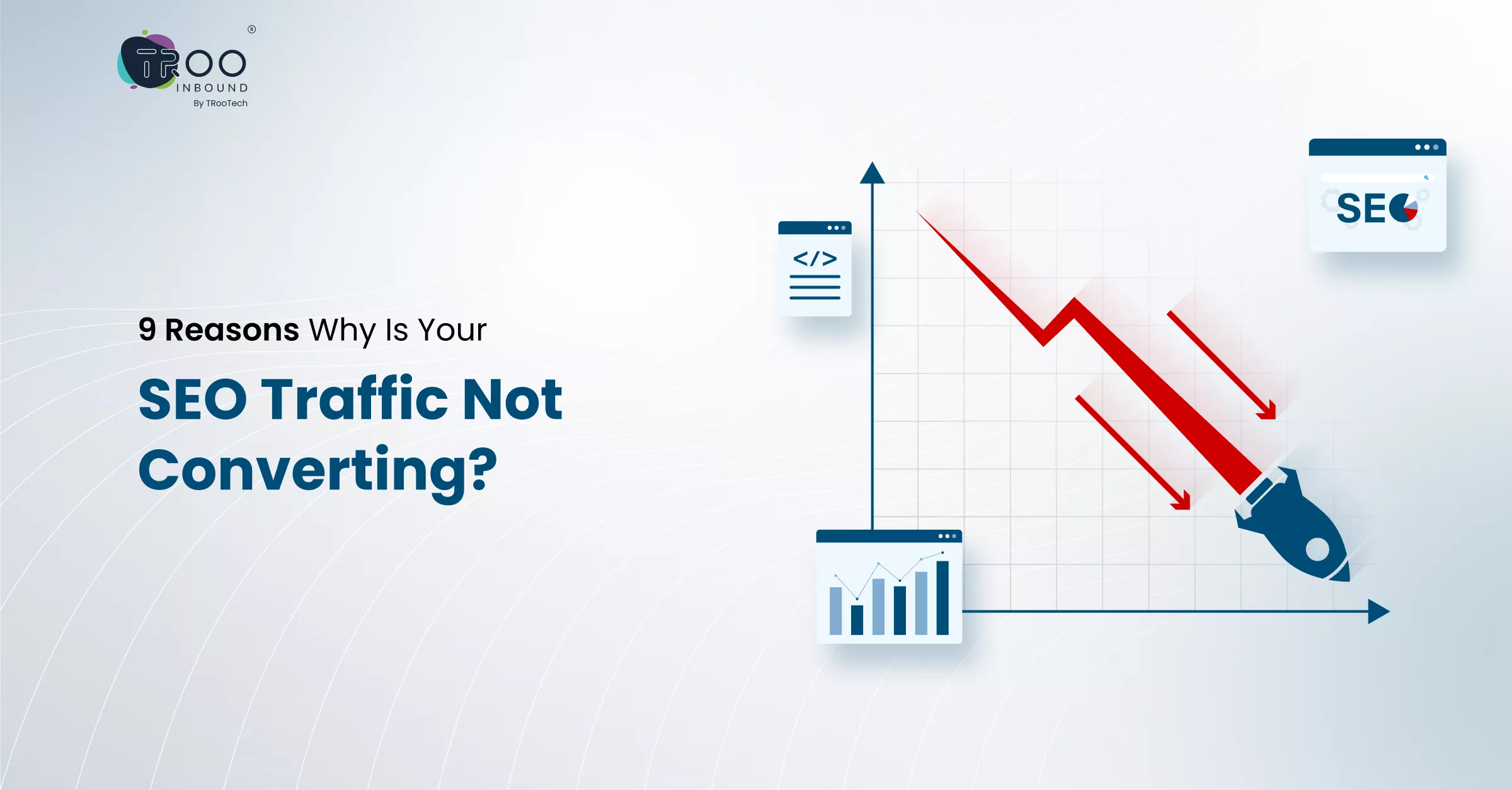
This gap between traffic and results is one of the most common issues in digital marketing today. Traffic alone does not generate revenue; conversions do. If your website attracts visitors but fails to turn them into customers, the problem is rarely the traffic itself. The issue usually lies in how that traffic interacts with your website and content.
This article explores the most common reasons why SEO traffic does not convert and how businesses can fix the problem using better SEO conversion optimization practices.
9 Common Reasons Why Your SEO Traffic Isn’t Bringing Quality Leads
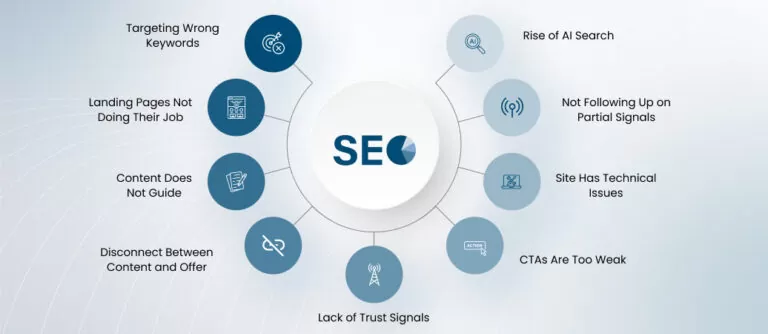
Understanding why SEO traffic fails to convert requires looking beyond rankings and keywords. It requires examining search intent, user experience, content relevance, and the entire journey from search result to conversion.
Reason 1: Targeting the Wrong Type of Keywords
Traffic without intent is just a vanity metric. One of the most overlooked issues in SEO lead generation is targeting the wrong type of keywords.
Many SEO campaigns focus heavily on high search volume keywords because they promise more visitors. While this approach increases traffic, it often attracts users who are not ready to buy or even interested in the service being offered.
For example, a company offering enterprise CRM consulting may rank for informational queries such as:
- What is CRM software
- Benefits of CRM
- Best CRM tools
These keywords attract readers who are still researching. They are learning about the topic but may not have any immediate purchasing intent.
In contrast, transactional queries like these are far more likely to convert:
- CRM implementation services
- HubSpot onboarding consultant
- CRM setup agency
When SEO strategies prioritize informational keywords without balancing them with intent-driven queries, traffic increases, but conversions remain stagnant.
SEO lead generation works best when keyword targeting aligns with business outcomes. Ranking for the right searches matters more than ranking for the most searches.
Reason 2: Your Landing Pages Are Not Doing Their Job
Even when you are attracting the right audience, a poorly designed landing page will kill your conversion rate. Many SEO-focused teams spend most of their energy on getting rankings and very little on what happens after the click. The page a visitor lands on needs to immediately confirm that they are in the right place, communicate your value clearly, and make the next step obvious and easy.
Common landing page problems include slow load times, confusing layouts, too much text without a clear structure, weak or missing calls to action, and a lack of trust signals like testimonials, case studies, or certifications. Any one of these issues can cause a visitor to bounce, even if they were genuinely interested in your services.
Mobile experience is another major factor that often gets overlooked in SEO conversion optimization. A large share of search traffic today comes from mobile devices, and if your pages are not responsive, easy to navigate, and fast on a phone, you are losing a significant portion of your potential leads before they even read your first paragraph.
Reason 2: Your Landing Pages Are Not Doing Their Job
Even when you are attracting the right audience, a poorly designed landing page will kill your conversion rate. Many SEO-focused teams spend most of their energy on getting rankings and very little on what happens after the click. The page a visitor lands on needs to immediately confirm that they are in the right place, communicate your value clearly, and make the next step obvious and easy.
Common landing page problems include slow load times, confusing layouts, too much text without a clear structure, weak or missing calls to action, and a lack of trust signals like testimonials, case studies, or certifications. Any one of these issues can cause a visitor to bounce, even if they were genuinely interested in your services.
Mobile experience is another major factor that often gets overlooked in SEO conversion optimization. A large share of search traffic today comes from mobile devices, and if your pages are not responsive, easy to navigate, and fast on a phone, you are losing a significant portion of your potential leads before they even read your first paragraph.
Reason 3: Your Content Educates But Does Not Guide
Content that ranks well is often educational, comprehensive, and structured around answering questions. That is exactly what search engines reward. But content that converts needs to do more than inform. It needs to build trust, address objections, and guide the reader toward a specific outcome.
If your blog posts and service pages read like encyclopedias rather than conversations, visitors will absorb the information and leave without feeling compelled to reach out. The most effective content finds a balance between delivering genuine value and consistently pointing readers toward the next step in their journey with your brand. This does not mean every sentence needs to be a sales pitch. It means your content should feel like it was written by someone who understands the reader’s problem and genuinely wants to help them solve it.
One emerging area that connects content quality with visibility is the rise of large language models in search. Following LLM SEO Best Practices is becoming essential as more users get their answers directly from AI-powered tools. If your content is authoritative, well-structured, and genuinely useful, it has a better chance of being surfaced in both traditional search and AI-generated responses, which means more of the right traffic finds you in the first place.
Reason 4: There Is a Disconnect Between Your Content and Your Offer
Another common issue is a mismatch between what your content promises and what your business actually offers. If someone reads a blog post about a specific problem and clicks through to a service page that talks about something only loosely related, the conversion path breaks down. The visitor feels disoriented, and most of them will leave.
Every piece of content you publish should have a clear connection to at least one specific action you want the reader to take. That might be requesting a consultation, downloading a resource, or reading another piece of content that moves them further along the funnel. The transition from content to conversion needs to feel natural, not like a jarring shift from helpful article to sales brochure.
SEO lead generation works best when the entire experience feels coherent. The keyword brings in the visitor, the content addresses their specific concern, and the call to action offers a logical next step that feels genuinely helpful rather than pushy. When these three elements are aligned, conversion rates improve significantly without needing to increase your traffic at all.
Reason 5: Lack of Trust Signals
Visitors who arrive through organic search usually do not know your brand yet. They may discover your website for the first time while researching solutions.
Without trust signals, these visitors may hesitate to take action.
Trust signals include elements such as:
- Client testimonials
- Case studies
- Certifications
- Partner badges
- Industry recognition
- Real results or performance metrics
For example, agencies that showcase proven success stories immediately demonstrate credibility.
Trust elements reduce uncertainty and encourage visitors to move forward with inquiries or consultations.
If your SEO traffic is high but leads remain low, review whether your website clearly demonstrates expertise and proven outcomes.
Reason 6: Your Calls to Action (CTAs) Are Too Weak
Calls to action guide visitors toward the next step in the customer journey. Unfortunately, many websites rely on generic CTAs such as:
- Contact us
- Learn more
- Submit
These prompts are passive and lack urgency. Effective CTAs communicate value and encourage action. Instead of generic messaging, stronger calls to action may include:
- Get a free SEO audit
- Speak with an SEO strategist
Request your growth roadmap. Clear CTAs positioned strategically throughout the page help convert passive readers into engaged prospects. When CTAs feel relevant and helpful rather than sales-driven, users are more likely to engage.
Reason 7: Your Site Has Technical Issues That Erode the Experience
Technical problems are often invisible to the human eye but devastating to conversion rates. Pages that load slowly, links that go nowhere, forms that do not submit properly, or checkout processes that break on certain browsers can all cause visitors to give up before completing an action. Search engines also penalize sites with poor technical health, so these issues can hurt both your rankings and your conversions at the same time.
A thorough technical audit should be part of any serious SEO strategy. This includes checking page speed on both desktop and mobile, ensuring all links and redirects are working correctly, validating that forms and interactive elements function across browsers and devices, and confirming that structured data is implemented correctly so search engines understand your content as intended.
If technical SEO is not something you have the bandwidth to manage internally, it makes sense to explore working with a qualified team. You can hire SEO experts who can run these audits systematically and fix problems before they cost you conversions. Having the right expertise in your corner often makes the difference between a site that struggles and one that consistently performs.
Reason 8: You Are Not Following Up on Partial Signals
Not every visitor is ready to convert on their first visit. In fact, research consistently shows that most people need multiple touchpoints with a brand awareness with traffic growth before they make a decision. If your SEO strategy only focuses on first-time conversions and does not have a system for staying in front of warm visitors, you are leaving a lot of potential business on the table.
Retargeting, email capture, and content sequencing are all ways to maintain contact with visitors who showed interest but were not ready to act. A well-placed lead magnet, such as a guide, checklist, or free consultation offer, can give fence-sitters a reason to share their email address, allowing you to nurture them over time until they are ready to buy.
This kind of follow-through is part of what separates average SEO efforts from a truly comprehensive SEO conversion optimization strategy. Getting someone to your site is only the beginning. Keeping them engaged and guiding them toward a decision is what ultimately drives revenue.
Reason 9: The Rise of AI Search and Changing User Behavior
Another emerging reason SEO traffic may not convert lies in the evolution of search itself.
Search behavior is rapidly changing due to AI-powered search engines and large language models. Users increasingly expect direct answers, summarized information, and conversational results.
Traditional SEO strategies that focus purely on keyword rankings may not perform as well in this new environment.
Businesses must adapt their SEO strategies to account for AI-driven search experiences. Content must be structured, authoritative, and easily understandable for both users and AI systems.
This is where LLM SEO Best Practices become increasingly important.
Optimizing content for AI search involves:
- Clear topic authority
- Structured headings and logical flow
- High-quality factual information
- Semantic keyword coverage
- Strong internal linking
Organizations that adapt their Search Engine Optimization strategies to AI search will gain an advantage as search engines continue evolving.
What a Truly Effective SEO Strategy Looks Like
When all the pieces are working together, SEO drives the right traffic, connects those visitors with content that speaks to their specific needs, builds enough trust to earn a conversion, and then retains and nurtures the ones who were not ready to act immediately. This is what a complete and well-executed SEO strategy looks like, and it requires both technical expertise and a genuine understanding of your audience.
The businesses that see the strongest ROI from their search efforts are the ones that treat SEO as an integrated system rather than a checklist of tasks. They think carefully about who they are trying to reach, what those people need to hear, how to make the experience on-site as smooth and persuasive as possible, and how to stay in touch with visitors who need more time.
Investing in the right SEO services means getting support not just with rankings, but with the entire conversion journey. From keyword strategy and content development to technical health and user experience, every element needs to be working in service of your business goals, not just your analytics dashboard.
Final Verdict: Turning SEO Traffic Into Real Business Growth
SEO traffic is only the first step in a much larger process. The true goal of Search Engine Optimization is not visibility alone but meaningful engagement that leads to inquiries, conversations, and long-term customer relationships.
Businesses that approach SEO strategically understand that rankings must be connected to real outcomes. Traffic should support SEO lead generation, not simply increase analytics numbers.
Organizations that combine strong SEO strategies with conversion-focused website design, persuasive messaging, and user-centered content are far more likely to turn organic traffic into consistent revenue opportunities.
If your website attracts visitors but struggles to convert them, it may be time to rethink how SEO supports your broader digital strategy.
With the right combination of professional SEO services, thoughtful content planning, and conversion optimization techniques, organic traffic can become one of the most powerful growth channels for your business.